May 16th, 2016 by Dr. Val Jones in Opinion
No Comments »
 *This blog post was initially published on the Barton Blog.
When doctors complete their residency training, they are under a lot of pressure to land their first “real job” quickly. Student loan deferments end shortly after training, and whopping debt faces many of them. But choosing a job that is a good long-term fit can be difficult, and gaining a broader exposure to the wide variety of options is key to success. That’s why “try before you buy” can be an excellent strategy for young physicians.
Locum tenens agencies such as Barton Associates work with healthcare organizations and practice locations across the country to offer a variety of temporary assignments for physicians.
These agencies negotiate your salary and call schedule. They also arrange the logistics, covering the costs of travel and accommodations. Once the doctor and the facility agree to terms, the physician simply arrives on the required date(s) and takes on the responsibilities requested. It’s a hassle-free, minimal-commitment arrangement that pays an hourly or daily rate for work.
Locum providers are given the convenient option to receive direct deposits to their bank accounts at regular intervals. Physicians can travel as broadly as they like for assignments, and the agency credentialing team works to efficiently complete any needed paperwork for new licenses and hospital privileging.
I enjoyed “living la vida locum” for six years before I landed my dream job. That’s a long time to be living out of a suitcase, and I doubt that most of my peers would want to do it for that long of a stretch. But an amazing thing happened during those years: With each new hospital experience, I gained insight and knowledge about my specialty. By rubbing elbows and networking with a wide swath of patients and experts across the country, I became a sought-after consultant in my own right.
I experienced different ways of delivering healthcare — from critical access hospitals to bustling academic centers. I learned about best practices and creative solutions that administrators and clinical staff had discovered to improve care quality, given the limitations of Medicare rules and private insurance restrictions.
When I was hired as the Medical Director of Admissions at St. Luke’s Rehabilitation Institute in Spokane, Washington, I came armed with creative ideas and a wealth of experience to draw from. I was a highly seasoned physician who had been exposed to the widest variety of patient populations and practice styles. I knew all about the unique struggles, successes, and solutions of various rehab centers across America. I now leverage that experience to drive change at my institution, and I am virtually unfazed by new problems and challenges.
The career value of locum tenens work is extraordinary. Take the time to look around you at each assignment. Learn what works and what doesn’t work, and file it away for future reference.
Like a bumblebee cross-pollinating hospital or medical practice “flowers,” locum tenens providers have the potential to drive change like no one else. When you’ve seen it all, your insights become invaluable, and you gain the maturity to know when a full-time job is the right cultural fit. Choosing the right job, on your terms and in your time, is the key to finding happiness in healthcare.
February 20th, 2016 by Dr. Val Jones in Opinion
6 Comments »
 Hope is a tricky thing. On the one hand, false hope can lead patients to opt for painful, futile treatments at the end of life. On the other, unnecessarily bleak outlooks can lead to depression and inaction. When health is at stake, presenting information with the right amount of hope can guide patients away from both suffering needlessly and/or succumbing to treatable disease.
I was reading a sad story about a patient whose physician had made her feel hopeless. She was an elderly widow with some real, but not immediately life-threatening, medical conditions. His attitude led her to believe that she was sick and useless – with little to look forward to but ongoing testing, disease progression and eventual death. His professional opinion held special weight for her, coloring her entire outlook. It wasn’t until a friend reminded her of the doctor’s fallibility that she began to question her diagnoses, treatment options, and even prognosis.
When faced with concerning new medical diagnoses, even the most educated among us tend to imagine the worst case scenario. Knowing this, physicians should take care to offer reassurance and optimism whenever it is warranted. Hope provides the energy to course correct, to fight battles that can be won, and to hold on to trust in a brighter future. Why be stingy with it when it is so easily given?
As a rehab physician I have regularly encountered bias on the part of healthy people in regards to certain injuries. I hear them whisper, “I wouldn’t want to go on living if I couldn’t walk” or “That poor man’s life must be ruined.” And yet, these feelings are not shared by those fighting the battles. In many cases, losing an ability focuses the mind on what’s important – and on all the things that can still be achieved and enjoyed. Life is a gift, and while we all still have breath – we can make meaningful contributions.
It breaks my heart to see patients lose hope, and it is sadder still when physicians facilitate the loss. What we say carries psychological weight, and we should recognize the duty we have to deliver information with kindness and respect – focusing on the possible, dispelling unreasonable fears, and emphasizing that inner peace is attainable no matter the circumstance.
In healthcare we ought to always have hope – not for perfect health, or longer life – but in our ability to overcome obstacles, to make good come from bad, and to have a positive impact on others. The choice to live our best life is ours to make, no matter the disease or condition. Never let a doctor steal your hope, but adopt the rehab mission: to add life to years.
December 28th, 2015 by Dr. Val Jones in True Stories
1 Comment »
 Most physicians will be thrust into the role of patient or caregiver at some point during their careers. Unfortunately, it’s not until this occurs that many become fully aware of the finer points of excellent care and communication. Take for example, the simple act of reporting test results to a patient. We do this every day, but may not realize that how we frame the information is as important as the data themselves.
I came to realize this on a recent hospital visit when I was in the role of healthcare proxy for a loved one with heart disease. Not only did various physicians present information with different degrees of optimism, but individual doctors presented things differently on different days… depending on (I guess) how tired/hurried they were. Consider these different messages with the same ejection fraction (EF – a measure of heart pump strength) and angiogram (heart vessel imaging) test results:
Doctor 1: “I wish I had better news. The EF is lower than we thought. It is low because of your previous massive heart attack.”
Doctor 2: “Although your EF is impaired, there’s a lot that can be done to improve pump function with medications.”
Doctor 1 (different day): “On the other hand, the EF might be temporarily low because of your recent flu infection. It’s possible it will bounce back in a couple of months and you’ll be back to your usual self.”
Doctor 2: “I’m not worried about your chest pain because we know it’s caused by small vessel disease. Your angiogram showed that all your main heart arteries are wide open. The pain is not dangerous, though I’m sure it’s annoying.”
Doctor 1: “Chest pain is always serious. You never know when it could be the big one.”
Doctor 3: “It’s hard to interpret EF because some people live long and productive lives with low EFs, and others are quite impaired with only a small dip in pump function.”
Doctor 2: “Sure there are medications we can try to improve your EF, but I doubt you’ll tolerate them because your blood pressure is kind of low.”
Doctor 3: “Don’t worry about the EF, it will correct on its own once we get your rhythm controlled. This is an electrical problem, not plumbing.”
All of this emotional whiplash caused by the same test results… due to different physicians’ interpretations of prognosis and treatment options. What can be done? First of all, we physicians need to take a deep breath and realize how our words affect our patients. They are scared and vulnerable, and they are looking to us for hope… and when there is real hope, why not emphasize it? There is no need to focus on the worst-case scenarios until we are well and truly in their midst.
I believe that being a good clinician is not just about giving patients factual information, but also about presenting data with kindness. Sometimes, as I’ve discovered with my own loved one, it’s not as important what you say, as how you say it.
November 9th, 2015 by Dr. Val Jones in True Stories
1 Comment »
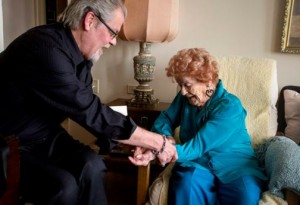 My patient’s son stood vigil outside her hospital room day and night. His eyebrows were frozen at an anxious angle. Although his mom was healing well from her injury, I could see that he was worried about next steps. He asked staff repeatedly about his mom’s pain management, and reviewed every therapy session she attended.
His mom, on the other hand, was deceptively charming. She was a thin, well-groomed elderly woman who knew how to exact empathy from others. When I looked into her room from a distance she appeared comfortable, lying in her hospital bed covered in a quilt that her son had brought her from home. When I entered the room to check on her, she would grab my hand and wince, telling me that the pain was severe but that she didn’t want any medication. She was quite invested in convincing me that she was unable to go home and care for herself, and that she needed to be discharged to her son’s home. She would not accept others help at home, nor would she go to a skilled nursing facility.
She was doing well in therapy, limited mostly by her macular degeneration (poor eyesight). Again, I watched her from outside her field of vision. I saw her stand without assistance, push her walker across the room, and navigate a couple of stairs. I heard her speak to her son in angry and dismissive tones. When she saw me approach her knees buckled and she crumpled to a padded bench. “I am not safe to go home, doctor.” She said. And her eyes filled with tears – “I am going to fall and no one will know.”
I took her son to a private room to discuss the predicament. I carefully raised the subject of how his mom was doing well physically, and could discharge home safely with home health services, but was angling for a discharge to his house. I asked him some open ended questions and learned that he was her only son, that his mom had been guilting him about quitting his job to care for her full time.
He became tearful – “I have only a few more years to go before I can collect my pension. Mom knows this but wants me to quit right now and move back home. If I do that I won’t have enough money to survive my own retirement. She has no friends and dad died several years ago. She says she doesn’t want any hired help at her house, and she cries when we discuss nursing homes. She says if I love her I will let her live with me. But I don’t have time to help her during the day. What am I supposed to do? She has been doing this to me all my life – getting me to do what she wants!”
I decided to tell him the unvarnished truth.
“I can see that your mom can be quite manipulative, and this has been an ongoing struggle. You need to take care of yourself. The fact that she wants to be with you 24/7 does not prove her love — a loving mom would not ask her son to jeopardize his financial future so that she wouldn’t have the ‘discomfort’ of caregivers in her home. Do not feel guilty about continuing to work. Her insurance will cover the care she needs. It’s ok to say no to her. That’s my professional opinion.”
The son let out an audible sigh. He thanked me profusely for telling him the truth. I told him that it was entirely possible that his mom would fall down on purpose once out of the hospital, to try to get him to change his mind. I warned him not to let her consume his life. She likely had a personality disorder that made her capable of squeezing the very life out of him.
My patient ended up discharging to a very nice skilled facility that her son had pre-screened for her. She was as happy as a wet cat on departure, but I believe it was the right decision for both of them. I just hope that she didn’t succeed in wrapping her emotional constrictor muscles around the neck of her poor son again. I tried my best to save him, but in the end I know that sometimes people have to save themselves.
October 20th, 2015 by Dr. Val Jones in Health Tips, Opinion
1 Comment »
 Most of my patients think about pain medicines in terms of the symptoms they treat. “This is my headache medicine, and this is my arthritis medicine,” they often say. Healthcare providers are more likely to categorize pain medicines by the way they work: some are anti-inflammatory, some affect nerve endings, and others influence how the brain perceives pain. But the truth is that no matter how you classify pain medicines, there is no way to know if they’ll help until you try them for yourself.
Most people don’t realize that pain management is personal. Research is beginning to help us understand why people respond to medicines so differently, and one day we will probably be able to personalize treatment plans more successfully. For now, there are several known genetic reasons why pain medicines are more or less effective for one individual over another. Genes affect:
-
The number of enzymes that break down medicines and remove them from the body. Some people have larger numbers of these enzymes and therefore require more drug to feel its pain-relieving effects. Others may be strongly affected by even small doses of drug.
-
Pain medicine receptor variations can make one medicine effective and another (nearly identical medicine) ineffective in relieving pain.
-
Differences in carrier molecules that transport pain medicine across the blood stream and into the cells that are triggering pain sensations. Some people have fewer carrier molecules to bring the medicine to the site of pain.
-
The number of “middle man” neurotransmitter molecules that pass along the pain response. Too many of these molecules can reduce drug binding and mute the pain relief effects of some drugs.
When pain is severe, prescription medications may be necessary. However, mild to moderate pain may be effectively managed with over-the-counter (OTC) medicines. I believe in the start low, go slow approach to finding the smallest effective dose of pain medicines. I always recommend that my patients read and follow all the instructions on the Drug Facts labels to make sure that they don’t accidentally overdose on active ingredients.
When I choose a pain reliever with my patients, the first thing I think about is potential side effects. Some medicines (such as non-steroidal anti-inflammatory drugs like ibuprofen and naproxen sodium) can be hard on the stomach lining, or cause bleeding in people who are at risk for it. Other medicines (such as acetaminophen) can harm the liver if used in excess, while prescription pain medicines can cause constipation and drowsiness. The best pain medicine to start with is one that is least likely to cause harm to the specific person.
The next thing I ask is whether or not the medicine has worked for the patient in the past. Previous experience is one of the best indicators of future success. Since I know that my patient has a unique, genetically determined number of enzymes, transporters, and receptors, previous experience with pain medicines will give me a good idea of how well they will tolerate it again, and if it will be effective.
Finally, I consider the type of pain that they are experiencing. If the pain is caused by inflammation (from an injury, surgery, or arthritis) I’ll consider a medicine with primarily anti-inflammatory properties. If the pain is caused by tension (such has headache) or complicated by fever, I may consider acetaminophen first. If the pain is coming from a nerve (such as sciatica or neuropathy) then I’ll use pain medicines that work for nerve pain specifically. If the pain is complicated by depression, I may discuss additional medicines and approaches.
Sometimes, combinations of medicines are significantly more effective than one medicine alone at treating pain (this is why some prescription pain relievers are combinations of an opioid and acetaminophen). When using more than one pain relief medicine, it is important to compare active ingredients in both prescription medications and OTC products to make sure that accidental overdoses do not occur. I also recommend consulting with a healthcare professional if there are concerns about drug interactions or if the patient is already on a significant number of prescription medications that could interact with his or her OTC pain medicine choices.
The bottom line is that science is still catching up to pain management. Perhaps one day a simple blood test will help us to determine the very best pain medicine regimen for a specific patient at a given time. But until then, adopting a strategy of careful trial and error (avoiding unwanted side effects, using the lowest effective doses, and consulting a physician when pain is severe) is the only option. Don’t worry too much about whether a specific medicine is “best” for your pain. Pain management is very personal, so you will need to discover your own best solution.
***
Disclosure: Dr. Val Jones is a paid consultant for McNeil Consumer Healthcare Division.