September 23rd, 2013 by Dr. Val Jones in Health Tips
No Comments »

This actress keeps her dermatologist on speed dial too.
As a light skinned, be-freckled woman with a history of pre-melanoma, I have been sternly instructed to keep my dermatologist on speed dial. Every six months I dutifully return to his office for inspection – nervously eyeing the biopsy tray as I sweat through my paper gown, legs dangling from a vinyl exam table.
In preparation for my most recent trip, I decided to be “an empowered patient” and arrive with a list of general dermatology and skin care questions that could be answered during my skin check. Judging from the near-syncopal episodes that I induced in my dermatologist while describing some of my hygiene practices, I’m not being very good to my skin. In fact, he wanted me to know that at least three products that I currently use are “of the devil.” Just in case you are inadvertently engaging in demonic skin care practices as I was – I thought I’d share what I learned:
1. Dryer sheets. According to my dermatologist, dryer sheets contain “a horrible chemical that no one can pronounce” that becomes “slathered all over your clothing” during the drying process. Although I was fond of the fresh scent and soft texture of my gym clothes, he assured me that heat and moisture was the best way to re-activate the irritating chemicals on delicate skin, virtually guaranteeing a contact dermatitis of the nether regions. So if you’ve been experiencing any unpleasant post-work out skin “issues” – consider dryer sheets as a potential cause.
2. Antibacterial ointments. Personally, I find that over-the-counter antibacterial ointments do a great job of preventing razor bumps. However, my dermatologist says that repeated or excessive use of these products can lead to allergies and colonization with antibiotic-resistant organisms. So… unless you want to be giving MRSA a “come-hither stare,” you might want to opt out of the Neosporin.
3. Battery-operated exfoliating brushes. I’ve seen so many ads for Clarisonic-type products that I figured they would be a reasonable choice for facial exfoliation needs. In fact, this topic may be somewhat controversial since I know other doctors who recommend these products. However, my dermatologist says that they are overkill and might do more harm than good to delicate facial skin, especially if you use any products that have an exfoliating acid included in their ingredient list, or if you use scrub creams. In other words, if you wash your face regularly, you probably don’t need to use additional aggressive cleaning measures.
In addition to the information provided about evil products commonly used by innocent people across America, my dermatologist offered these general tips for healthy skin:
1. You don’t need so much moisturizer. “You don’t need to put on moisturizer every night just because your mother told you to,” he said, bow tie looming large at eye-level. “Women think they need to apply moisturizer multiple times a day, but there is enough moisturizer in sunscreens and anti-oxidant serums to make additional products unnecessary.”
2. Throw away your 10x mirror. “Honestly, no one sees your skin at 10x, so why should you worry about what it looks like so close up? The best way to make your pores look smaller is to quit looking at them under a magnifier.”
3. Use physical block sunscreen every day. Most of the cheaper, spray-on sunscreens use chemicals to scatter light, but zinc-based sunscreens physically block incoming UV radiation. “The most important part of an ‘anti-aging’ regimen is to avoid sun exposure, and the best way to do that is with constant use of physical blocks.”
4. Skin-lightening cream (hydroquinone) can reduce the appearance of sun damage. Hydroquinone is the active ingredient in most skin-lightening creams. It acts to down-regulate melanin production in melanocytes, but can be reversed fairly easily by UV exposure (i.e. sunlight up-regulates melanin production). So even if you’re already pale-skinned, hydroquinone products can even out skin tones and sun spots – but only if you simultaneously commit to aggressive avoidance of UV exposure.
I hope you’ve found these skin tips enlightening (pun intended). I’ll have to think of some other good questions to ask my dermatologist in 6 months from now, during my next cancer screening. Because as an empowered patient, I intend to learn as much as I can in my 15 minutes with the doctor, and then share it with as many people as possible. 🙂
December 13th, 2011 by Paul Auerbach, M.D. in Health Tips
No Comments »

There is a site on the Internet named “Bee Aware” that provides information for patients and physicians about stinging insect allergies and venom immunotherapy. The quality of the information is good, so this website makes an excellent reference for the average person and can be reliably used by doctors and other health care providers to assist in educating their patients.
For instance:
| “It is impossible, not to mention undesirable, to avoid going outdoors, but there are certain precautions that can be taken that will allow you to enjoy the outdoors while minimizing your chances of being stung.
It is important to remember that stinging insects do not seek out humans. The sting of these insects is only used against people for self-defense or in defense of their nest. This is why it is important to never approach or provoke an insect of this kind unnecessarily.
- If a stinging insect approaches, remain calm and stay still.
- Never Read more »
|
This post, Website Offers Tips For Dealing With Stinging Insect Allergies, was originally published on
Healthine.com by Paul Auerbach, M.D..
November 25th, 2011 by ChristopherChangMD in Health Tips
No Comments »

A deviated septum is a well known factor causing nasal obstruction in people. However, many patients with a deviated septum will also state that there are times when they can breathe just fine from their nose. As such, can a deviated septum truly be the cause of their nasal obstructive symptoms? Shouldn’t the obstruction be constant?
The blunt answer is ABSOLUTELY nasal obstruction can be intermittent OR constant with a deviated septum!!! It’s more a question of degree.
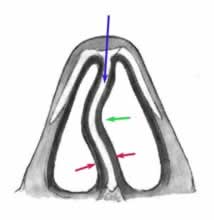
To begin with, a deviated septum is when the wall that separates the right and left nasal cavities is bent one way (green arrow in left illustration) instead of being perfectly straight (right illustration).

 If there is no mucosal swelling, a person with a deviated septum is able to breathe from both sides just fine. However, if there is the slightest bit of mucosal swelling from turbinate hypertrophy, allergies, upper respiratory infection, or any other environmental irritation, the side that is more narrow will obstruct much more readily with less swelling given there is just “less room” for swelling to occur before obstruction occurs.
Below is the same exact nose and septum as above, but with mucosal swelling present. Read more »
*This blog post was originally published at Fauquier ENT Blog*
August 7th, 2011 by David H. Gorski, M.D., Ph.D. in Opinion, Research
No Comments »

Ever since I was a teenager, I’ve intermittently read Consumer Reports, relying on it for guidance in all manner of purchase decisions. CR has been known for rigorous testing of all manner of consumer products and the rating of various services, arriving at its rankings through a systematic testing method that, while not necessarily bulletproof, has been far more organized and consistent than most other ranking systems. True, I haven’t always agreed with CR’s rankings of products and services about which I know a lot, but at the very least CR has often made me think about how much of my assessments are based on objective measures and how much on subjective measures.
Until now.
I just saw something yesterday on the CR website that has made me wonder just how scientific CR’s testing methods are, as CR has apparently decided to promote alternative medicine modalities by “assessing” them in an utterly scientifically ignorant manner. Maybe I just haven’t been following CR regularly for a while, but if there’s an article that demonstrates exactly why consumer product testing organizations should not be testing medical treatments; they are ill-equipped to do so and lack the expertise and knowledge. The first red flag was the title, namely Hands-on, mind-body therapies beat supplements. The second red flag was the introduction to the article: Read more »
*This blog post was originally published at Science-Based Medicine*
July 6th, 2011 by Paul Auerbach, M.D. in Health Tips
No Comments »
 Nasal irrigation is sometimes recommended to thin or remove mucous from the nose. The two most common conditions that produce mucous are upper respiratory infections (e.g., the “common cold”) and allergies. Irrigation may also be beneficial to clear out dust, dirt, and allergens, and to allow the cilia within the nose to function more efficiently. Cilia are organelles that work to move mucous and debris in the nose (among other parts of the body) to a location where they can be expelled more easily. Another benefit of nasal irrigation is that it moisturizes the mucous membranes inside the nose.
Methods of Nasal Irrigation
Irrigation can be pulsatile or non-pulsatile (sometimes called “laminar flow”). Each type has its advocates. It is generally felt to be a safe practice so long as Read more »
This post, Everything You Wanted To Know About Nasal Irrigation, was originally published on
Healthine.com by Paul Auerbach, M.D..