November 25th, 2011 by Bryan Vartabedian, M.D. in Opinion
No Comments »

 This is my 3rd year participating in The Engage with Grace Blog Rally. Engage With Grace is a movement designed to help advance the conversation about the end-of-life experience. It began with a simple idea: Create a tool to get people talking. Their tool is a slide with five questions designed to initiate dialog about our end-of-life preferences. I originally heard about Engage with Grace from Paul Levy and he’s at it again this year.
This campaign has forced me to Read more »
*This blog post was originally published at 33 Charts*
November 27th, 2010 by DavidHarlow in Better Health Network, Health Policy, Health Tips, Medblogger Shout Outs, News
No Comments »

As patients, as family members, as friends, as health care providers, we have all faced end-of-life issues at one time or another, and we will face them again. And again.
This weekend the “Engage With Grace” message is being broadcast virally, through a “blog rally,” at a time when many people are with family and friends over the long weekend. The point is: We all need to have the potentially uncomfortable conversation with people close to us about what kind of treatment we would want, and they would want, if incapable of making or communicating healthcare decisions. CNN ran a story on “Engage With Grace” yesterday.
End-of-life decision-making has long been an issue of great personal and professional interest to me, and I am proud to have played a role in having out-of-hospital DNR orders recognized in Massachusetts by EMS providers, as an example. Read more »
*This blog post was originally published at HealthBlawg :: David Harlow's Health Care Law Blog*
November 30th, 2008 by Dr. Val Jones in True Stories
4 Comments »
The successful “Engage with Grace” campaign resulted in ~95 bloggers promoting end-of-life care discussions with family members over Thanksgiving. Paul Levy called it the first “medical blog rally on the Internet.” I wonder how many readers took the challenge?
I spent Thanksgiving with my sister (mom of 3) and brother-in-law in Michigan. After our dinner (with the kids tucked in for the night) we enjoyed a glass of wine and a game of Cranium (if you haven’t tried this game yet, you might want to pick one up in time for the next group of holidays – it’s like Pictionary, Charades, Trivial Pursuit, and American Idol wrapped into one). I looked for an opportunity to “pop the question” on end-of-life issues.
During a brief lull between rock song humming I casually inquired about whether or not my sister and brother-in-law had a living will. They said they hadn’t thought of it but agreed that it would be important to have one. We discussed various scenarios related to organ donation, end-of-life care, and cremation vs. burial preferences. Things degenerated a bit as I asked what their individual preferences might be for resuscitation under special circumstances (it was almost like a scene from Monty Python – “So, if you had no arms and no legs and you had a 10% chance of normal brain function recovery, would you like to be tube fed? How about if you had one leg and half an arm and a 5% chance of mental recovery? What about if you had 1/2 a liver, no spleen, and only one eye worked, but you COULD do math questions?”) We all had a good laugh at the black humor, but recognized that something important underlay the jesting. There is no doubt that we each had a 100% chance of dying at some point during our lives.
And then something unexpected happened – my brother-in-law looked me in the eye and said, “If anything happened to us, we’d really love it if you took our children and raised them as your own.”
I was very touched and happily agreed to do so. I replied with a wagging finger, “Now this doesn’t mean that you should take up helmet-free motorcycling…”
We all had a good chuckle and returned to Cranium, each feeling a little richer for the experience – we knew how we’d like to be cared for in case of critical illness, and I’d become the proud new godmother of 3.
November 26th, 2008 by Dr. Val Jones in Announcements
4 Comments »
Matthew Holt and Paul Levy have encouraged medical bloggers to join together around a common goal for Thanksgiving: to talk to our loved ones about end-of-life preferences. Now I know this may seem a bit morbid at first blush – but it is really important that each of us create a living will and durable power of attorney document. There’s no better time to discuss this than a holiday where we all get together with our families to enjoy one anothers’ company and our gratitude for what we have.
I used the Suze Orman site templates to create mine (I received a free CD Rom). It was really easy to do. Living Wills provide guidelines about your wishes for care in the event that you are unable to express your opinions. The Durable Power of Attorney document makes it clear whom you’d like to “call the shots” on your care if you’re unable to do so for yourself.
If you haven’t done so already, why not consider the following three steps over Thanksgiving?
1. Discuss the “Engage with Grace” slide with your loved ones.
2. Fill out living will and power of attorney documents at Suze’s site (or find another site online that has a good template that you can use to express your wishes).
3. Get those documents affirmed by a notary public and send a copy to your doctor to add them to your medical record.
Every person at every age needs to have an end-of-life care plan. Why not join with thousands of blog readers in settling this matter for yourself and your loved ones this Thanksgiving?
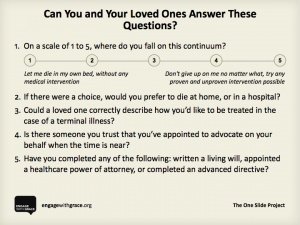


 This is my 3rd year participating in The Engage with Grace Blog Rally. Engage With Grace is a movement designed to help advance the conversation about the end-of-life experience. It began with a simple idea: Create a tool to get people talking. Their tool is a slide with five questions designed to initiate dialog about our end-of-life preferences. I originally heard about Engage with Grace from Paul Levy and he’s at it again this year.