August 5th, 2015 by Dr. Val Jones in True Stories
No Comments »
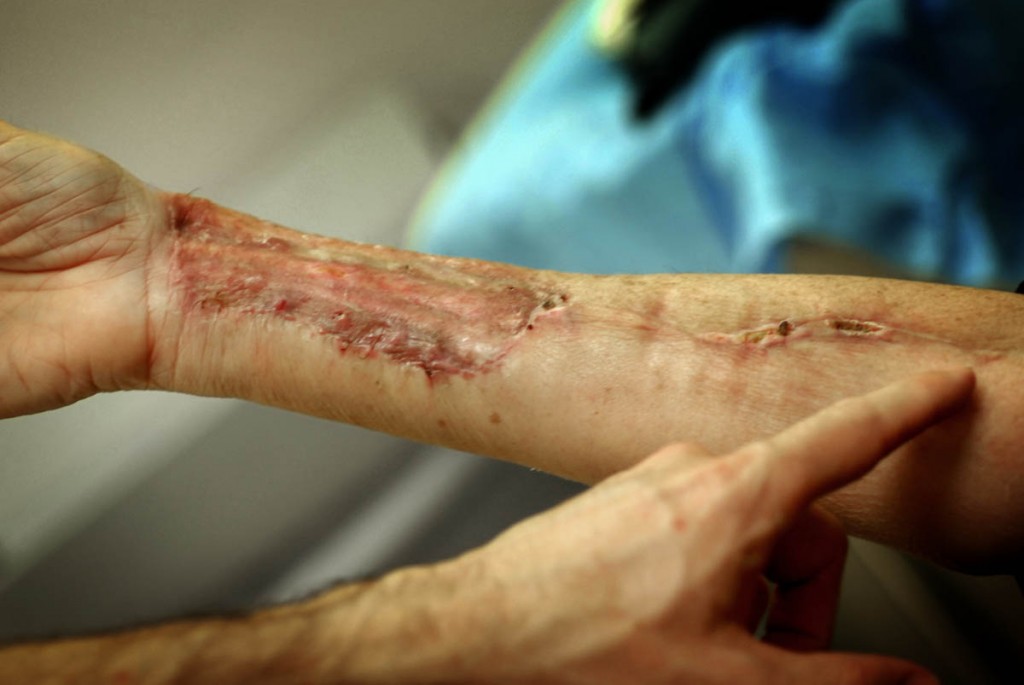
A wrist graft similar to what my friend's husband required.
I watched helplessly as a dear friend went through the emotional meat grinder of a new cancer diagnosis. Her husband was found to have melanoma on a recent skin biopsy, and she knew that this was a dangerous disease. Because she is exceptionally intelligent and diligent, she set out to optimize his outcome with good information and the best care possible. Without much help from me, she located the finest specialists for her husband, and ultimately he received appropriate and state-of-the-art treatment. But along with his excellent care came substantial (and avoidable) emotional turmoil. The art of medicine was abandoned as the science marched on.
First came the pathology report, detailed and nuanced, but largely uninterpretable for the lay person. She received a copy of it at her request, but without any attempt at translation by her physician. In his view, she shouldn’t be looking at it at all, since it was up to him to decide next steps. She brought the report to me, wondering if I could make heads or tails out of it. Although I am not trained in pathology, I did know enough to be able to translate it, line-by-line, into normal speak. This was of great comfort to her as the ambiguity of prognosis (rather than certainty of metastasis and or mortality, etc.) was clearly outlined for the trained eye.
Then came the genetic testing and node biopsy. She was told that the tests could identify variants that would portend poorer outcomes, though it would take 6 weeks to find out if he had “the bad kind of melanoma.” Those 6 weeks were excruciating for her, as she planned out how they would manage financially if he needed treatment for metastatic disease, and if his life were shortened by various numbers of years. At week 6 they received no word from the physician, and so she called the office to inquire about how much longer it would take for the genetic testing to come back. She was rebuffed by office staff and was instructed to be patient because the lab was “processing an unusual number of samples” at this time.
Another week of anguish passed and she decided to contact the lab directly. As it turned out, they were eagerly awaiting the arrival of her husband’s sample, but it had been “lost” in hospital processing somehow. She called the hospital’s facility and someone found the tissue under a pile of other samples and tagged it appropriately and sent it on to the genetics lab. The hospital apologized for the delay via email – and she forwarded the note to her oncologist, so that he could sort out the potential processing bottleneck for other patients going forward.
The result was reported to the oncologist within a week’s time and in turn, the physician called (at 6:30am on a Monday morning) to discuss the result with my friend’s husband. He missed the call as he was in the shower getting ready for work, and wound up playing phone tag with the physician’s office for 3 more days. My friend had her heart in her mouth the entire time. She continued to imagine a world without her husband. If the disease stole him from her, how would she manage? What about the children? Could she make enough money alone to support her family?
“Why didn’t the physician leave any hint of the result in the phone message? If it was good news, surely he would have mentioned that.” She presumed. The physician required his patient to come into the office to discuss the results. And so they booked the next available time slot, another couple of days later. My friend was certain this was a bad sign.
As they arrived at the oncologist’s office, the staff forbade my friend to accompany her husband to the meeting. “Clinic policy” they stated. My friend’s mind was now spinning out of control – maybe my husband needs to be alone with the doctor because the results are so devastating that he must hear it by himself?
She insisted, nonetheless, to accompany him – and the staff felt obligated to clear it with the oncologist before they allowed her to enter the examining room with her husband. They whispered to him in another room before giving her the irritated nod that she could proceed. You could have cut the tension with a knife… she was certain that a death sentence was about to be handed down.
Once the oncologist entered the room, he spent the first 10 minutes making excuses for the delay in genetic tissue results. He argued that the hospital lab was actually not at fault for the delay and listed all the various reasons why nothing had been done incorrectly. His was so single-mindedly focused on the email he received weeks prior (simply describing the delay — as if it were some kind of assault on his own competency) that he almost left the room without telling them the results of the genetic test and biopsy sample.
As an afterthought at the end of the meeting, he announced: “Oh, and the tests suggest that you have a melanoma that is extremely unlikely to metastasize. The wide excisional biopsy is likely curative.”
And off he swished, white coat flowing behind him as he flung wide the door and moved on to the next patient.
The irony is that my friend’s husband got “great” medical care with a large helping of unnecessary suffering. His initial biopsy, wide excision and skin grafting, lymph node testing, and genetic lab studies were all appropriate and helpful in his diagnosis and treatment. But the way in which the information was presented (or not presented) was what made the entire process so painful. Unfortunately, we spend most of our time as physicians focused on the technicalities of what we do, rather than the emotional consequences they have on our patients and their families.
As we continue to “deliver healthcare” to our patients, let’s remember not to serve up any sides of unnecessary mental anguish. Clear and timely communication makes a world of difference in patient anxiety levels. And reducing those is part of the art of medicine that is so desperately needed, and disturbingly rare these days.
February 2nd, 2015 by Dr. Val Jones in Health Policy, Opinion
1 Comment »
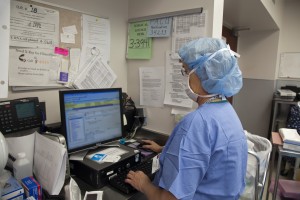 Electronic medical record systems (EMRs) have become a part of the work flow for more than half of all physicians in the U.S. and incentives are in place to bring that number up to 100% as soon as possible. Some hail this as a giant leap forward for healthcare, and in theory that is true. Unfortunately, EMRs have not yet achieved their potential in practice – as I have discussed in my recent blog posts about “how an EMR gave my patient syphillis,” in the provocative “EMRs are ground zero for the deterioration of patient care,” and in my explanation of how hospital pharmacists are often the last layer of protection against medical errors of EPIC proportions.
Considering that an EMR costs the average physician up to $70,000 to implement, and hospital systems in the hundreds of millions – it’s not surprising that the main “benefit” driving their adoption is improved coding and billing for reimbursement capture. The efficiencies associated with access to digital patient medical records for all Americans is tantalizing to government agencies and for-profit insurance companies managing the bill for most healthcare. But will this collective data improve patient care and save lives, or is it mostly a financial gambit for medical middle men? At this point, it seems to be the latter.
There are, however, some true benefits of EMRs that I have experienced – and to be fair, I wanted to provide a personal list of pros and cons for us to consider. Overall however, it seems to me that EMRs are contributing to a depersonalization of medicine – and I grieve for the lost hours genuine human interaction with my patients and peers. Though the costs of EMR implementation may be recouped with aggressive billing tactics, what we’re losing is harder to define. As the old saying goes, “What good is it for someone to gain the whole world, yet forfeit their soul?”
| Pros Of EMR |
Cons Of EMR |
| Solves illegible handwriting issue |
Obscures key information with redundancy |
| Speeds process of order entry and fulfillment |
Difficult to recall errors in time to stop/change |
| May reduce redundant testing as old results available |
Facilitates excessive testing due to ease of order entry |
| Allows cut and paste for rapid note writing |
Encourages plagiarism in lieu of critical thinking |
| Improves ease of coding and billing to increase reimbursement |
Allows easy upcoding and overcharging |
| Reminds physicians of evidence-based guidelines at point of care |
Takes focus from patient to computer |
| Improves data mining capabilities for research and quality improvement |
Facilitates data breaches and health information hacking |
| Has potential to improve information portability and inter-operability |
Has potential to leak personal healthcare information to employers and insurers |
| May reduce errors associated with human element |
May increase carry forward errors and computer-generated mistakes |
| Automated reminders keep documentation complete |
May increase “alert fatigue,” causing providers to ignore errors/drug interactions |
| Can be accessed from home |
Steep learning curve for optimal use |
| Can view radiologic studies and receive test results in one place |
Very expensive investment: staff training, tech support, ongoing software updates, etc. |
| More tests available at the click of a button |
Encourages reliance on tests rather than physical exam/history |
| Makes medicine data-centric |
Takes time away from face-to-face encounters |
| Improved coordination of care |
Decrease in verbal hand-offs, causing key information to be lost |
| Accessibility of health data to patients |
Potential for increased legal liability for physicians |
July 24th, 2014 by Dr. Val Jones in Opinion
1 Comment »
 Medical errors are estimated to be the third leading cause of death in America’s hospitals. Though some of these errors are beyond physician control, many are the direct result of physician action and inaction. I spend a lot of time thinking about how to reduce these errors and I (like many of my peers) lose sleep over the mistakes I witness.
When you ask patients what quality is most important in a physician, they often answer, “empathy.” I think that’s close, but not quite right. I know many “nice” and “supportive” doctors who have poor clinical judgment. When it comes to excellent care quality, one personality trait stands out to me – something that we don’t spend much time thinking about:
Curiosity.
A physician with a curious mind doesn’t necessarily know all the answers. He may not be the “smartest” graduate of his medical school. But he is a great detective, and doesn’t rest until problems are solved. This particular quality isn’t nurtured in a system that rewards partial work ups, rapid patient turnover, and rushed documentation. But some doctors retain their intellectual curiosity about their patients – and to the extent that they do, I believe they can significantly reduce medical errors.
Many of the preventable adverse events I have witnessed (outside of procedure-based errors) began with warning signs that were ignored. Examples include abnormal lab tests that were not followed up in a timely manner, medication side effects that went unrecognized, copy errors in drug lists, and subtle changes in the physical exam that were presumed insignificant. All of these signs trigger the curious mind to seek out answers in time to head off problems before they evolve into real dangers.
Of course, there are other qualities that make a physician excellent – wisdom, experience, kindness, and a grounding in evidence-based practice come to mind. But without an engaged mind fueled by genuine curiosity, it’s hard to retain the vigilance required for continued good outcomes.
Curiosity may have killed a cat or two, but I’ve seen it save a large number of patients!
August 15th, 2012 by Dr. Val Jones in Health Policy, Opinion
1 Comment »
 Hospitals can be dangerous and inefficient; therefore it is easy to connect with Atul Gawande’s recent New Yorker essay “BigMed” suggesting that the streamlined, production processes found at the Cheesecake Factory can and likely will be applied to healthcare. Yet hospital care should not be confused with the full spectrum of healthcare. One must make the distinction between the cognitive process of medical diagnosis occurring in exam rooms, with the procedural basis of surgical care and hospital recovery. While Dr. Gawande has provided a wonderful revealing portrait of cost-effective, fast, food preparation and delivery at the Cheesecake Factory, he has focused on the process of creating the meal, not the process of deciding what meal to make. Successful surgery, for the wrong diagnosis, is a problem. If we are to solve some of healthcare’s largest failings we should focus on what happens as physicians try to address their patient’s problems, diagnose and make decisions, at the table of medicine called the exam room.
Consider the continuum of the patient encounter, from first symptoms, through diagnosis and therapy at a restaurant called Med. At Med I spend all of my shifts with my patrons at my tables. This is an unusual restaurant since the patrons are never sure of what they want to eat and appear every 20 minutes with ever changing lists of unique groups of ingredients to share with me. There are varying ingredients and thousands of meals that can be created. The patrons know the ingredients, but not the meal that they would like to eat. From memory I respond to the customers list of ingredients and ask many questions, take the pulse and other vital signs of the customer, order blood samples, radiographic studies and then decide for the patron which meal their ingredients add up to. All from memory. At Med, restaurant patrons also ask for foods and “food tests” they have seen on television all purported to be risk free. Further complicating the process is my customer is not out for a fun and relaxing evening, they are in small booths in skimpy, open at the back gowns, often anxious and uncertain if they will be harmed or poisoned by my foods, or simply receive a meal they do not want. Some are in pain and some are depressed, while other customers are totally unrealistic about the meal that is to be delivered. You see at Restaurant Med, where patrons only can speak to their wait staff about ingredients, and demand the modern but unhelpful ovens they heard about from friends and the media, it is really difficult to create meals that patrons thoroughly enjoy.
An appendectomy should be consistently performed and priced, but how do we consistently perform and price considering the ambiguity inherent in diagnosis itself? Unlike a restaurant, where customers choose a meal by ordering a meal, at restaurant Med some higher force gives an unfortunate person an undifferentiated and undiagnosed problem that needs and deserves an answer. As it turns out, none of the patrons really want to be eating at restaurant Med, as they always receive a meal they did not ask for.
Patients do not choose their diagnoses from menus; doctors must discover and diagnose them.
If your waiter tries to memorize all the orders at all the tables, you might get the wrong meal, and if your server is in a hurry, thai dipping sauce might be spilled on your new silk blouse. Likewise if physicians are in a rush, they might not take a thorough history, perform a complete physical exam, or have an accurate and thorough list of diagnostic possibilities, ultimately resulting in the wrong diagnosis. If your physician believes he or she can memorize all the questions, tied to all the possible diagnoses you also might receive the wrong diagnosis. With that wrong diagnosis you might end up in a hospital more efficient than the Cheesecake Factory with doctors efficiently ordering unnecessary tests, and performing wrong surgeries for the wrong diagnosis all with the ease and speed of the best assembly line on the planet.
Diagnostic and patient management error caused by cognitive mistakes in the exam room are all too often overlooked and unmentioned in the discussion of repairing our broken healthcare system. There are over a billion outpatient visits in the US each year, and numerous studies have shown 15-20% of these visits have an inaccurate diagnosis. Autopsy data proves this, malpractice insurers know this, and policy makers avoid it. Add diagnostic error in the emergency room and walk-in clinics to error in the out-patient offices of medicine and you have more than 200 million errors. If we are to resolve some of healthcare’s deepest woes we need to address diagnostic errors and the decision-making occurring at the restaurant table of medicine, the exam room. A bright light needs to be shined on the simple fact that there is too much to know, to ask and to apply during a 15 minute encounter unless the patient has the simplest of medical questions or problems. Medical informaticists, researchers and innovative companies are focusing on this essential limitation of medical decision-making by designing information systems to be used by physicians at the point of care, during the patient encounter. Problem oriented systems can also be designed for use by patients in advance of the visit, and the future holds home-based information coordinated with professional clinical decision support. These new information tools are beginning to take the guessing out of which ingredients (symptoms) relate to the meals that the patient ultimately receives (diagnosis and treatment). If medical care is truly to be driven back to primary care we need to arm the waiters of medicine with purposefully designed tools and training to resolve ambiguity, aid diagnosis and inform therapy in the exam room.
Art Papier MD
Art Papier MD is CEO of Logical Images the developer of www.visualdx.com a clinical decision support system, Associate Professor of Dermatology and Medical Informatics at the University of Rochester College of Medicine, and a Director of the Society To Improve Diagnosis In Medicine (SIDM) http://www.improvediagnosis.org/
May 8th, 2011 by Elaine Schattner, M.D. in True Stories
No Comments »

Last week I had some blood tests taken before a doctor’s appointment. I went to a commercial lab facility, one of several dozen centers for collecting specimens have opened up in otherwise-unrented Manhattan office spaces lately.
I have to say I really like getting my blood work done at this place, if and when I need blood tests. And it’s gotten better over the past few years.
First, pretty much all they do in the lab center is draw blood and collect other samples based on a doctor’s orders. So the people who work there are practiced at phlebotomy, because it’s what they do most of the time. The guy who drew my blood last week did the same a year or two ago, and he was good at it back then. He used a butterfly needle and I didn’t feel a thing.
Second, they seem organized and careful about matching specimens to patients. The man who drew my blood didn’t just confirm my name and date of birth, but he had me sign a form, upon my inspecting the labels that he immediately applied to the tubes of blood he drew from my right arm, that those were indeed my samples and that I was the patient named Elaine Schattner with that date of birth and other particulars. Read more »
*This blog post was originally published at Medical Lessons*