May 19th, 2013 by Dr. Val Jones in Opinion
2 Comments »
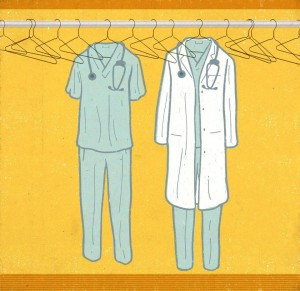
Image Credit: Dan Page, Boston Globe
What is the US going to do about our current and future primary care physician shortage? Many believe that the solution is to expand the scope of nursing practice, and license non-physicians (such as naturopaths) to practice medicine. In the face of scarcity, 17 states have licensed naturopaths to provide primary care and nurse-led, in-store pharmacy clinics are gaining popularity.
Studies have shown that nurse practitioners are as capable as physicians at treating common primary care complaints such as strep throat and headache. What studies have NOT shown is that nurse practitioners recognize and diagnose less common diseases with similar symptoms. What if the strep throat were throat cancer? What if the headache were meningitis? Substituting practitioners with half the training and experience of an MD comes at a price. And that price may include missed diagnoses, delay of appropriate treatment, and life threatening consequences.
But the lure of cost savings cannot be ignored. Nurses are paid less to practice primary care, so in theory we could save untold millions each year by having patients see nurses instead of doctors. That sounds good, but now nurse practitioners are lobbying to receive the same salary as MDs for their time. After all, they’re doing the same work, right? Never mind that everyone they treat must be squeezed into a limited set of diagnosis codes – when all you have is a hammer, then everything starts looking like a nail. “Poof” goes the savings, while care quality standards are permanently reduced by forced limitations on differential diagnoses.
A better solution would be to find ways to extend physician reach and expertise with telemedicine platforms, longer patient visit times, and by reducing their non-clinical practice burden. Nurses and ancillary providers are valued members of the clinical team who are dearly loved by patients and doctors alike, but they simply do not have enough training to be ruling out tens of thousands of rare diseases and conditions. This is why we need physicians at the helm of the clinical team – to make sure that patients are on the right treatment pathway.
Some nurses cry “prejudice” when physicians suggest that MDs provide better primary care. But we all know that knowledge and experience are a critical asset when lives are at stake. As the research results begin to roll in regarding better patient outcomes under the care of physicians versus nurse practitioners, common sense tells us that outsourcing primary care to the less qualified will have undesirable consequences for some. And if you choose to get your primary care from a naturopath or nurse, you’ d better hope that headache isn’t anything serious. Because a little savings now could cost you your life.
September 21st, 2011 by Michael Kirsch, M.D. in Opinion
No Comments »

 All of us have been to fast food establishments. We go there because we are in a hurry and it’s cheap. We love the convenience. We expect that the quality of the cuisine will be several rungs lower than fine dining.
We now have a fast medicine option available to us. Across the country, there are over 1000 ‘minute-clinics’ that are being set up in pharmacies, supermarkets and other retail store chains. These clinics are staffed by nurse practitioners who have prescribing authority, under the loose oversight of a physician who is likely off sight. These nurses will see patients with simple medical issues and will adhere to strict guidelines so they will not treat beyond their medical knowledge. For example, if a man comes in clutching his chest and gasping, the nurse will know not to just give him some Rolaids and wish him well. At least, that’s the plan.
Primary care physicians are concerned over the metastases of ‘minute-clinics’ nationwide. Of course, they argue from a patient safety standpoint, but there are powerful parochial issues worrying physicians. They are losing business. They have a point that Read more »
*This blog post was originally published at MD Whistleblower*
February 1st, 2011 by DrWes in Better Health Network, Opinion
No Comments »

 It came as a Twitter “follow” from @coldfeet65, a self-proclaimed “Nurse Practitioner Hospitalist.” I had never heard this term before. Does it mean a nurse practitioner who cares for hospitalists? Or is it a hospitalist who is a nurse practitioner? Or maybe it’s a nurse practitioner who helps hospitalists? (Honestly, I think I know which one she means, but you get my point.)
Perhaps this is a prescient glimpse to healthcare of the future, where our more typical nurse and doctor labels are supplanted by more and more monikers that serve to confuse, rather than clarify, each of our roles in healthcare delivery. As specialists in cardiology, we’ve seen a similar trend with cardiology hospitalists. But we should be clear what this means to the patients and doctors going forward.
No doubt most people in America still expect to see a doctor when they come to the hospital. Increasingly, it appears that might not be the case. Your doctor might be a robot while a nurse (aka, nurse practitioner) will be the one providing the hands-on care in the inpatient setting. Is that a good thing? Honestly, I’m not sure.
No one argues that the costs in healthcare need to be cut. No doubt the central authority has deemed that doctor salaries will be a big part of that effort. Already, 20 states have cut physician Medicaid payments for fiscal year 2010 and, given the current economic pressure on our states both now and after they start feeling the financial impact of the “Affordable” Care Act in 2019, this trend is not likely to improve anytime soon. As a result, we are seeing that the world is full of “creative solutions” to our healthcare access crisis and the evolution to “nurse practitioner hospitalists” might be one of these. Read more »
*This blog post was originally published at Dr. Wes*
January 24th, 2011 by Davis Liu, M.D. in Better Health Network, Opinion
No Comments »

 A recent post on the Health Affairs blog proclaimed “The End of Internal Medicine As We Know It.” What the post is really asking about is the future of primary care in the world of healthcare reform and the creation of accountable care organizations (ACOs). While doctors should be naturally concerned about change, I don’t completely agree with this article.
ACOs are organizations that are integrated and accountable for the health and well-being of a patient and also have joint responsibilities on how to thoughtfully use a patient’s or employer’s health insurance premium, something that is sorely lacking in the current health care structure. These were recently created and defined in the healthcare reform bill.
Yet the author seems to suggest that this is a step backwards:
Modern industry abandoned command-and-control style vertical integration decades ago in favor of flatter, more nimble institutions.
Not true. Successful organizations are ones that are tightly integrated, like Apple, FedEx, Wal-Mart, and Disney.
The author talks briefly about how Europe in general does better than the U.S. in terms of outcomes and costs and has a decentralized system. All true. However, contrasting Europe and America isn’t relevant. After all, who isn’t still using the metric system? Therefore solutions found outside the U.S. probably aren’t applicable due to a variety of reasons. Americans like to do things our way.
What I do agree on is that doctors need to be part of the solution and ensure that the disasters of decades ago — like labeling primary care doctors (internists and family physicians) as “gatekeepers” rather than what we really do — never happen. Read more »
*This blog post was originally published at Saving Money and Surviving the Healthcare Crisis*
May 19th, 2010 by KevinMD in Better Health Network, Health Policy, Opinion, Research
No Comments »

What if some physicians actually like the way primary care is currently practiced? It’s hard to believe, considering the majority of studies suggest marked dissatisfaction among primary care doctors, and an increasing prevalence of physician burnout.
The ACP’s Bob Doherty recently summarized an epic Health Affairs article devoted to fixing primary care. The bottom line was that paying primary care doctors better isn’t enough. The whole field needs to be re-invented. Read more »
*This blog post was originally published at KevinMD.com*