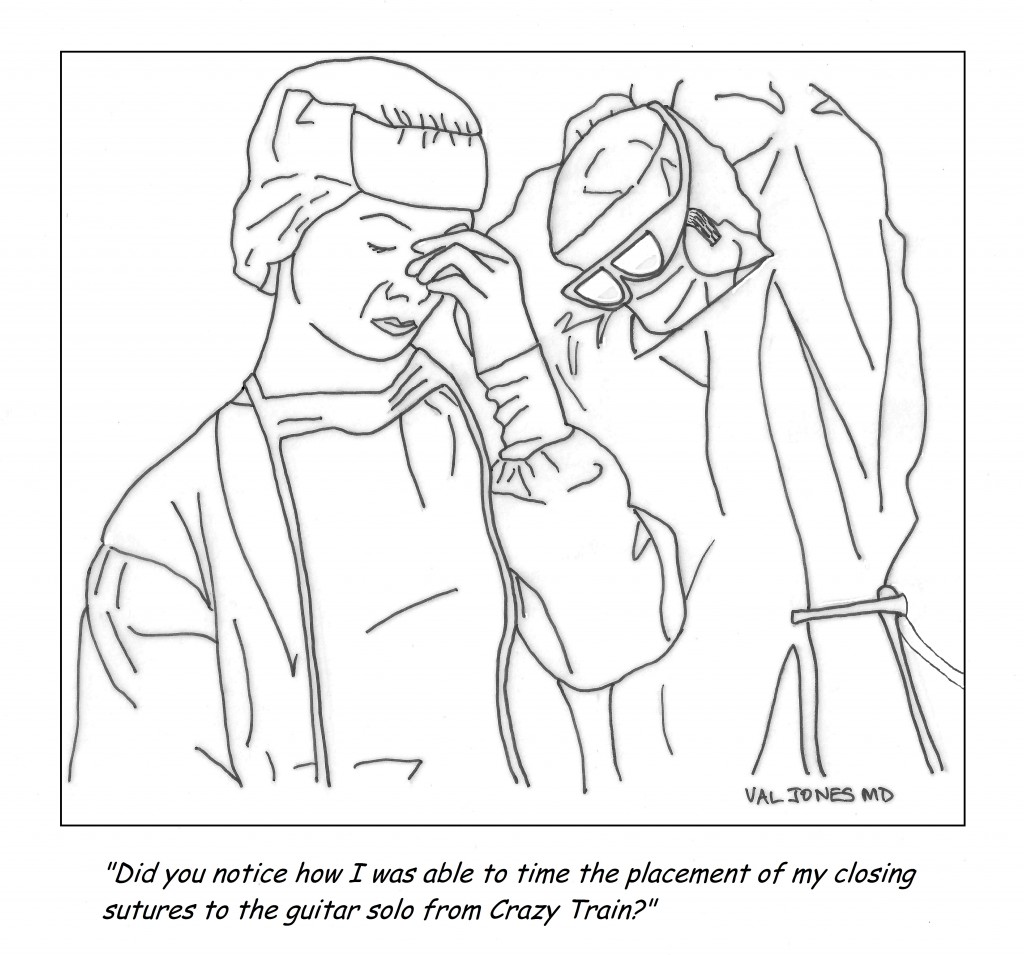
Cartoon: How Some Surgeons Behave In The O.R.




As we discussed in the first of this two part series, mobile devices are already entering the world of the surgeon. Currently, it is mostly downloadable apps that promise to help surgeons with the informational portions of their tasks, such as tracking the cases they have done, e.g. Surgichart or helping in the consent process, e.g. Surgery Risk
While apps that are dedicated to the technical aspects of surgery, such as the excellent AO Surgery Reference, are becoming available, in the future we will see the iPad (or its brethren) actually in the operating room. Why ? Because the iPad has many characteristics that make it a great an advanced surgical instrument.
First is its small size. Every modern operating room has stacks of electronic equipment hanging from the ceiling or in large cabinets for patient monitoring and controlling in-field devices. Since the iPad already supports a bevy of standard wireless communication protocols, many of these large boxes’ functions could likely be off-loaded to an iPad with clever engineering. One immediate advantage would be that Read more »
*This blog post was originally published at iMedicalApps*

Surgery is messy… and I don’t mean in terms of blood and guts…

What I mean are wires, cables, tubing, etc.
Electric cord for the operating tableLet’s take a routine tonsillectomy and adenoidectomy for example…
*This blog post was originally published at Fauquier ENT Blog*

Tomorrow we’ll be far away
Tomorrow is the judgement day
Tomorrow we’ll discover what our God in heaven has in store
One more dawn…
On an unrelated note, tomorrow morning at 5AM our new ER opens and the old one closes down. I’ll be there working clinically. To the degree that it doesn’t interfere with patient care, I’ll live-tweet the experience.

For those not familiar with the institution or the project — it’s a 110,000 annual visit ER closing down and reopening next door in a new, state of the art 83 bed ER, with an entire new 10-story hospital opening directly above at the same time, more or less. The logistics of the transition are pretty staggering. The ER will be the first unit to open. The old ambulance bay will have a barrier put up at 5AM and the new department’s ambulance bay and drop-off will be illuminated at that time and all new patients will go there. The staff closing out the old shop will dispo all the patients they can, and at a certain point, maybe by ten AM, any patients still in the old ER will roll across the skybridge to the new facility. We will open one cath lab and one OR in the new hospital while retaining capability at the old rooms. New patients admitted will go to the new tower and the old inpatient units will start discharging patients. By Friday, any patients still in the old tower will move across to the new inpatient units. They’ll be bringing the other ORs and interventional labs online in a stepwise fashion during the week. Interestingly, a lot of expensive equipment is being “salvaged” from the old hospital. For example, the telemetry monitors in the ICU — about half of the new ICU beds have monitors now. When a patient is discharged from the old ICU, they will take that monitor across to the new building and install it in a new ICU bed, which will only then become open for a new patient. Eventually, all the monitors will be re-installed in the new units. Elective surgeries are pretty much out this week. When everything is open we will have 16 ORs and 8 cath/vascular/EP labs with room for four more as need demands.
For the ER (and more importantly for ER patients) this will be Read more »
*This blog post was originally published at Movin' Meat*

He must have been about eight at the time. I had made the mistake of watching doctor shows on TV with him and he had probably heard my wife and I describe the challenges of my doctor lifestyle at times over dinner. For the most part, he seemed oblivious and liked the things that most young boys at that age do: sports, jungle gyms, mud, and bicycles, but he had never seen his Dad at work.
So the day came when my wife was doing errands and stopped by the hospital with the kids to drop off my pager which I had inadvertently left at home. As timing would have it, I had just scrubbed in a case, so she was kind enough to bring the pager to the electrophysiology lab control room where the technicians could retrieve it for me. My son, realizing how close he was to my workplace asked within earshot of the technician, “Mom, could I see?” She looked at the technician, and he nodded agreement. Cautiously, they entered the control room just to wave “hi” briefly through the glass. Read more »
*This blog post was originally published at Dr. Wes*
It’s no secret that doctors are disappointed with the way that the U.S. healthcare system is evolving. Most feel helpless about improving their work conditions or solving technical problems in patient care. Fortunately one young medical student was undeterred by the mountain of disappointment carried by his senior clinician mentors…
I am proud to be a part of the American Resident Project an initiative that promotes the writing of medical students residents and new physicians as they explore ideas for transforming American health care delivery. I recently had the opportunity to interview three of the writing fellows about how to…

Book Review: Is Empathy Learned By Faking It Till It’s Real?

I m often asked to do book reviews on my blog and I rarely agree to them. This is because it takes me a long time to read a book and then if I don t enjoy it I figure the author would rather me remain silent than publish my…
The Spirit Of The Place: Samuel Shem’s New Book May Depress You

When I was in medical school I read Samuel Shem s House Of God as a right of passage. At the time I found it to be a cynical yet eerily accurate portrayal of the underbelly of academic medicine. I gained comfort from its gallows humor and it made me…
Eat To Save Your Life: Another Half-True Diet Book

I am hesitant to review diet books because they are so often a tangled mess of fact and fiction. Teasing out their truth from falsehood is about as exhausting as delousing a long-haired elementary school student. However after being approached by the authors’ PR agency with the promise of a…