The Science Of Radiofrequency: Why Cell Phones, Microwaves, Wi-Fi, And Smart Meters Are Unlikely To Pose Health Risks
 Cell phones, microwave ovens, wi-fi, smart meters. What do they have in common? They all emit radiation in the radiofrequency range. And they all radiate controversy. Given that these devices are set to become as commonplace as light bulbs, it is understandable that questions arise about their possible health effects. There are all sorts of allegations that exposure can trigger ailments ranging from headaches to cancer. Allegations, however, do not amount to science. And there is a lot of science to be considered.
Let’s start with the fact that an alternating current flowing through a wire generates an electromagnetic field around it. This field can be thought of as being made up of discrete bundles of energy called “photons” that are created as the electrons in the wire flow first in one direction then in the other. Photons spread out from the wire, their energy depending on the frequency with which the current changes direction. The number of photons emitted, referred to as the ‘intensity’ or ‘power” of the radiation, depends on the voltage, the current and the efficiency of the circuit to act as an antenna.
In ordinary household circuits, the direction of the current changes sixty times a second, that is, it has a frequency of 60 Hz, the unit being named after Heinrich Rudolf Hertz, the first scientist to conclusively prove the existence of electromagnetic waves. The photons emitted by such a circuit travel through space and have the capacity to induce a 60Hz current in any conducting material they encounter. Essentially, we have a “transmitter” and a “receiver.” If special circuitry is used to produce current in the range of 10 million (10MHz) to 300 billion Hz (300 GHz), the photons emitted are said to be in the radiofrequency region of the electromagnetic spectrum. That’s because with appropriate modulation at the transmitter (amplitude modulation (AM), or frequency modulation (FM)) these photons can induce a current in an antenna that can be converted into sounds or images.
But what happens when photons in this energy range interact with living tissue, such as our bodies? The greatest concern would be the breaking of bonds between atoms in molecules. Disrupting the molecular framework of proteins, fats and particularly nucleic acids can lead to all sorts of problems, including cancer. However, photons associated with radiofrequencies do not have enough energy to do this, no matter what their intensity. An analogy may be in order.
Consider a weather vane sitting on a roof. It is mounted on a sturdy metal rod, but of course can spin. You decide you want to knock it off the roof, but all you have are tennis balls. You start throwing the balls, but even if you hit the support, nothing happens. You just can’t impart enough energy to the ball to have it break a metal rod. And it doesn’t matter if you gather all your friends, and they all throw balls at the same time. You may have increased the “intensity” of your efforts, but it doesn’t matter, because no ball has enough energy. Of course if you had a cannon, you could knock down the target with one shot. That’s why high energy photons such as generated by very high frequency currents, as in x-rays, are dangerous. They can break chemical bonds! While you are not going to damage the weather vane with the tennis balls, you can surely make it spin, and the friction generated will heat up the base, the extent depending on how many balls are thrown.
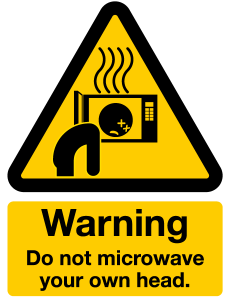
Now, back to our photons. In the radiofrequency region, no photon has enough energy to break chemical bonds, but they can make molecules move around, generating heat. The more photons released, the greater the heating effect. This is exactly how microwave ovens work. They operate at radiofrequencies, but at a very high intensity or “power” level, meaning they bombard the food with lots of photons causing the food to heat up. You certainly wouldn’t want to crawl into a working microwave oven and close the door behind you. Similarly, you wouldn’t want to stand right next to a high power radio transmitting antenna, such as used by radio or TV stations, because you could get burned very badly. But the number of photons encountered drops very quickly with distance as they spread out in all directions, so that even standing a few meters from the base of such an antenna would not cause any sensation of heat. Just think of how quickly the heat released by a light bulb drops off with distance.
The “smart meters” that are being installed by electrical utilities monitor the use of electricity and relay the information via a built-in radio transmitter. But the radiation to which people are exposed from these meters quickly drops off with distance, as with the light bulb, and is way below established safety limits. Furthermore, the smart meters only transmit for a few milliseconds at a time for a grand total of a few minutes a day! Cordless phones, cell phones, routers, baby monitors, video game controls and especially operating microwave ovens expose us to similar radiation, usually at far higher levels. Smart meters are responsible for a very small drop in the radiofrequency photon bucket.
It must be pointed out, though, that safety standards are essentially based on the heating of tissues. But what about the possibility of “non-thermal” effects? What if radiofrequency photons cause damage by some other mysterious mechanism? Over the last 30 years more than 25,000 peer-reviewed papers have been published on electromagnetic fields and health, many devoted to non-thermal effects. Health agencies do not find present evidence persuasive of a hazard at ordinary exposure levels, and given the extent of research that has been carried out, it is unlikely that one will be identified in the future.
Although an overwhelming number of studies on cell phones and brain cancer have shown no effect, admittedly some have suggested a barely detectable link. Despite the weak evidence, the International Agency for Research on Cancer has classified electromagnetic fields associated with radiofrequencies as “possibly carcinogenic,” indicating a level of suspicion without any implication that the fields actually cause cancer. This notion pertains to cell phone use and has nothing to do with the far weaker fields associated with wi-fi and smart meters. I would have no issue with a smart meter in my house.
What then about those consumers who claim they have developed symptoms after smart meters were installed? I think it is appropriate to consider John Milton’s poetic view of the power of imagination: “The mind is its own place, and in itself can make a heaven of hell and a hell of heaven.”
***
Joe Schwarcz, Ph.D., is the Director of McGill University’s Office for Science and Society and teaches a variety of courses in McGill’s Chemistry Department and in the Faculty of Medicine with emphasis on health issues, including aspects of “Alternative Medicine”. He is well known for his informative and entertaining public lectures on topics ranging from the chemistry of love to the science of aging. Using stage magic to make scientific points is one of his specialties.



 Contagion
 And while it’s an action-thriller first and foremost, you don’t have to concentrate hard to notice that it also shows: