Cartoon: Why Are Hospitals So Noisy?



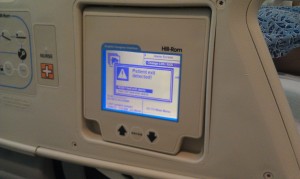
An ICU Bed False Exit Alarm
I just spent the last 8 days in the hospital, at the bedside of a loved one. Although I squirmed the whole way through a tenuous ICU course and brief stop-over in a step-down unit, it was good for me to be reminded of what it feels like to be a patient – or at least the family member of one – in the hospital. The good news is that the staff were (by and large) excellent, and no major medical errors occurred. The bad news is that the experience was fairly horrific, mostly because of preventable design and process flaws. Having worked in a number of hospitals over the years, I recognized that these flaws were commonplace. So I’ve decided to tilt at this great hospital design “windmill” on my blog – with the hope that someone somewhere will make their hospital a friendlier place because of it.
Most of these design and process flaws have one thing in common: they prevent the patient from sleeping. In some circles, sleep deprivation is an organized form of torture reserved only for the most dangerous of terrorists. In other circles, it is hospital policy. And so, without further ado, here is my top 10 list of annoying hospital design flaws:
#1: False Alarms. Every piece of hospital equipment seems to be designed to beep for a complex list of reasons, many of which are either irrelevant or unhelpful. I snapped a photo of a particularly amusing (to me anyway) alarm (see above). This was a bed alert, signaling the “patient exit” of an intubated and sedated gentleman in the ICU. Not only was the location of the alert sign curious (if you could get close enough to the alert screen to read the text, you would surely already have noticed that the patient was AWOL) but it was triggered by mattress pressure changes that occurred when the patient was repositioned every 2 hours (as per ICU pressure ulcer prevention protocol).
The I.V. drip machines are probably one of the worst noise pollution offenders, beeping aggressively when an I.V. *might* need to be changed or when the patient coughs (this triggers the backflow pressure alarm, leading it to believe that a tube is blocked). Of course, I also thoroughly enjoyed the vitals monitor that beeped every time my loved one registered atrial fibrillation on the EKG strip – a rhythm he has been in and out of for years of his life.
#2: Intercom Systems. Apparently, some hospital intercom systems are wired into every patient room and permanently set at “full volume.” This way, every resting patient can enjoy the bleating cries for housekeeping, tray pickup, incoming nurse phone calls,physician pages, and transport requests for the entire floor full of individuals undergoing the sleep deprivation protocol.
#3: The Same Questions Ad Nauseum. Over-specialization is never more apparent than in the inpatient setting. There is a different team of doctors, nurses, PAs, and techs for every organ system – and sometimes one organ can have four teams of specialists. Take the heart for example – its electrical system has the cardiac electrophysiology team, the plumbing has the cardiothoracic surgery team, the cardiologists are the “minimally invasive” plumbers, and the intensivists take care of the heart in the ICU. Not only is a patient assigned all these individual micro-managing teams, but they work in groups – where they rotate vacations and on-call coverage with one another. This virtually insures that the sleep-deprived patient will be asked the same questions relentlessly by people who are seeing him for the very first time at 20 minute intervals throughout the day.
#4: Inopportune Intrusions. There are certain bodily functions that benefit from privacy. I was beginning to suspect that the plastic urinal was attached to the staff call bell after the fifth time that someone summarily entered my loved one’s room mid-stream. Enough said.
#5: Poorly Designed Tubing. Oxygen-carrying nasal cannulas seem to be designed to maintain a slight diagonal force on the face at all times. This results in the slow slide of the prongs from the nostrils towards the eye. Since the human eye is less efficient at absorbing oxygen than the lungs, one can guess what might happen to oxygen saturation levels to the average, sleep-deprived patient, and the resulting flurry of nursing disturbance that occurs at regular intervals throughout the night (and day). My loved one particularly enjoyed the flow of air pointed directly into his left eye as he attempted to rest.
#6: The Upside Down Call Bell. In an age of wireless technology, where almost every American has a cell phone and/or a flat screen television, it is odd that the light, TV, and nurse call bell control system must be tethered to a short cord positioned just outside of the patient’s reach. The controller is also designed so that the cord comes out of the box’s farthest point, causing it to remain upside down in the hands of anyone lucky enough to reach it from a chair or bed.
#7: Excessive Hospital Bands. In addition to multiple rotating IV access points, my loved one’s wrists and ankles were tagged with not one but four hospital band identifiers, including one neon yellow band sporting the ominous warning: “Fall risk.” If that little band is the only way that a staff member can ascertain a patient’s risk for falling down unassisted, then one is left to wonder about their powers of perception. In a moment of rare good humor, my loved one looked down at his assorted IV tubes and three plastic wrist bands and concluded, “I’m one stripe away from Admiral.”
#8: The Blank White Board. Sleep-deprivation-induced delirium can be rather disorienting. To help patients keep track of their core care team names, most hospital rooms have been outfitted with white boards. Ideally they are to be filled out each shift change so that the patient knows which activities are scheduled and the names of the staff that will be performing them. Filling out these boards is tiresome for staff members (not to mention that the dry erase markers are usually missing) and so they remain blank most of the time. This has an anxiety producing effect on patients, as the boards boldly proclaim that no nurse is taking care of them, and no activities are scheduled. I also noted that the size of the board lettering was a fraction smaller than a person with 20/20 vision could make out from the distance of the bed.
#9: The Slightly-Too-Tight Pulse Oximeter. Because being tethered to a bed with IV tubing, telemetry cords, and a nasal cannula is not quite irritating enough, hospital staff have devised a way to keep one unhappy finger in a constant, mild vice grip. This device monitors oxygenation status and helps to trigger alarms when nasal cannulas achieve their usual peri-ocular destination every 30 minutes or so.
#10: The Ticking And Creaking IV Drip. During the few rare moments of quiet, we did not enjoy any sort of blissful silence, but rather the incessant ticking of the I.V. drip machine. My loved one remarked that he felt as if he were trapped in an endless recording loop of the first 5 seconds of the TV show “Sixty Minutes.” And so if the alarms, tethering, interruptions, PA announcements, tubing, or white boards didn’t drive you mad, the auditory reinforcement of a ticking time bomb next to your head could bring you close to tears.
And so, because of all these nuisances (not to mention the ill-fitting hospital gowns, inedible food, and floors covered with various forms of “seepage” that penetrated patient socks on hallway ambulation attempts) we had one of the most unpleasant experiences in recent memory. All this, and no dissatisfaction with the surgical team or the primary procedure performed during the hospital stay. In the end, it’s the little things that can drive you crazy – or make you well.

 As of this writing, 5 air traffic controllers have been found asleep at the switch. By the time this piece is posted, several others may have joined the slumber party. Keep in mind, there’s a lot more snoozing in the towers than we’re aware of. We don’t know the denominator here. Our wise reactive government has recently issued orders that airport control towers must not be manned by only one individual. Somehow, prior to NappingGate, our bloated and inefficient government that is riddled with redundancy, thought that one sole guy watching the radar at night was sufficient.
There are some jobs where nodding off poses no risk. Let me test my readers’ acumen on this issue. Which of the following professions would not be at risk if an unscheduled siesta occurred?
Let’s face it. Some folks on the job simply can’t safely snore their way through it. We don’t want Read more »
*This blog post was originally published at MD Whistleblower*

In a recent New England Journal of Medicine, a perspective piece on what to do with fatigued surgeons is generating debate. The issue of work-hour restrictions has been a controversial issue when it comes to doctors in training, something that I wrote about earlier in the year in USA Today. But once doctors graduate and practice in the real world, there are no rules.
As summarized in the WSJ’s Health Blog, the perspective piece argues for more regulation for tired surgeons:
… self-regulation is not sufficient. Instead, “we recommend that institutions implement policies to minimize the likelihood of sleep deprivation before a clinician performs elective surgery and to facilitate priority rescheduling of elective procedures when a clinician is sleep-deprived,” they write. For example, elective procedures wouldn’t be scheduled for the day after a physician is due to be on all-night call.
And the authors suggest that patients be “empowered to inquire about the amount of sleep their clinicians have had the night before such procedures.”
It’s a noble goal, and indeed, data does show that fatigued surgeons tend to make more errors. Patients, once confronted with a choice of being operated on by a tired surgeon, may choose to postpone surgery. Read more »
*This blog post was originally published at KevinMD.com*

Our busy lifestyles often aren’t conducive to getting the recommended amount of sleep at night. According to the National Sleep Foundation, adults need between seven and nine hours of sleep every night.
Dr. Kenneth Berg of the Mayo Clinic states that people who get less than seven hours of sleep per night have a higher mortality than those who have adequate sleeping habits.
Inadequate sleep has been linked to increased risk of motor vehicle accidents, an increase in body mass index and a greater likelihood of obesity due to an increased appetite caused by sleep deprivation, increased risk of diabetes and heart problems, increased risk for psychiatric conditions including depression and substance abuse, and decreased ability to pay attention, react to signals or remember new information. Read more »
*This blog post was originally published at eDocAmerica*
It’s no secret that doctors are disappointed with the way that the U.S. healthcare system is evolving. Most feel helpless about improving their work conditions or solving technical problems in patient care. Fortunately one young medical student was undeterred by the mountain of disappointment carried by his senior clinician mentors…
I am proud to be a part of the American Resident Project an initiative that promotes the writing of medical students residents and new physicians as they explore ideas for transforming American health care delivery. I recently had the opportunity to interview three of the writing fellows about how to…
Book Review: Is Empathy Learned By Faking It Till It’s Real?

I m often asked to do book reviews on my blog and I rarely agree to them. This is because it takes me a long time to read a book and then if I don t enjoy it I figure the author would rather me remain silent than publish my…
The Spirit Of The Place: Samuel Shem’s New Book May Depress You

When I was in medical school I read Samuel Shem s House Of God as a right of passage. At the time I found it to be a cynical yet eerily accurate portrayal of the underbelly of academic medicine. I gained comfort from its gallows humor and it made me…
Eat To Save Your Life: Another Half-True Diet Book

I am hesitant to review diet books because they are so often a tangled mess of fact and fiction. Teasing out their truth from falsehood is about as exhausting as delousing a long-haired elementary school student. However after being approached by the authors’ PR agency with the promise of a…