There aren’t too many grandmothers developing mobile health apps these days, but I met a charming one (Jill Campbell) at the mHealth Summit yesterday. Jill is a 60 year-old woman from Texas who has been actively concerned for the safety of herself and her daughter over the years.
“My daughter took a self-defense class,” Jill explained, “And she was taught the ‘fight or flight’ response to escape harm. I’m 60 years old. I’m not good at fighting and not very fast at fleeing. So what’s my third option?” Jill created the WatchMe 911 app to provide the solution.
“I first started thinking about a personal alarm system before smart phones even existed. I saw that there were car alarms and house alarms, and wondered why there weren’t personal alarms. At the time I imagined that the personal alarm would go through an answering service system, but since smart phones were created, it can all be tied together in an app format.”
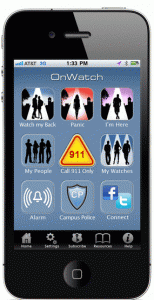
Jill demonstrated the WatchMe 911 app to me during our interview. It contains features such as a panic button that can be armed in advance. Two taps on the smart phone screen and a circle of friends and 9-1-1 are contacted immediately with your GPS location and an alert message. The panic button is a favorite for women who are concerned for their safety when walking late at night or in dimly lit parking lots or alleys. Read more »
As my regular readers already know, I’ve been eagerly coaching the Boys & Girls Clubs’ Triple Play Fit Family Challenge (FFC) participants on healthy eating. During a recent phone call with the families I expressed some wistfulness about not being able to *see* what they’ve been eating (the FFC blog is filled with charming action shots of the families exercising, but almost no food cameos). And this is what the Porter family just sent me. It’s a video inviting me to a dinner of grilled tilapia, brown rice, acorn squash, mushrooms and broccoli. Tell me if this isn’t the cutest nutrition video ever?
Ten days ago a post here mentioned the 14th ICSI / IHI Colloquium. I said the Society for Participatory Medicine was well represented, including:
Jessie Gruman, four time cancer patient and founding co-editor of our journal, gave an important breakout session, about which I’ll be writing soon. (Jessie is founder and president of the excellent Center For Advancing Health.)
Jessie’s talk was so good it had me going nuts on Twitter – I couldn’t keep up with all the “tweet-worthy” things that came out of her mouth.
Well, I’ve just re-read her text, and it brought back why I went nuts. I was going to write about it, but I’m just going to post the full text.
For those who don’t know, last fall Jessie underwent surgery for her fourth cancer; she has some experience. Read more »
*This blog post was originally published at e-Patients.net*
How is it that a person with an illness forgets to take their medicine, or refuses to get a treatment, or forgoes important monitoring? I’ve been thinking about that because someone close to me has hit that “medical fatigue” wall. There has been no effective treatment for their digestive system illness and they are tired of the prods, pokes, and special exams. They just want to live their life and “cope.”
One can understand – especially in a child or teenager. Imagine someone with diabetes. Diet, exercise, monitoring, medication. It can be so tiring. If only the illness – the boogieman or what some call “the beast” could just go away!
But it can’t and it doesn’t. And medical treatments may well be imperfect. They probably are. So do you give up? There is no “right answer,” only a right answer for you. Here are some examples: This week I am interviewing Kathy Sparks of suburban Seattle. Kathy is a nurse who was diagnosed with melanoma on her forearm. It was cut out. Then more was cut out. Then it came back. She had chemotherapy with lots of side effects. A remission followed, and then it came back again, this time in her breast. As time passed doctors gave her only months to live. Unwilling to try to fairly toxic chemo again, she spent time making peace with her impending demise. Read more »
*This blog post was originally published at Andrew's Blog*
The New York Times has a series called “Patient Voices” which gives insights from the patients with the disease, physical and emotional changes in their lives, and accommodations made. The most recent series is on patients with alopecia (hair loss).
“The Voices of Alopecia” by Tara Parker-Pope (July 6, 2010):
This week, Patient Voices explores alopecia, an autoimmune disease that leads to a few bald patches to the loss of every hair on a person’s body.
It’s no secret that doctors are disappointed with the way that the U.S. healthcare system is evolving. Most feel helpless about improving their work conditions or solving technical problems in patient care. Fortunately one young medical student was undeterred by the mountain of disappointment carried by his senior clinician mentors…
I am proud to be a part of the American Resident Project an initiative that promotes the writing of medical students residents and new physicians as they explore ideas for transforming American health care delivery. I recently had the opportunity to interview three of the writing fellows about how to…
I m often asked to do book reviews on my blog and I rarely agree to them. This is because it takes me a long time to read a book and then if I don t enjoy it I figure the author would rather me remain silent than publish my…
When I was in medical school I read Samuel Shem s House Of God as a right of passage. At the time I found it to be a cynical yet eerily accurate portrayal of the underbelly of academic medicine. I gained comfort from its gallows humor and it made me…
I am hesitant to review diet books because they are so often a tangled mess of fact and fiction. Teasing out their truth from falsehood is about as exhausting as delousing a long-haired elementary school student. However after being approached by the authors’ PR agency with the promise of a…


 There aren’t too many grandmothers developing mobile health apps these days, but I met a charming one (Jill Campbell) at the mHealth Summit yesterday. Jill is a 60 year-old woman from Texas who has been actively concerned for the safety of herself and her daughter over the years.