Latest Posts
Paul Ryan’s Take On Healthcare Reform
4 Comments »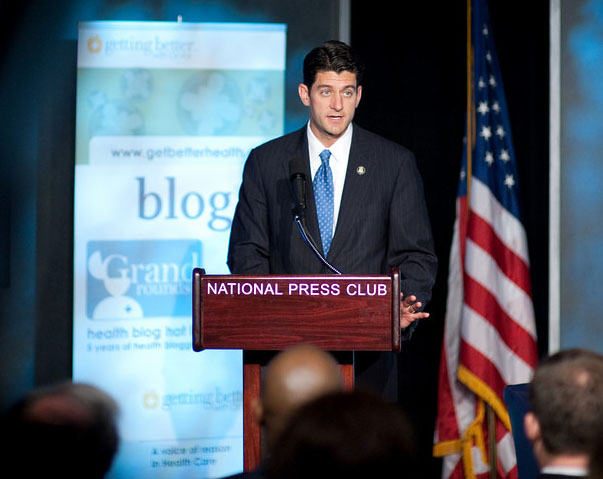
Paul Ryan, Romney's VP Pick
Now that Mitt Romney has announced that Paul Ryan is his VP pick, I thought it would be helpful to repost some video and transcripts from a healthcare reform conference that I organized in 2009. Paul Ryan was our keynote speaker at the National Press Club, and I found him to be a bright, articulate, and humble person. I remember that he was eager to please, and that he came to the conference early so that he would have time to listen to the physicians and nurses who had traveled from across the country to speak out about healthcare reform.
I hope the video and transcript give you some insight into his take on (what is now) Obamacare. Enjoy!
*** Congressman Paul Ryan addressed the crowd at Better Health’s “Healthcare Reform: Putting Patients First” event. This is a transcript of his speech: ***
This event is a landmark in how we get discussion and debate going in the 21st century. We are communicating with the grass roots, with medical bloggers here in this room and across the country.
Let me tell you this: I don’t want government interfering in the relationship between doctors and patients…and I don’t want insurance companies interfering either! I want a vibrant health care market that lets patients choose the health care options that are right for them and their loved ones. I want a free market democracy that puts patients first. We can have this, and I’ll say something more about that in a minute.
Right now Congress is rushing through a health care overhaul that goes in the opposite direction. It’s important to analyze the relative financial costs and benefits of these proposals, but our greater challenge is not the dollars and cents. It goes to the issue of continuing the tradition of excellent health care that medical practitioners now provide. It’s about the equal dignity of each human person…and the future of America as a free society. The American character, and the principles of freedom & democracy which protect & preserve it, may be lost beyond recovery if Congress chooses the wrong path on health care reform—the path down which I believe the Obama Administration seems determined to lead our country.
Public health has always been a government priority. Our Constitution’s Framers saw every individual as having a “right of personal security” which includes being protected against acts that may harm personal health. This right is part of the natural right to life, and it is government’s very purpose to secure our natural rights to live, to be free, and to pursue happiness.
Now here is where believers in big government make their big mistake. The right of each person to protection of health does not imply that government must provide health care. The right to have food in order to live doesn’t require government to own the farms and raise the crops. Government’s obligation is normally met by establishing the conditions for free markets to thrive. Societies with economic freedom almost always have a growing abundance of goods and services at affordable costs for the largest number. When free markets seem to be failing to meet this test – and I’d argue today’s health care delivery is an example – government should not supply the need itself. It should correct its own interventions and liberate choice and competition.
We know from survey after survey that a vast majority of Americans are personally satisfied with the quality of their own health care. The problem is really with health care delivery, which is growing too costly and leaving many people without coverage. The proponents of government-run health care claim there are only two alternatives: either enact their plan or do nothing. This is false. Government bureaucracy is not the answer to insurance company bureaucracy.
An authentic solution to the problem of affordability should be guided by the principles of moral and political freedom… respect doctor and patient privacy…restrain spending…and channel the energy of our free market system, not dry it up. There is no lack of sensible alternative solutions proposed by Republicans to put patients first. Senators Coburn and Burr, and Congressman Nunes and I have offered one, called “The Patients’ Choice Act.” It’s an example of how to eliminate government-driven market distortions that exclude many from affordable health care delivery. More uninsured Americans can be covered by spending current dollars more wisely and efficiently than by throwing trillions more at the problem. Our health care delivery alternatives are based on timeless American moral and political truths.
In essence, we believe that the dollars and decisions should flow through the individual patient, not from the government. I want to see a market where providers truly compete against each other for our business as consumers and patients – not a bureaucratized system where health care providers vie for government favor as patients wait in line.
When federal bureaucracy replaces consumer choice and competition, services are distorted and costs escalate. Consider Medicare and Medicaid. Real cost control has become a national nightmare. Fraud has proliferated despite every effort to stop it. Program costs are always underestimated. In 1966, the cost of Medicare to the taxpayers was about $3 billion. Congress estimated that by 1990, Medicare would cost taxpayers only about 12 billion in real dollars. The actual cost? Nearly nine times as high — $107 billion. By 2006, Medicare reached $401 billion, while Medicaid added another $309 billion for a total of $710 billion. The failure to control Medicare’s costs shows us why we should look to free markets and decentralization for the answers.
The health care programs being pushed by the Democrats are outrageously expensive and fiscally irresponsible. Like Medicare and Medicaid, they will fail to control health care costs. They will exacerbate our growing debt. They will require crushing taxes. Their approach would spend trillions more dollars, mandate that all but the smallest of businesses provide health insurance, require every American to pay for health insurance or punish them for not buying it, impose a massive new tax burden on employers & heath care practitioners, and make our entitlement crisis worse by adding yet another open-ended entitlement.
The so-called “public option” is presented as a way of “keeping private insurance honest”. Well, if this is their idea of “honesty,” we’re in really big trouble. The “public option” isn’t honest. It is designed to make private insurers go away.
Government has four huge powers that force free market competitors out of business. First, the government does not pay taxes and the private competitors do. Second, it forces competitors to establish high capital reserves while the government has none. Third, the government does not have to account for employee wage and benefit costs – private competitors do. Fourth, the government gets to dictate the prices it pays, which are much lower than its competitors.
It isn’t “honest competition” when government serves as both referee and player in the same game. Before the game begins, you know who will win. Unfortunately, it’s the people who lose. According to one independent study from a reputable actuarial firm, two out of three Americans will lose the health coverage they now have in three years if the House bill becomes law.
Government-monopolized health service contradicts everything America stands for. It conflicts with our people’s character…it conflicts with moral principles…it conflicts with market freedom…it conflicts with democracy…and it conflicts with American health care excellence that still draws patients from socialist utopias for medical treatments in this country.
Bureaucratized health care is not compassionate health care. Let me say that again: bureaucratized health care is uncompassionate, impersonal, and inflexible. When government agents make decisions about how to treat the sick, they don’t decide according to need…they decide according to a budget-driven calculus. Bureaucratic indifference replaces compassionate caregiving by loved ones under free markets offering a range of health services. We need to restore personal, patient-centered health care, the very opposite of the plan now moving through Congress.
The question really before us is about power. Where does the power go? In other words, where do the money and decisions come from? Right now, the nucleus of power in health care lies with third parties – insurers, employers, administrators. Patients and doctors are at the fringe. Should this power be shifted to the government OR to patients and doctors?
It’s a truly critical question. The answer will determine how competition in health care works. Will doctors, hospitals, and patients contend for government favors? A better reimbursement? Coverage of a new cancer treatment? Approval of a new process? The currency in this power structure is political connections, interest group politics, and bureaucratic dictates. OR will providers compete with each other based on price, quality, and outcome for the patient’s business? The currency in this power structure is value, results, and achievement. These principles work in every other market when used – why not health care?
In this debate, direction is destiny. And the destination of the bill now before Congress is government-run health care.
The logic of this bill will require government rationing of health care resources. Last February, the Economic Stimulus package set up a new agency to do this, the Council for Comparative Effectiveness Research, or CCER, modeled on Britain’s National Institute for Health and Clinical Excellence—they call it “NICE”. CCER’s stated purpose is to identify medical practices that produce outcomes that work as opposed to those that don’t work. As long as there is a competitive private health care market, better information on price and quality could help bring much needed transparency to healthcare in America. But under the government-run plan, providers will not be paid for health care which CCER disapproves of. Once competing plans have been driven out, CCER’s approval or disapproval will dictate the care providers may offer, automatically denying treatments for certain categories of patients.
England’s NICE is now a rationing bureaucracy. Under NICE rationing, the government has capped the amount that may be spent on treatments to extend someone’s life by six months. The amount is $22,000, an arbitrary number arrived at not by medical professionals but by government accountants.
The idea that the government should make decisions about how long people should live is deeply offensive to everything America stands for. It is wrong to conclude that because health care resources are limited, therefore the federal government must ration care. This is what free markets are for: finite goods and services, including health care, are rationed by each person judging their unique needs as they allocate their own resources among competing producers. But should government do this with its “one-size-fits-all” template? I believe government rationing is morally and politically abhorrent. It denies basic personal rights. The sick, special needs patients, and seniors – those most at risk when the government involves itself in these tough decisions – deserve better. Like it or not, once government-run health care is a fait accompli, government rationing becomes the logical endpoint.
Now I want to speak from the heart to every provider of health-related services, including doctors and nurses, assistants, educators, hospitals and clinics. Many of you have traveled great lengths to join us today. You will be profoundly affected by the outcome of this debate. EITHER US health care will travel down a path directed by Washington, where you take your orders and instructions from the federal government – a path like that of our friends to the North and many in Europe – OR health care will be reformed to empower practitioners to pursue health care excellence. Countries that have chosen nationalized health services have wiped out individual competition and stunted innovation, by eliminating the incentives to outperform. By law or in effect, medical professionals become government wage earners without adequate reward for exceeding average standards.
Government-driven health care threatens providers in at least three ways:
First: Every aspect of government-monopolized medicine inevitably will be reduced to “cookie cutter” standards. As providers, you know patients’ conditions are not exactly the same. Treatments must be tailored to unique needs. Health care excellence like this is only possible under a vibrant free market.
Second: The cost and price structure of nationalized medical services are distorted by price controls dictated by political demands for low rates of reimbursement. The principal result is to shrink supplies of price controlled human and material resources – fewer doctors, medicines, & hospitals. Then government must manage the decline. The shortages must be spread around by deciding who shall receive and who shall be denied life-saving support. Patients with greater needs and groups deemed less worthy of treatment are the first victims.
Third: Government-run health services build barriers to talented young men and women considering a career in medicine. Today there is a growing need for more talented medical practitioners to care for aging boomers. America needs young people with ability and skill to take on the long years of education and incur substantial student loans to serve our growing need for health care. The best and brightest won’t do this just to become de facto government employees whose practice and reimbursement are dictated by Congress.
If government-run health care becomes law, it will prove lethal to America’s health care providers. We will be on the path to socialized medicine. The Congressional majority ridicules the claim that this is their objective, but the government-run plan which they propose as “an important tool to discipline insurance companies,” in the President’s own words, must lead step-by-step down that road. Mocking a fact does not make it untrue.
Some of the biggest health care organizations are trying to cut a “deal” with the Administration and Congressional leaders. With all due respect, they should know better. This is a fool’s errand. All they can salvage is a temporary stay of execution…because a government takeover of health care in the United States will either squeeze out or take over all private sector providers, large and small.
What is at stake in this battle goes far beyond health care. This debate encapsulates the defining issue of our generation: do we reform and strengthen American free market democracy, or abandon it for European-style social welfare?
If the majority party wanted more competition, why propose government insurance instead of enabling more non-profit insurance?
If they had no intention of transforming the system into Medicare for all, why do they tie all payments to Medicare?
If they were so worried about our skyrocketing national debt and the burden on the next generation, why do they want to create an entirely new entitlement that would deal a staggering blow to our economy – an entitlement that rivals the size and liabilities of Medicare and Medicaid? Just yesterday the Director of the nonpartisan Congressional Budget Office told the Senate that their health care plan would worsen the overall fiscal outlook, and his review so far of the House proposal draws the same conclusion. It makes the fiscal situation even worse.
The fact is, this is ultimately not about health care but about promoting an ideological objective. This nation, founded on the self-evident truth that unalienable rights were granted to all not by government but by “nature and nature’s God,” is to be remade into a “benevolent” social welfare state. Federal health care is but the first step. Until now, people in other countries that have chosen that path might at least come to the United States. But where will Americans go when the US also has government-run health care? There will be no place of freedom left to us.
Every day America’s health care professionals meet the critical medical needs of our people with selfless dedication and passion. They would jump in front of a bus to save their patients. They deserve not just thanks but our recognition that their excellent care cannot continue under a government monopoly.
This is not the time to stand to one side. Providers themselves must engage in the struggle for the future of their high profession and commitment to the wellness of our people.
August is the time for action. This is the time when Americans either engage this debate and tell Congress they reject government-run health care…or sit silently by while Congress forces it on them. The President and Congressional leaders are saying this has to be done immediately – it has to be done right now – and leave the details to them – they know best. Well, whether your pet peeve is Iraq or bailouts or the so-called stimulus, we’ve all heard that line before. You know what they say: fool me once, shame on you. Fool me twice – or in the current political environment – 3 or 4 times – shame on me. Will we heed this lesson?
I am initiating this call to every person and group involved in health care: you must act now! Doctors, your patients trust you, they will listen to your “prescription.” Ask them. They’ll jam the Congressional switchboards. They have done it before and need to do this from now through August. They will defeat this threat to everything America has stood for.
Let’s get government health care off the table. Then we can address real reforms to bring patient-based health care back to America.
Thank you very much.
The Primal Games: My Life Outside The Comfort Zone
No Comments »
This weekend I accidentally stepped way outside my comfort zone. A friend of mine had invited me to compete in the Primal Games – an event that she described as a “fun time for all fitness levels with some guys dressed up as cave men.” Sounded innocent enough. And it appealed to my sense of whimsy, so I signed up without a second thought. A couple of weeks prior to the event I decided to do a little more research and discovered that this competition *might* be a bit more challenging than I had originally thought. The event website was somewhat vague, but alluded to things like “Atlas balls,” climbing over walls, obstacle trail run, military crawls, and medicine ball tosses. Hmmm. I’d never attempted to scale a wall in my life, nor was I too thrilled about the idea of hoisting around beach-ball-sized cement objects. I was getting nervous.
I soon discovered that my nervousness was more than well-founded. As I arrived at the event, the temperature was rising above 90 degrees Fahrenheit as I was greeted by shirtless male competitors (see photo above). Apparently, almost everyone at the Primal Games was on a team of some sort already, and many had prepared for the event for over a year (mostly at CrossFit gyms). As I gingerly approached the registration tent a well-muscled woman wrote a number in permanent marker on my arm and calf. I was branded and there was no turning back, so I decided to spend some time watching the other athletes warm up. I was astonished by some of their capabilities.
 Take this guy for example (photo at left). He was able to hurdle the “women’s wall” that I struggled to scale and climb over. I stood there, staring aghast at the fellow like some kind of animal in headlights. I realized that I belonged on the sidelines as a spectator, not a competitor – but alas, I was in it for the duration.
The women at the event were only slightly less intimidating. Some looked like Olympic weight lifters, others were lean, mean, muscle machines. Very few were as old as I was. My fantasies of a day tossing water balloons back and forth with people in spandex and super-hero capes were fading fast.
And so the games began – three individual events arranged in heats, requiring a whole lot of “hurry up and wait.” My first challenge was a 1.5 mile trail run with obstacles. The distance seemed fairly innocuous so I took off at full tilt when they blew the air horn for my group. About a half-mile in I began passing members of the group that started ahead of mine. I wondered if I had misjudged my pace, but figured I’d deal with that later. I navigated jumping over some hay bales (no problem for a former dairy farmer), threw myself into the Army low-crawl and bolted across a boardwalk to come into the finishing stretch. And that is when I hit the wall. Literally.
I had never scaled a wall in my life and apparently there’s some technique to it. I ran up to the 6-foot obstacle, jumped up and grabbed the ledge and then hung there like some kind of limp towel. Nope, that was definitely not the right way to do it. Race officials tried to explain more successful strategies to me as I failed to scale the wall in a second embarrassing attempt. I opted for the penalty Burpees and crawled under the wall… only to face the next, slightly shorter wall. There was no way around it this time – I had to do it. A miss was a disqualification on the shorter wall.
Panting, sweating, and wearing all black in the midday sun, I somehow muscled my way over the short wall in the least elegant way known. I jogged ahead to the water slide, took a hard dive onto my chest and bolted to the finish line with no energy to spare. That performance was good enough for an 11th place finish in my age group (the “Masters women” – which hardly seemed a fair category title considering my lack of mastery of this challenge!)
The second event appeared deceptively straight forward. I had three minutes to launch 6 medicine balls backwards over a wall. But for every 7 feet closer to the wall you got, you had to do increasing numbers of penalty Burpees. I figured I’d be pretty good at this since I’m built more like a water buffalo than a gazelle, but no dice. This event was 70% technique, and figuring out how to get the ball to make the correct-shaped arc (so it cleared the wall) had a steep learning curve. Even the strongest-looking women often missed the wall because their ball ended up going straight up and down instead of backwards. I opted to get as close to the wall as possible and just “gut out” the high reps of Burpees.
I was relieved to see a familiar face in the crowd as I approached my med ball toss challenge. The owner of my home gym had arrived, video phone in hand, to memorialize my event. She was my only fan, and asked if I’d mind if she yelled out encouragements during my event. I agreed hesitantly, both nervous about the permanency of the video that was being made of my potential “flailings” and unsure if her shouts would induce panic or perseverance. Luckily for me it turned out to be the latter. And here’s the video to prove it:
The final event was a true soul-sucker. I watched some of the men compete, and they made it look easy. It was a combination of cement (aka Atlas) ball carries (up and down a field) and tire rope pulls. Again, as a “water buffalo” I figured I’d have an advantage on this one, but here is where I crumbled. As they started the timer, I ran out to the end of the tire pull rope and started dragging it towards myself, hand-over-hand. The weight of the tractor tire was startling, and it moved at about 1/5 the speed of the men’s pulls as I realized that this event was MUCH harder than it looked. I finally got the tire across the line and had to drag it back to the start. I was the slowest in my heat and could tell this wasn’t going to go well.
And then the race official pointed to the Atlas ball that I needed to pick up and put on my shoulder. I had never even touched one before. I squatted down, got my arms under it and used my quads to get it on my lap. The weight (75lbs) took my breath away. I knew there was no way I was going to be able to get this thing up and down the field and I lost heart. Somehow I managed to muscle it up to my shoulder, where it perched on my clavicle ominously. I started taking steps across the field. The weight was crushing. I marveled at the women in lanes next to me who were managing to make it down the field. Time stood still in the 95 degree heat with no shade and no relief anywhere in site.
By some miracle I got that ball all the way up and back, and made it through the next tire pull. Then back to the start again where the official instructed me to pick up the same Atlas ball and do a second lap. I felt the will drain out of my body. There was just no way I could do it. I struggled to get it on my shoulder again and made it on my third attempt but then got about 20 feet down the field and dropped the ball. I tried to get it up again but couldn’t. I tried to carry it like a baby in front of me but it broke through my arm hold. I asked the official if I could take a penalty and get a lighter ball. Nope. That was not an option. So I spent the last few minutes in a futile effort to move the ball down the field and then finally the merciful timer signaled the end of the heat. I was the only woman who couldn’t get the ball back the second time.
And it was at that point that the infamous words of Dirty Harry Callahan came to me, “A man’s gotta know his limitations.” I had certainly found mine, and the humble pie was bitter-sweet. On the one hand, I was pretty amazed that I had not given up and gone home at any of several understandable points during the day. On the other, I was keenly aware of my physical limitations – and had to bow the knee to the truly gifted athletes who won the day. Would I do this again? Hmmm. Ask me once my cuts and bruises are healed. All I can say is that other competitions seem less frightening now, and maybe that’s the best gift that the Primal Games has given me.
In the future when I’m asked to join friends for a half-marathon or similarly grueling event, all I need to ask is, “does it include Atlas balls?” And if the answer is, “no” then I’m in! Thanks to the Primal Games my comfort zone has permanently expanded. I hope you’ll join me in the zone sometime, my friends! Misery loves company, after all. 😉
P.S. The team winners of the Primal Games:

Eye Allergy Sufferers: Rubbing Your Eyes Is The Number One No-No
No Comments » I’m afraid this is one of those do-as-I-say, not-as-I-do blog posts. I must confess that when my eyes are itching from pollen exposure I can rarely resist rubbing them. So I absolutely empathize with those of you who also fall victim to the sweet lure of eye-rubbing when allergies flare. But as a responsible physician, I must tell you that rubbing those itchy eyes is like pouring water on a grease fire. It only makes things worse.
Allergens (including foreign substances including pollen) like to stick to moisture-rich surfaces such as eye lids, eye balls, noses, and throats. Our bodies’ immune cells recognize these allergens and launch an attack to break down their proteins and remove them from the tissues. Specialized allergen removers, called mast cells, flock to areas that are heavy laden with pollen (or mold, pet dander, dust mite feces, etc.) Once they are near the allergens they break apart, spilling their acidic chemicals and histamines onto the invaders to break them down to remove them. These chemicals can cause stinging and itching sensations in the eyelid edges and other sensitive areas.
When we rub our eyes, we actually rupture mast cells at a faster pace due to mechanical traction. The result is that massive loads of acid and histamine are released into the already-sensitive tissues and the itching and burning often increases exponentially. So we rub harder!
As you can see, this is a vicious cycle that is best avoided. When your eyes become red, watery, and itchy from allergens the smartest course of action is to wash the area that has been exposed, flush the eyes with artificial tears, and try anti-histamine drops for itch relief. If you’re a contact lens wearer like me, try daily disposable lenses. A fresh pair every morning prevents possible allergens (that can cling to contacts from the day before) from being re-introduced into your eyes.
Let’s hope that pollen counts are more manageable next year, and until then we should all try our very best to remember the alternatives to eye-rubbing. I’m putting a bottle of artificial tears in my purse right now!
For more eye-allergy tips, please check out my recent interview with ABC News:
For further information about general eye health, please check out my Healthy Vision podcasts at Blog Talk Radio.
Disclosure: Dr. Val Jones is a paid consultant for VISTAKON® Division of Johnson & Johnson Vision Care, Inc.
The Year In Review: Social Media Medical Stories
No Comments »
2011 was a very intense and exciting year regarding the developments and new insights of the relationship between medicine/healthcare and social media. Here are my favourite stories from 2011 selected and featured month by month.
January
I had the honour to be included in the Advisory Board of the Mayo Clinic Center for Social Media; I wrote about how a Samsung Galaxy Tab changed totally my online activities, how Google Translate can be used in medicine and featured HealCam, a medical alternative of ChatRoulette.

February
Facebook diagnosis by surgeon saved a friend; there was a lively discussion whether pharma companies can edit Wikipedia entries about their own products, it turned out Wikipedia can be a key tool for global public health promotion; and Scienceroll won the Best Medical Technology/Informatics Blog category for the third time in a row in the Medgadget’s Weblog Awards.

March Read more »
*This blog post was originally published at ScienceRoll*