November 28th, 2012 by Dr. Val Jones in Health Policy, Opinion, Primary Care Wednesdays
Tags: A New Model For Primary Care, CMS, Concierge Care, Direct Pay, Fraud and Abuse, Health Insurance, Lab Rats, Medicare, Primary Care, Skinner Box, Think Outside The Box
No Comments »
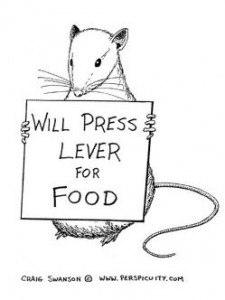 Animal research has shown that the best way to get a rat to press a pellet-producing lever is to set the mechanism so that it doesn’t always release a pellet with each push. The unpredictability (or scarcity) of the reward causes the rat to seek it with more fervor. Casino owners are well aware of this phenomenon, gaming our brain’s natural wiring so that our occasional wins drive us to lose more than we would if our winning had a predictable pattern.
I believe that the same principle is at work in physician reimbursement. Although most patients don’t realize this, physicians aren’t always paid for the work they do, and they are paid wildly different rates depending on how they code an encounter or procedure. After several health insurance denials of payment for legitimate work, physicians look for ways to offset their losses. Those may include changing the coding of their procedures to enhance the rate of reimbursement, exaggerating the complexity of an encounter, or (less commonly) billing for things they didn’t do. Because of the perceived injustice in a system that randomly denies payment for legitimate work, the physician feels less morally concerned about her over billing and coding foibles.
And so a vicious cycle of reimbursement deprivation, followed by fraud and abuse, becomes the norm in the U.S. healthcare system. Payers say that physicians are greedy and unethical, and physicians say that payers deny reimbursement unfairly and pay rates that are too low to be sustainable. The government’s response is to hire a cadre of auditors to ferret out physician fraud while cutting reimbursement to physicians further. This is similar to reducing the rate of pellet release to the rats in the Skinner boxes, while randomly electrocuting them through the metal flooring. The result will be that rats will work harder to find work-arounds to get their pellets, including gathering together into larger groups to share pellets. This is occurring more and more commonly as solo practitioners are joining hospitals or large group practices to make ends meet.
But we need to realize a few things about the “Skinner box healthcare system:”
1. Rats are not evil because they press levers manically when there is a scarcity of pellets. Physicians are not evil when they look for ways to make up lost revenue. While fraud and abuse are always wrong, it is not surprising that they are flourishing in an environment of decreasing reimbursement and increasing health insurance payment denials. If we want to address fraud and abuse, we need to understand why it’s happening so that our “solutions” (i.e. hiring thousands more government auditors to investigate medical practices) don’t end up being as useless as shocking the rats.
2. Health insurance (whether public or private) is not evil for trying to rein in costs. Payers are in the unenviable position of having to say “no” to certain expenditures, especially if they are of marginal benefit. With rats pressing levers at faster and faster rates for smaller and smaller pellets, all manner of cost containment mechanisms are being applied. Unfortunately they are instituted randomly and in covert manners (such as coding tricks and bureaucratic red tape) which makes the rats all the more manic. Not to mention that expensive technology is advancing at a dizzying rate, and direct-to-consumer advertising drives demand for the latest and greatest robot procedure or biotech drug. Costs are skyrocketing for a number of good and bad reasons.
3. There is a way out of the Skinner box for those primary care physicians brave enough to venture out. Insurance-free practices instantly remove one’s dietary reliance on pellets, therefore eliminating the whole lever pressing game. I joined such a practice several years ago. As I have argued many times before, buying health insurance for primary care needs is like buying car insurance for your windshield wipers. It’s overkill. Paying cash for your primary care allows you to save money on monthly insurance premiums (high deductible plans cost much less per month) and frees up your physician to care for you anywhere, anytime. There is no need to go to the doctor’s office just so that they can justify billing your insurance. Pay them for their time instead (whether by phone, in-person, or at your home/place of business) and you’ll be amazed at the convenience and efficiency derived from cutting out the middle men!
Conclusion: The solution to primary care woes is to think outside the box. Patient demand is the only limiting factor in the growth of the direct-pay market. Patients need to realize that they are not limited to seeing “only the physicians on their health insurance list” – there is another world out there where doctors make house calls, solve your problems on the phone, and can take care of you via Skype anywhere in the world. Patients have the power to set physicians free from their crazy pellet-oriented existence by paying cash for their health basics while purchasing a less expensive health insurance plan to cover catastrophic events. Saving primary care physicians from dependency on the insurance model is the surest path to quality, affordable healthcare for the majority of Americans. Will you join the movement?
May 4th, 2011 by Davis Liu, M.D. in Primary Care Wednesdays
Tags: Electronic Medical Records, Extinction, Family Medicine, Ideal Medical Practice, Kaiser, NYT, Primary Care, Solo Practice
No Comments »

 The New York Times recently published an article titled the Family Can’t Give Away Solo Practice wistfully noting that doctors like Dr. Ronald Sroka and “doctors like him are increasingly being replaced by teams of rotating doctors and nurses who do not know their patients nearly as well. A centuries-old intimacy between doctor and patient is being lost, and patients who visit the doctor are often kept guessing about who will appear in the white coat…larger practices tend to be less intimate”
As a practicing family doctor of Gen X, I applaud Dr. Sroka for his many years of dedication and service. How he can keep 4000 patients completely clear and straight in a paper-based medical system is frankly amazing. Of course, there was a price. His life was focused solely around medicine which was the norm of his generation. Just because the current cohort of doctors wish to define themselves as more than their medical degree does not mean the care they provide is necessarily less personal or intimate or that the larger practices they join need to be as well. Read more »
*This blog post was originally published at Saving Money and Surviving the Healthcare Crisis*
April 27th, 2011 by Dr. Val Jones in Opinion, Primary Care Wednesdays, True Stories
Tags: High Cholesterol, Hypercholesterolemia, Internal Medicine, Obesity, Obesity Counseling, Primary Care, Weight Loss
No Comments »
 A friend of mine is in great physical shape but her husband (we’ll call him “Mr. B”) has gained 40 pounds since they were married five years ago. He also has familial hypercholesterolemia, and several of his relatives have had heart attacks at young ages. Mrs. B is distraught – she is worried about her husband’s health, and has tried to gently nudge him towards healthier eating habits and regular exercise (as well as taking a statin for his cholesterol). Unfortunately, the nudges were received as nagging, and a wedge has formed between them in their relationship.
Last week my friend planned a trip to a primary care physician in the hopes that he would educate Mr. B about the dangers of being overweight and not treating his high cholesterol. “Surely Mr. B will listen to an expert” she thought, “then perhaps he’ll realize that he has to change his behavior.”
Unfortunately, the primary care physician didn’t offer any health counseling to Mr. B. Not only did he not mention that Mr. B should lose weight, but he didn’t provide any warnings about the dangers of untreated, very high cholesterol levels. He merely reported that Mr. B’s total cholesterol was 300, and that a statin was indicated.
Mrs. B was crestfallen. She was depending on the physician’s authoritative input to help her come up with a strategy to steer her husband towards better health. Now Mr. B was left with the impression that things were more-or-less ok, and that his wife’s concerns were exaggerated. Read more »
April 13th, 2011 by BobDoherty in Health Policy, Opinion, Primary Care Wednesdays
Tags: Accountable Care Organizations, ACOs, Cynicism, EMRs, HIT, Internal Medicine, Meaningful Use, P4P, Primary Care, Primary Care Models
No Comments »

When I talk to internal medicine audiences around the country about the latest health policy flavor of the day – accountable care organizations (ACOs) – a typical reaction is skepticism trending toward cynicism. Many don’t quite get what ACOs are all about and certainly don’t want to be lectured about how they need to re-invent their practices. And they don’t buy the idea that ACOs will somehow save internal medicine primary care. The same can be said, perhaps to a lesser extent, about their reactions to PCMHs (Patient-Centered Medical Homes), P4P ( pay-for-performance), HIT (health information technology), MU (meaningful use), and the whole alphabet soup of other reforms being proposed to reform health care delivery and payment systems.
And who can blame them? Older internists have seen this all before, and the word has gone out from them to medical students and younger doctors not to trust policy prescriptions that promise to save primary care. Read more »
*This blog post was originally published at The ACP Advocate Blog by Bob Doherty*
October 13th, 2010 by AlanDappenMD in Better Health Network, Health Policy, Opinion, Primary Care Wednesdays
Tags: DocTalker Family Medicine, Dr. Alan Dappen, Empowered Patients, General Medicine, Internal Medicine, Participatory Medicine, Patient Empowerment, Patient Participation, Patient-Doctor Relationship, Primary Care
No Comments »
No matter where one stands on appropriateness and advantages of each patient being involved in self-diagnosis and treatment of their own medical problems there are two inevitable conclusions:
• First of all, self diagnosis and treatment are as natural as breathing and as impossible to extinguish as thought itself.
• Secondly, given today’s healthcare system, there always will exist a dynamic tension between self-determination of the individual patient and the powerful healthcare system which often insists on patients falling back in line and complying with orders.
Few would argue against the need for a powerful alliance that embraces the benefits brought to the table by both the practitioner and the patient. Simplistically, the physician would carry the role of healthcare consultant and guidance while the patient ultimately becomes responsible for the choices. Read more »