November 21st, 2012 by Dr. Val Jones in Health Policy, Opinion
No Comments »
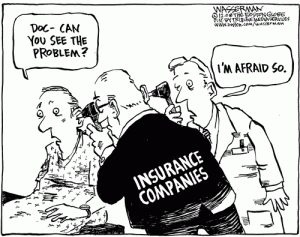 In a recent post entitled, “The Joys Of Health Insurance Bureaucracy” I described how it took me (a physician) over three months to get one common prescription filled through my new health insurance plan. Of note, I have still been unable to enroll in the prescription refill mail order service that saves my insurer money and (ostensibly) enhances my convenience. The prescription benefits manager (PBM) has lost three of my physician’s prescriptions sent to them by fax, and as a next step have emailed me instructions to complete an online form so that they have permission to contact my physician directly (to confirm the year’s refills). Unfortunately, page one of the form requires you to fill in your drug name and match it to their database’s list before you can continue to page two. For reasons I can’t understand, my common drug is not in their database. Therefore, I am unable to comply with my insurer’s wish that I enroll in mail order prescription refills. This will further delay receipt of my medication – and probably increase my cost as I will be penalized for not opting into the “preferred” mail order refill process.
Now, all of this is infuriating enough on its own, but the larger concern that I have is this: How many patients are not “compliant” with their medication regimen because of problems/delays with their health insurer or PBM? Physicians are being held accountable for their patients’ medication compliance rates, even receiving lower compensation for patients who don’t reach certain goals. This is called “pay-for-performance” and it’s meant to incentivize physicians to be more aggressive with patient follow up so that people stay healthier. But all the follow up in the world isn’t going to get patient X to take their medicine each day if their health insurer or PBM makes it impossible for them to get it in the first place. And shouldn’t there be consequences for such excessive red tape? Who is holding the insurers and PBMs accountable for their inefficiencies that prevent patients from getting their medicines in a timely manner?
Pay-for-performance assumes that physicians are the only healthcare influencers in the patient compliance cycle. I’ve learned that we only play a part in helping people stay on the best path for their health. Other key players can derail our best intentions, and it’s high time that we look at the poor performance of health insurers and PBMs as they often block (with intentional bureaucracy) our patients from getting the medicine they need. While insurers save money by having patients struggle to get their prescriptions filled, doctors are payed less when patients don’t take their medicines.
Not a great time to be a doctor or a patient… or both.
September 22nd, 2011 by Happy Hospitalist in Health Policy, Opinion
No Comments »

Ask yourself this question: Would you pay 20-30% less in insurance premiums if it meant you were locked into one hospital system for your health care? I would. That’s what one hospital system in Massachusetts is offering to provide. It is, essentially, a concierge hospital plan. You or your employer will pay a set premium, which the hospital is offering at a 20-30% discount, and you get all your health care needs in their system, only going to a competing hospital system if they are unable to provide your necessary services.
What a great idea. In fact, it’s an idea I have thought about previously for Happy’s hospital. Why shouldn’t Happy’s hospital offer direct premiums to large and small business employers in our city in exchange for reduced pricing? I’d sign up. My health insurance premiums cost over $12,000 a year. In the eight years of my practice, I’ve probably sent over $100,000 to health insurance companies and realized less than $10,000 in expenses.
It’s a concept who’s time has come. In fact, direct concierge hospital plans also offer patients and their employers the opportunity for tiered pricing for special amenities (flat screen television service, pet therapy dog service, dialysis spa, designer ostomy covers, wine vending machines, free soda machines, gourmet cookies, closer parking, door-to-door service, and 24 hour special access to their physicians and nursing staff).
No more worries about Read more »
*This blog post was originally published at The Happy Hospitalist*
September 16th, 2011 by BobDoherty in Health Policy, Opinion
No Comments »

Graduate Medical Education has for the most part escaped big budget cuts in the past, mainly because powerful lawmakers have aligned to protect funding for teaching hospitals in their own states and districts. Plus, the Association of American Medical Colleges, the American College of Physicians, hospital organizations, and many others long have made funding for GME a top legislative priority.
GME, though, could be on the chopping block as Congress’s new “Super Committee” comes up with recommendations to reduce the deficit by at least $1.2 trillion over the next decade. A report from the Congressional Budget Office of options to reduce the deficit to suggests that $69.4 billion could be saved over the next decade by consolidating and reducing GME payments. Earlier this year, the bipartisan Fiscal Commission on Fiscal Responsibility and Reform also proposed trimming GME payments.
How then should those who believe that GME is a public good respond? One way is to circle the wagons and just fight like heck to stop the cuts. But that raises a basic question: is GME so sacrosanct that there shouldn’t be any discussion of its value and whether the current financing structure is effective and sustainable?
Another approach, the one taken by the ACP in a position paper released last week, is to Read more »
*This blog post was originally published at The ACP Advocate Blog by Bob Doherty*
July 25th, 2011 by Edwin Leap, M.D. in Opinion
No Comments »

For years now, we’ve all heard the drum-beat. Bill-boards in cities have proclaimed it. Various medical associations have touted it’s importance. Stroke symptoms have to be treated immediately! Give clot-busting drugs, also known as ‘thrombolytics!’
Until, of course, those in favor of giving the drugs (namely neurologists) realized that a) Not everyone with a stroke, aka ‘brain attack’ has insurance and b) people have a very inconsiderate habit of having said strokes at the most inconvenient of hours. For instance, after 5PM, on the weekend, on holidays. The nerve!
So across the country, physicians in emergency departments like mine are finding themselves expected by the court of public opinion to give a potentially dangerous drug (albeit a sometimes useful drug) without any neurologist being available to evaluate the patient. Our emergency department thought we had a tele-medicine link; even that has failed, as nearby physicians in our regional referral center don’t feel keen to take responsibility for our patients. Our own neurologists, of course, have Read more »
*This blog post was originally published at edwinleap.com*
July 20th, 2011 by Stanley Feld, M.D. in Health Policy, Opinion
No Comments »

President Obama, where is your promise about transparency and accountability in Obamacare?
A major problem in the healthcare system is the lack of transparency and accountability. It has been unchecked for a very long time.
Both primary and secondary stakeholders act in their self-interest. These stakeholders have had ample opportunity to be non-transparent and non-accountable. All the stakeholders have abused the healthcare system.
I hit a nerve with my last blog “Patients And Physicians Must Control Costs”. Multiple readers responded with the usual comments:
“Patients are not smart enough to handle their own healthcare dollars.”
“Your basic idea makes sense, but in reality I doubt that a patient knows enough to make intelligent medical/financial decisions, because there are too many unknowns and variables.”
“Physicians over use the fee for service system in order to make more money.”
“If a physician tells a patient that there is only a 1/10,000 chance that an MRI will yield something useful, if the patient doesn’t have to pay for it, the patient wants the MRI.
Patients (consumers) must be taught and motivated to manage their own healthcare dollars. Patients’ choice Read more »
*This blog post was originally published at Repairing the Healthcare System*