September 9th, 2015 by Dr. Val Jones in Health Tips, True Stories
1 Comment »
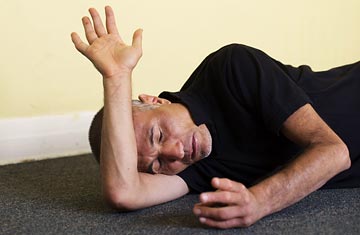
Photo Cred: Max S. Gerber
I learned a valuable lesson recently about how difficult it can be to make the correct diagnosis when you see a patient for a very short period of time. In the acute rehab setting I admit patients who are recovering from severe, life-altering brain events such as strokes, head injuries, and complex medical illnesses. It is challenging to know what these patients’ usual mental function was prior to their injuries, and so I rely on my knowledge of neuroanatomy, infectious disease, and pharmacology to guide my work up. However, I have learned that asking the patient’s family members about what they were like (in their healthier state) is extremely important as well. Personality quirks, likes and dislikes, and psychiatric history all offer clues to ongoing behavioral challenges and mental status changes.
This fact was never clearer than when I met an elderly gentleman with a new stroke. He was extremely drowsy, non-participatory, and was not oriented to anything but his name. The stroke had occurred in a part of the brain that does not affect cognition, so I began to wonder if he had an infection or was having a reaction to a medication. I carefully ruled out all possible sources of infection, and I combed through his medication list and removed any potentially sedating drugs. His mental status remained unchanged for several days. I then began to wonder if perhaps he was suffering from significant dementia at baseline, and that he was living at home with more help from his family than they had initially reported. The therapy team and I began to consider a transfer to a nursing home. The family was horrified by the idea.
As it turned out, his grandson shared with me that he believed that the patient was autistic. Because his grandpa was elderly, he grew up in a time where not much was known about autism, and diagnoses of the condition was rarely made. He was therefore never formally diagnosed, but had many of the textbook characteristics. His stroke, combined with a sudden transfer to an inpatient hospital setting, was very distressing for the patient, and he had shut down to protect himself from the mental anguish. The “dementia-like” behavior that we were witnessing was merely an acute psychological reaction.
Armed with this new information, the therapy team requested family members to be present during all sessions – to encourage participation and to provide comfort and normalization of the transition from home to hospital. The patient responded beautifully, and made remarkable gains in his ability to walk and participate in self care activities.
I apologized profusely to the family for our period of confusion about his diagnosis and care needs, and offered reassurance that we would do our very best to help him recover from his stroke so that he could go home directly from the hospital. He did in fact return home, and with a little extra help from his daughters, he is enjoying his usual projects and activities.
As for me, I will never presume dementia without careful family confirmation again.
December 5th, 2011 by ErikDavis in Opinion, Quackery Exposed, Research
No Comments »

Source
There has been much abuzz about “pox parties” – the practice of parents getting a bunch of unvaccinated kids together with an infected one (pick one, really, though chicken pox is the focus of the recent article in Time) in the hope that their little sweethearts become ill and therefore “naturally” immune to the disease. This deliberate infection involves things as seemingly innocent as breathing the same air as the infected to the stomach-turning sharing of bodily fluids (Saliva lemonade, anyone?). To compound the issue, it seems that parents aren’t always taking into account how the viruses are transmitted, and end up trying oral transmission to transmit a disease that is transmitted through the air. And yes, the whole thing is as stupid as it seems.
Given that the people partaking in these events have likely not vaccinated their children against anything else, these parties could be a source point for multiple highly contagious infections. Most of us have had chicken pox as children and don’t remember it fondly – now imagine having chicken pox with mumps, mono, and maybe a little hepatitis A to top it off. It is also easy to forget in Western luxury that these innocuous childhood illnesses are actually lethal. Just measles? Well, one death per 3000 measles infections might not seem like much, until you consider the fact that in 2008, 164,000 people died of the measles worldwide – approximately the same number of civilians that have died in the entire length of the current Iraq war. That’s an annual number, and it’s gone down by almost 80% over 10 years. How? Read more »
*This blog post was originally published at Skeptic North*
November 7th, 2011 by RyanDuBosar in Research
No Comments »


Human brains have a consistent molecular architecture despite all the other genetic differences across individuals and ethnicities, according to two studies that recorded when and where genes turn on and off in multiple brain regions throughout life.
Despite individual and ethnic genetic diversity, the human prefrontal cortex shows a consistent molecular architecture, as shown in this picture. The vertical span of color-coded areas is about the same, indicating that our brains all share the same tissue at a molecular level, despite distinct DNA differences on the horizontal axis. Each dot represents a comparison between two individuals.
The research appeared in the Journal Nature and was described by the National Institutes of Health in a press release.
The first study focused on Read more »
*This blog post was originally published at ACP Internist*
July 12th, 2011 by Toni Brayer, M.D. in Opinion, Research
No Comments »

 Two news events got people talking recently. One was that Casey was deemed not guilty of killing little daughter Caylee ( “O.J. all over again”, I heard repeatedly). I must admit I was rather surprised….
The second was the results of two new studies that were published in the Archives of General Psychiatry. One of them stated that environmental factors during pregnancy might contribute as much as genetics in the development of autism spectrum disorders. The 2nd study conducted by Kaiser Permanente Northern California found a 3 times higher risk of autism if the mother took antidepressants in the first trimester of pregnancy.
With the incidence of autism disorders increasing over time to the current range of 3-6 per 1,000 births, these studies are of interest to millions of parents and professionals. Autism affects boys at a rate of three times more than girls, and is usually detected by the age of 3. The cause has been maddeningly unknown.
While genes certainly play a part (as they do in most every disorder) other theories and assertions have been disproven. It certainly does not have anything to do with “poor mothering” or “lack of maternal bonding”. Those theories did more harm than bloodletting in the 19th century! The link between autism and vaccines has been thoroughly debunked. If you believe in science and research, you must believe that vaccines are not the cause and finally leave that one in the dust. Read more »
*This blog post was originally published at EverythingHealth*
June 21st, 2011 by Harriet Hall, M.D. in Health Tips, Research
No Comments »

Science has found no evidence that vaccines cause autism; but the true cause(s) of autism have not yet been determined. So far the available evidence has pointed towards a largely genetic cause with possible interaction with environmental factors. A new study supports that interpretation. It also supports previous evidence that autism is triggered prior to birth, rather than at the time of vaccinations.
Schmidt et al. published a study in Epidemiology on May 23, 2011, entitled “Prenatal Vitamins, One-carbon Metabolism Gene Variants, and Risk for Autism.” It was a population-based case control study of 566 subjects comparing a group of autistic children to a matched control group of children with normal development. They looked at maternal intake of prenatal vitamins in the 3 months before conception and the first month of pregnancy, and they looked for genotypes associated with autism. They found that mothers who didn’t take prenatal vitamins were at greater risk of having an autistic child, and certain genetic markers markedly increased the risk. There was a dose/response relationship: the more prenatal vitamins a woman took, the less likely she would have an autistic child. There was no association with other types of multivitamins, and no association with prenatal vitamin intake during months 2-9 of pregnancy.
They had a large sample size, and they tried to eliminate confounders. They looked for these potential confounders of the association between prenatal vitamin intake and autism: child’s sex, birth year, parent-reported race/ethnicity, family history of mental health conditions, paternal age at child’s birth, maternal age at child’s birth, education, prepregnancy body mass index (BMI) category, cereal intake from 3 months before through the first month of pregnancy, cigarette smoking, alcohol consumption, and residence with a smoker during the period 3 months before pregnancy to delivery. Only maternal education and the child’s year of birth proved to be confounders. They adjusted for these two factors in their analyses. A weakness of their study is that it depends on patient recall long after the fact. Also, it did not attempt to gather any diet information.
Mothers of children with autism were less likely to report taking prenatal vitamins (odds ratio 0.62). Having certain genotypes increased the odds that a vitamin-omitting woman would have an autistic child. Children with the COMT 472 AA gene were at increased risk of autism. If their mothers took prenatal vitamins, the odds ratio for the risk of autism was 1.8; if their mothers didn’t, the odds ratio jumped to 7.2. This suggests that the maternal-fetal environment can magnify the effects of a child susceptibility gene. There was an association with certain maternal genes as well: those odds ratios went as high as 4.5.
The association was robust. The authors think Read more »
*This blog post was originally published at Science-Based Medicine*