September 26th, 2011 by PJSkerrett in Health Tips
No Comments »

The death of Kara Kennedy, the only daughter of the late Senator Edward M. Kennedy, at age 51 from an apparent heart attack while exercising, was yet another tragedy for one of the country’s most prominent political families. It also offers a reminder of the possible long-term effects of cancer and its treatment.
In 2002, Kennedy was diagnosed with lung cancer that her doctors initially said was inoperable. Her father refused to accept that diagnosis, according to an article in the Boston Globe. He found doctors at Brigham and Women’s Hospital in Boston who thought they could treat the cancer. They removed a portion of Ms. Kennedy’s right lung and then administered radiation and chemotherapy. She lived for another nine years, in apparently good health.
While the cause of Kennedy’s death has not yet been confirmed, the long-term effects of her lung cancer treatment could have played a role. Cancer survivors are often at increased risk of heart disease. That’s because the treatments used to fight cancer—drugs, radiation, and hormones—can damage the heart and arteries. (These are detailed in a Harvard Heart Letter article on cancer therapy and heart disease.)
If life were completely fair, cancer survivors would be exempt from future health problems. Sadly, that isn’t the case. Read more »
*This blog post was originally published at Harvard Health Blog*
August 23rd, 2011 by DavidHarlow in Health Policy, News
No Comments »

 Partners Health Care (the dominant provider network in Greater Boston) and Neighborhood Health Plan (a local mostly-Medicaid HMO) just announced that the former intends to acquire the latter, and maintain it as a separate operating entity. No money will change hands between the parties, but an unspecified amount of money will be given by Partners as grants to community health centers where NHP members receive much of their health care services. Gary Gottlieb, CEO of Partners, graciously allowed that it would not seek to interfere with the current referral patterns of NHP members to the two local safety-net hospitals (which get disproportionate share hospital payments; Partners hospitals do not).
The deal is contingent on several layers of regulatory review, including Read more »
*This blog post was originally published at HealthBlawg :: David Harlow's Health Care Law Blog*
January 21st, 2011 by DavedeBronkart in Health Tips, Opinion
No Comments »

There are several stages in becoming an empowered, engaged, activated patient — a capable, responsible partner in getting good care for yourself, your family, whoever you’re caring for. One ingredient is to know what to expect, so you can tell when things seem right and when they don’t.
Researching a project today, I came across an article* published in 2006: “Key Learning from the Dana-Farber Cancer Institute’s 10-Year Patient Safety Journey.” This table shows the attitude you’ll find in an organization that has realized the challenges of medicine and is dealing with them realistically:
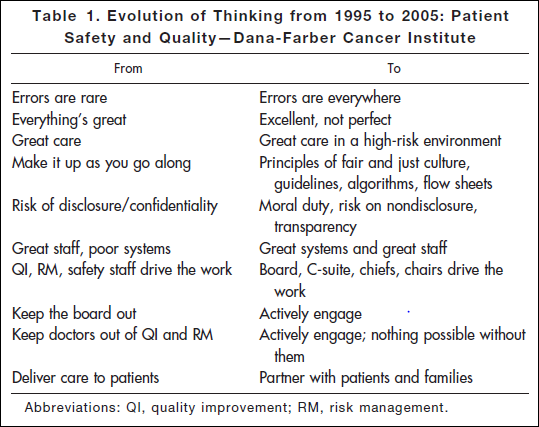
“Errors are everywhere.” “Great care in a high-risk environment.” What kind of attitude is that? It’s accurate.
This work began after the death of Boston Globe health columnist Betsy Lehman. Long-time Bostonians will recall that she was killed in 1994 by an accidental overdose of chemo at Dana-Farber. It shocked us to realize that a savvy patient like her, in one of the best places in the world, could be killed by such an accident. But she was.
Five years later the Institute of Medicine’s report “To Err is Human” documented that such errors are in fact common — 44,000 to 98,000 a year. It hasn’t gotten better: Last November the U.S. Inspector General released new findings that 15,000 Medicare patients are killed in U.S. hospitals every month. That’s one every three minutes. Read more »
*This blog post was originally published at e-Patients.net*
November 17th, 2010 by John Mandrola, M.D. in Better Health Network, News, Opinion
No Comments »

The best part of doctoring is its humanness. Machines can’t do it — not even Apple products.
But that’s the worst part, too. Since humans practice medicine, there will be “medical errors.” And when doctors err, people — not spreadsheets or profits — are hurt. That’s the rub. Like any endeavor, the greater the reward the greater the risk. Those cards were put on the table in medical school.
“Don’t want mistakes? Don’t do anything. Don’t make any decisions. Don’t do any procedures. Then, there will be no errors,” the grey-haired, Swiss-born cardiac surgeon counseled me many years ago after an imperfect ablation.
The headline was about a doctor’s error. It was a doozy. But for me, the story belies the headline. A Boston Globe reporter called a surgeon’s public admission of performing a wrong operation “an unusual display of openness.” I would call it something else: Breathtaking. Unprecedented. Courageous. Read more »
*This blog post was originally published at Dr John M*
November 1st, 2010 by EvanFalchukJD in Better Health Network, Health Policy, News, Opinion
1 Comment »

You want to see a doctor? You’re going to have to wait. And I don’t mean like an hour in the office. I mean like 53 days.
It’s not some doomsday story from the future. It’s happening today here in Massachusetts. Massachusetts — the state whose 2006 law was the model for the federal healthcare reform law. Massachusetts — home to some of the world’s best medical centers and doctors. And, as the Boston Globe’s “White Coat Notes” blog reports, Massachusetts — home to doctor shortages and long waits to see a doctor:
When primary care patients do secure an appointment for a non-urgent matter, they have to wait to get in the door, the survey found. The average delay is 29 days to see a family medicine doctor, down from 44 days last year, and 53 days to see an internist, up from 44 days last year.
The report said shortages also exist in dermatology, emergency medicine, general surgery, neurology, orthopedics, psychiatry, urology, and vascular surgery.
But what about costs? If you make sure everyone’s covered, you’ve got the foundation for real cost control, right? Unfortunately, no. Healthcare costs have been booming in Massachusetts:
Costs are rising relentlessly for both families and for the state government. The median annual premium for family plans jumped 10% from 2007 to 2009 to $14,300 — again, that’s a substantial rise on top of an already enormous number. For small businesses, the increase was 12%. In 2006, the state spent around $1 billion on Medicaid, subsidies for medium-to-lower earners, and other health-care programs. Today, the figure is $1.75 billion. The federal government absorbed half of the increase.
So what are the lessons for the future of American healthcare? Read more »
*This blog post was originally published at See First Blog*