Animal research has shown that the best way to get a rat to press a pellet-producing lever is to set the mechanism so that it doesn’t always release a pellet with each push. The unpredictability (or scarcity) of the reward causes the rat to seek it with more fervor. Casino owners are well aware of this phenomenon, gaming our brain’s natural wiring so that our occasional wins drive us to lose more than we would if our winning had a predictable pattern.
I believe that the same principle is at work in physician reimbursement. Although most patients don’t realize this, physicians aren’t always paid for the work they do, and they are paid wildly different rates depending on how they code an encounter or procedure. After several health insurance denials of payment for legitimate work, physicians look for ways to offset their losses. Those may include changing the coding of their procedures to enhance the rate of reimbursement, exaggerating the complexity of an encounter, or (less commonly) billing for things they didn’t do. Because of the perceived injustice in a system that randomly denies payment for legitimate work, the physician feels less morally concerned about her over billing and coding foibles.
And so a vicious cycle of reimbursement deprivation, followed by fraud and abuse, becomes the norm in the U.S. healthcare system. Payers say that physicians are greedy and unethical, and physicians say that payers deny reimbursement unfairly and pay rates that are too low to be sustainable. The government’s response is to hire a cadre of auditors to ferret out physician fraud while cutting reimbursement to physicians further. This is similar to reducing the rate of pellet release to the rats in the Skinner boxes, while randomly electrocuting them through the metal flooring. The result will be that rats will work harder to find work-arounds to get their pellets, including gathering together into larger groups to share pellets. This is occurring more and more commonly as solo practitioners are joining hospitals or large group practices to make ends meet.
But we need to realize a few things about the “Skinner box healthcare system:”
1. Rats are not evil because they press levers manically when there is a scarcity of pellets. Physicians are not evil when they look for ways to make up lost revenue. While fraud and abuse are always wrong, it is not surprising that they are flourishing in an environment of decreasing reimbursement and increasing health insurance payment denials. If we want to address fraud and abuse, we need to understand why it’s happening so that our “solutions” (i.e. hiring thousands more government auditors to investigate medical practices) don’t end up being as useless as shocking the rats.
2. Health insurance (whether public or private) is not evil for trying to rein in costs. Payers are in the unenviable position of having to say “no” to certain expenditures, especially if they are of marginal benefit. With rats pressing levers at faster and faster rates for smaller and smaller pellets, all manner of cost containment mechanisms are being applied. Unfortunately they are instituted randomly and in covert manners (such as coding tricks and bureaucratic red tape) which makes the rats all the more manic. Not to mention that expensive technology is advancing at a dizzying rate, and direct-to-consumer advertising drives demand for the latest and greatest robot procedure or biotech drug. Costs are skyrocketing for a number of good and bad reasons.
3. There is a way out of the Skinner box for those primary care physicians brave enough to venture out. Insurance-free practices instantly remove one’s dietary reliance on pellets, therefore eliminating the whole lever pressing game. I joined such a practice several years ago. As I have argued many times before, buying health insurance for primary care needs is like buying car insurance for your windshield wipers. It’s overkill. Paying cash for your primary care allows you to save money on monthly insurance premiums (high deductible plans cost much less per month) and frees up your physician to care for you anywhere, anytime. There is no need to go to the doctor’s office just so that they can justify billing your insurance. Pay them for their time instead (whether by phone, in-person, or at your home/place of business) and you’ll be amazed at the convenience and efficiency derived from cutting out the middle men!
Conclusion: The solution to primary care woes is to think outside the box. Patient demand is the only limiting factor in the growth of the direct-pay market. Patients need to realize that they are not limited to seeing “only the physicians on their health insurance list” – there is another world out there where doctors make house calls, solve your problems on the phone, and can take care of you via Skype anywhere in the world. Patients have the power to set physicians free from their crazy pellet-oriented existence by paying cash for their health basics while purchasing a less expensive health insurance plan to cover catastrophic events. Saving primary care physicians from dependency on the insurance model is the surest path to quality, affordable healthcare for the majority of Americans. Will you join the movement?
Starting April 1, patients at Pacific Heart Institute can choose one of four plans for care. In the first option, they pay no “participation fee.” In the second option, called “Select,” they pay $500 a year for priority appointments, warfarin adjustments, defibrillator and pacemaker follow-up, notification of non-urgent lab, and test results, according to Pacific Heart Institute.
In the third option, called “Premier,” they pay $1,800, for everything in “Select,” plus e-mail communication with their doctor, same-day visits during regular office hours, priority lab testing and scheduling of diagnostics, free attendance at speaker seminars on cardiovascular issues, and a dedicated phone line to reach an institute nurse.
In the fourth option, “Concierge,” they pay $7,500 for everything in “Premier,” plus direct 24-hour access to a cardiologist via pager, e-mail, text message, plus the patient’s PHI cardiologist’s personal cell phone, annual personalized cardiovascular wellness screening, night and weekend access to a PHI cardiologist for hospital or emergency services, (regardless of whether he or she is on call) same-day visits with the cardiologist, evening and weekend office appointments and personal calls from the cardiologist.
-WesMusings of a cardiologist and cardiac electrophysiologist.
*This blog post was originally published at Dr. Wes*
In his past few posts, DrRich has offered a substantive criticism of the new code of medical ethics which has now been formally adopted by over 120 physicians’ organizations across the globe. (See here, here and here.) Fundamentally, the New Ethics abrogates the physician’s classic obligation to always place the welfare of their individual patients first, by adding to it a new and competing ethical obligation (called Social Justice), which requires doctors to work toward “the fair distribution of healthcare resources.”
The New Ethics was explicitly born of the frustration felt by physicians as a result of the multitude of coercions the payers have thought up to force them to place the needs of the payers (the proxy for “society”), ahead of the needs of their patients. Thanks to the New Ethics, doctors can now bend to this coercion without violating their ethical standards. Read more »
When I describe our medical practice, most people really like the concept: Our medical team at DocTalker (board certified doctors and a nurse practitioner) answers all the incoming patient phone calls and emails directly, solving over 50% of our patients needs remotely and conducts office visits and house calls when needed even at night and on weekends. People ooh and aah, offering praise: “What a good idea!” … “You’re really ‘retro’ — just like the quaint, old-fashioned doctor my grandparents used to describe so fondly” … “I wish my doctor did that!”
Yet there is a point at which our concept “loses” people, and it is when we describe that we have opted out of Medicare and sign no contracts with insurance companies. We are not preferred providers for anyone except our patients, and therefore no one is interfering with our relationship or telling us how to do our job.We have dismissed all of the parties that create conflicts of interest between ourselves and the patients, including those that add higher costs (e.g. drug reps or pay-for-performance administrators);or create conflicts of interest that interfere with the doctor- patient relationship (e.g. insurance) and the ability to deliver accessible, high-quality care (e.g. billing, coding, and administration organizations).
Instead we have moved to a transparent, time-based fee structure so that our clients can police our charges. Time is time. We make our living offering advice and time, no gimmicks, no sales.It’s that simple. If you don’t want to pay us for the time it takes to do the right thing for the right reason, or to be in control of when and how and who controls your health decisions, then we’re not the practice for you.
After this explanation, we typically get one of two responses:
1) “Thank you very much, but I just lost interest.”
or
2), “Oh, you’re a concierge doctor.”
We have come to expect the first response. The idea of paying directly for a service in healthcare remains foreign to most. The vast majority of Americans have been “socialized” over the years that paying monthly insurance premiums and adopting a co-pay model protect them from worrying about price from the often predatory and non-transparent pricing habits of the healthcare industry at large.
To the second response, we say that we are like a concierge practice … just priced for almost everyone. To begin with, we deliver a concierge level of care: comprehensive primary care, answering phones and emails directly, trying to deliver care whenever wherever and however its needed, seeing patients on the same day, being available to talk 24/7 no matter where a patient may be in the U.S., and even coming to a patient’s home at 3 AM if needed. We are doctors and want to do what’s best for our patients.
But after this point, the DocTalker model and others like it add a whole new dimension to the concierge model, thus requiring a category unto itself. We offer this high level of care for almost everyone because we make accessing quality care so affordable. About 75% of the members of our practice get all the day-to-day health care they need every year for less than $300/year.This is much less than the amount of money than the $1500/year membership fee required of many concierge practices which basically puts a premium price on access before they even begin to bill your insurance company.
Practices like ours expect to be busy, have to take care of many people of all ages and socioeconomic status, maintain active panels of patients approaching 2000, don’t expect to make tons of money while trying our hardest to give you the best service at the best price we can. We love primary care, want the best for our patients, and this is why we do it.
Our “Back to the Future” medical practice restores an integrity, balance, affordability and quality to healthcare that people need. It also delivers concierge level of service at a price that’s much less than most out there. Even President Obama says he’s looking for examples of better access, higher quality, at a lower price. There are others like us out there, including HelloHealth and Greenfield Health.
It’s not complicated to get accessible, affordable care and high quality primary care again once all the layers are eliminated of well intended administrators and obfuscators getting in the way of a doctor and any one seeking help.
It may not be complicated, but it’s not easy to find. There just aren’t enough of us yet. In the meantime, please excuse my sensitivity to the word “concierge.”I prefer phrases for this emerging movement like “patient-controlled primary care,” or “no nonsense care,” or”patients first.”
Dr. Alan Dappen, Dr. Steve Simmons, and nurse practitioner Valerie Tinley are regular contributors to the Better Health blog. I’m a big fan of their innovative medical practice, and decided to follow them during one of their work days as they deliver affordable, quality healthcare to patients in Virginia.
This is how primary care used to be… and a model that deserves more attention.
It’s no secret that doctors are disappointed with the way that the U.S. healthcare system is evolving. Most feel helpless about improving their work conditions or solving technical problems in patient care. Fortunately one young medical student was undeterred by the mountain of disappointment carried by his senior clinician mentors…
I am proud to be a part of the American Resident Project an initiative that promotes the writing of medical students residents and new physicians as they explore ideas for transforming American health care delivery. I recently had the opportunity to interview three of the writing fellows about how to…
I m often asked to do book reviews on my blog and I rarely agree to them. This is because it takes me a long time to read a book and then if I don t enjoy it I figure the author would rather me remain silent than publish my…
When I was in medical school I read Samuel Shem s House Of God as a right of passage. At the time I found it to be a cynical yet eerily accurate portrayal of the underbelly of academic medicine. I gained comfort from its gallows humor and it made me…
I am hesitant to review diet books because they are so often a tangled mess of fact and fiction. Teasing out their truth from falsehood is about as exhausting as delousing a long-haired elementary school student. However after being approached by the authors’ PR agency with the promise of a…


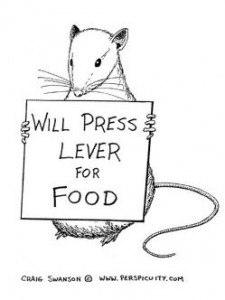 Animal research has shown that the best way to get a rat to press a pellet-producing lever is to set the mechanism so that it doesn’t always release a pellet with each push. The unpredictability (or scarcity) of the reward causes the rat to seek it with more fervor. Casino owners are well aware of this phenomenon, gaming our brain’s natural wiring so that our occasional wins drive us to lose more than we would if our winning had a predictable pattern.