May 20th, 2015 by Dr. Val Jones in Health Tips, True Stories
1 Comment »
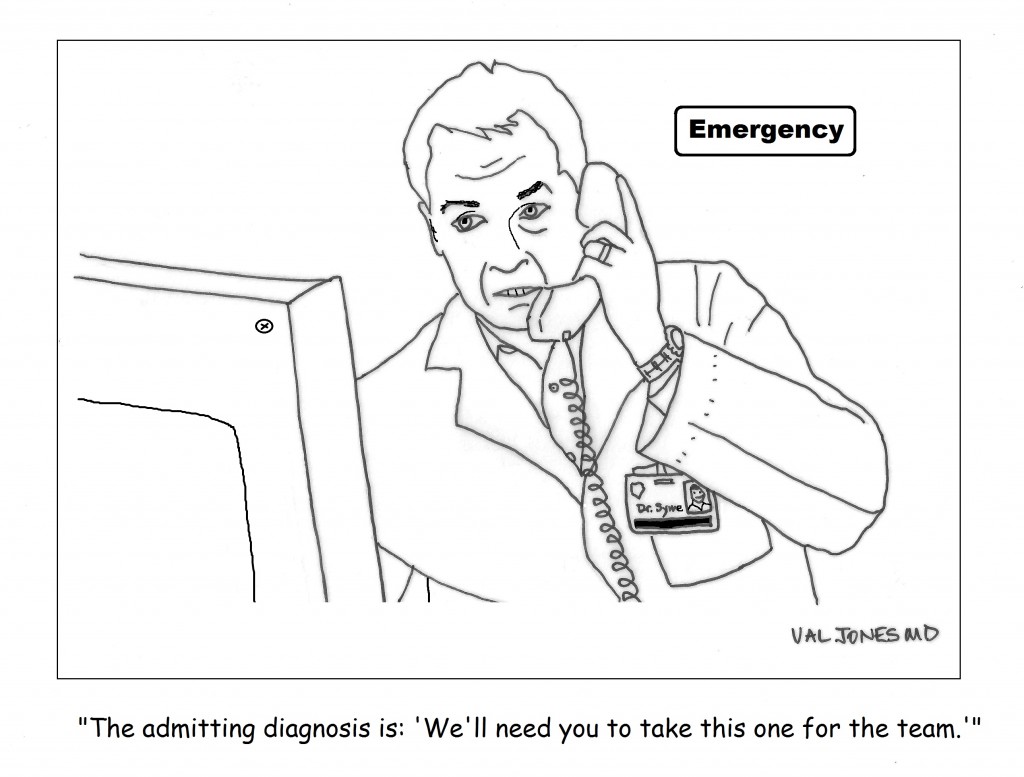
 Like most physicians, I feel extremely rushed during the course of my work day. And every day I am tempted to cut corners to get my documentation done. The “if you didn’t document it, it didn’t happen” mantra has been beaten into us, and we have become enslaved to the quantitative. It’s tempting to rush through physical exams, assuming that if there’s anything “really bad” going on with the patient, some lab test or imaging study will eventually uncover it. Just swoop in, listen to the anterior chest wall, ask if there’s any new pain, and dash off to the next hospital bed. Then we construct a 5-page progress note in the EMR, describing the encounter, our assessment, and plan of care.
Focused physical exams have their place in follow up care, but I strongly urge us all to reconsider skimping on our exams. A fine-toothed comb should be used in any first-time meeting – because so much can be missed as we scurry about. Some examples of things I discovered during careful examination:
1. A pulsatile abdominal mass in a woman being worked up for dizziness.
2. New slurred speech in an edentulous gentleman with poorly controlled hypertension.
3. A stump abscess in a 2-year-old leg amputation.
4. A bullet lodged in the scrotum.
5. Countless stage 1 sacral decubitus and heel ulcers.
6. Melanoma.
7. Rashes that were bothering the patient for years but had not previously been addressed and cured.
8. Early cellulitis from IV site.
9. Deep venous thrombosis of the calf.
10. New onset atrial fibrillation.
11. Thrush.
12. Cataracts.
13. Peripheral neuropathies of various kinds.
14. Lateral medullary syndrome.
15. Surgical scars of all stripes – indicating previous pathology and missing organs of varying importance.
16. Normal pressure hydrocephalus in a patient who had been operated on for spinal stenosis/scoliosis.
17. Parkinson’s Disease in a patient with a fractured hip.
18. Shingles in a person with eye pain.
19. Aortic stenosis in a woman with dizziness.
20. Pleural effusions in a man complaining of anxiety.
Oftentimes I don’t find anything new and exciting that is not already a part of the patient’s medical record. But a curious thing happened to me the other day that made me reflect on the importance of the physical exam. After a careful review of a complex patient’s history, I discussed every scar and “abnormality” I discovered as I did a thorough head-to-toe review of his physical presentation. His aging body revealed more than he had remembered to say… and as our exam drew to a close, he reached out and offered me a fist-bump.
It was charming and unexpected – but made me realize the true importance of the thorough exam. I had gotten to know him in the process, I had earned his trust, and we had built the kind of therapeutic relationship upon which good healthcare is based. No EMR documentation effort was worth missing out on this interaction.
You may not uncover a new diagnosis on each physical exam, but you can gain something just as important. The confidence and respect of the patient.
February 11th, 2013 by Dr. Val Jones in Opinion
1 Comment »
 Although most doctors say they believe in the immediate free flow of information from physician to patient, the reality is that many hospitalized patients don’t receive a full explanation of their condition(s) in a timely manner. I’ve seen patients go for days (and sometimes weeks) without knowing, for example, that their biopsy was positive for cancer when the entire medical staff was clear on the diagnosis and prognosis. So why are patients being kept in the dark about their medical conditions? I think there are several contributing factors:
1. Too many cooks in the kitchen. During the course of a hospital stay, patients are often cared for by multiple physicians. Sometimes it’s unclear who should be the first to give a patient bad news. Should the news come from their primary care physician (who presumably has a long standing, trusting relationship with the patient) or the surgeon who removed the mass but doesn’t know the patient well? In many cases each assumes/hopes the other will give the patient the unpleasant news, and so the patient remains in the dark.
2. Family blockades. It often happens that a patient’s spouse or family member will request that news of an unpleasant diagnosis be delayed. They argue that it would be best for the patient to feel better/get stronger before being emotionally devastated by a test result. In some cases the family may be right – grief and shock could impair their participation in recovery efforts, resulting in worse outcomes. Cultural differences remain regarding how patients like to receive information and how families expect to be involved in care. American-style, full, immediate disclosure directly to the patient may be considered rude and inappropriate.
3. Uncertainty of diagnosis. Sometimes a clear diagnosis only develops with time. Biopsy results can be equivocal, the exact type of tumor may be unclear, and radiology reports may be suggestive but not diagnostic. Some physicians decide not to say anything until all the results are in. They cringe at the prospect of explaining uncertainty to patients, and without all the answers they’d rather avoid the questions. What if it looks as if a patient has a certain disease but further inquiry proves that she has something else entirely? Is it right to frighten the patient with possibilities before probabilities have been established?
Although sensitivity must be applied to the nuances of individual care scenarios, my opinion is that patients should be immediately informed of their test results and their physician’s thought processes at every step along the diagnostic pathway. Family member preferences, however well-meaning they are, cannot trump the individual’s right to information about their health. If physicians are unclear regarding which of them should break the news to a patient then they should confer with one another and come up with a plan ASAP.
The right time to tell the patient the truth is: now. To my colleagues who avoid giving patients information because it is personally uncomfortable (often leaving me or other third party to be the messenger), I have two words: “man up.”
January 2nd, 2012 by EvanFalchukJD in Health Policy, Opinion
No Comments »

How Did My 2011 Predictions Turn Out?
Pretty well, actually.
As predicted last December, there was no big change to health care reform, doctors still didn’t have enough time with their patients, Microsoft (disclosure: Microsoft is a Best Doctors client) made moves to create a “Windows” for electronic health records, and “ACO” became the hot buzzword in health care. Some state governments started major redesigns of their benefits programs, saving money in the same ways private sector employers do. Meanwhile, more than ever, private sector employers are penalizing employees who don’t take care of themselves.
Misdiagnosis finally started to be recognized as a public health problem. At Best Doctors we got a great deal of press coverage in 2011 on this (for a few examples, go here, here, here, here and here). I will sneak in a 2012 prediction and tell you that you will hear a lot more about this this year, and not just from us.
What did I get wrong? Read more »
*This blog post was originally published at BestDoctors.com: See First Blog*
December 31st, 2011 by Toni Brayer, M.D. in News, Opinion
2 Comments »

 |
| Kwashiorkor in Niger |
Is it plausible that one small hospital in rural Northern California treated 1,030 cases of Kwashiorkor within a two year period?
Before you answer that, let me explain what Kwashiorkor is. It is a severe form of protein malnutrition…starving to death actually. It is the type of starvation you see in African children. It is so severe that the patient needs special nutritional support including special re-feeding with vitamins and it occurs mainly in children ages 1-4. Adults can starve to death, but they do not develop classic Kwashiorkor.
Medicare pays hospitals a flat rate based on diagnosis codes for patients. Patients with more severe coded illnesses get paid at a much higher rate. Shasta Regional Medical Center, located in Redding, Shasta County, California is under the microscope for billing Medicare (our tax dollars at work) for 1,030 cases of Kwashiorkor to the tune of $11,463 for each diagnosis. This medical center is Read more »
*This blog post was originally published at EverythingHealth*