March 6th, 2011 by Paul Auerbach, M.D. in Better Health Network, Health Tips
No Comments »

 This is a guest post by Dr. Erik McLaughlin.
**********
Traveler’s Diarrhea: The Basics
Known around the world by many names including “Montezuma’s revenge,” “Delhi belly” and “mummy tummy,” traveler’s diarrhea (TD) is the most common illness faced by travelers. Nothing can slow down a fun trip as easily as TD — and it can also have serious health implications. TD typically lasts four to six days, and 90 percent of cases occur within the first two weeks of travel.
Anatomy You Need to Know
The gastrointestinal tract starts at the mouth and ends at the anus. After food enters the mouth, it passes through the esophagus to the stomach, where it sits for approximately 45 minutes. After being broken down by gastric secretions, food matter enters the small intestine (duodenum, jejunum, and ileum in order). The small intestine is the site where most nutrients are absorbed by the body. From the small intestine, food matter begins to look more like feces as it progresses to the large intestine or colon. The colon absorbs water from the food material before the material passes through the anus and exits the body as feces.
Symptoms
Recognizing the warning signs of TD, such as blood in the stool, fever, or abdominal cramping, can help a savvy traveler know when to seek medical help.
TD has many definitions; the presence of three or more loose-formed stools in one day is a good one. Abdominal cramping, nausea, vomiting and fever may also occur. The presence of blood in the stool can indicate that infection has directly damaged the intestinal wall and should be taken seriously. Read more »
This post, Traveler’s Diarrhea: The Basics, was originally published on
Healthine.com by Paul Auerbach, M.D..
January 21st, 2011 by Paul Auerbach, M.D. in Book Reviews, Opinion
No Comments »
 “Heading Outdoors Eventually Leads Within” is a small book written by Kathy and Craig Copeland and published through their company, HikingCamping.com. Here’s a summary from the website:
Everyone walks. What distinguishes hikers is that walking does more than transport us, it transforms us. But nowhere is the thoughtful undercurrent of hiking celebrated. The wisdom we glean from the wilds is a match lit in the rain. That’s why we created this book: to cup our hands around the flame. These journal entries are the mental waypoints we recorded while hiking 30,000 miles / 48,280 km (more than the circumference of the Earth) through wildlands worldwide. Accompanying them are photos of the places (primarily the Canadian Rockies, Utah canyon country, and New Zealand) where we conceived and noted the initial ideas. We hope our words and images compel you to recognize, voice, own and honour the thoughts arising from within while heading outdoors. Doing so will deepen your fulfillment. A truly adventurous life is contemplative as well as vigourous.
It is important for me to state at the outset that my opinions, like those expressed in most book reviews, are highly personal. What I write about “Heading Outdoors Eventually Leads Within” are my impressions, and you may not agree with them. I am beginning with this comment because I truly had mixed feelings about the book. There were parts that seemed right on target, for me personally, and parts that seemed to miss the mark. I am certain that the authors have great pride in their work, and they are to be congratulated for their efforts. Read more »
This post, Book Review: Heading Outdoors Eventually Leads Within, was originally published on
Healthine.com by Paul Auerbach, M.D..
January 30th, 2010 by Paul Auerbach, M.D. in Better Health Network, True Stories
No Comments »
We found out today that we are going to ship out tomorrow. My feelings are certainly mixed. There is an incredible amount of work to be done here – we have only contributed to the first wave of what is necessary. This may sound strange, but I cannot remember the details of much of what we did the first three days, when we were functioning on hyperdrive in a battlefield setting. My recollections become detailed after the third day, when we were able to see only four or five patients at a time, and we stopped triaging amputees to the operating room.
Now the hospital has been substantially augmented. Teams of foreign (to Haiti) surgeons have left to go home, because the operations to be performed now are largely orthopedic and plastic surgery, as well as specialty cases. Sadly, there are scores of patients with spinal fractures who are paralyzed, and little can be done for them this far out from the initial injury. Children continue to break our hearts. I had a small child who is a triple amputee offer me his cracker with his remaining hand. One can only pray that the memories he carries of this tragedy are erased swiftly, that he is assisted in his rehabilitation, and that his life improves. All of these will, of course, be hard to achieve. Read more »
This post, Leaving Haiti: Small Child – A Triple Amputee – Offers MD A Cracker With His Remaining Hand, was originally published on
Healthine.com by Paul Auerbach, M.D..
January 25th, 2010 by Dr. Val Jones in Announcements, Audio, Better Health Network, Expert Interviews, True Stories
1 Comment »
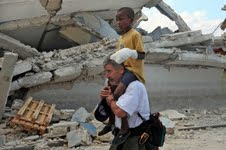
Dr. Paul Auerbach And Injured Haitian Boy
Dr. Paul Auerbach is the author of the definitive textbook on Wilderness Medicine. Though he’s spent his entire emergency medicine career teaching others how to survive in the wild, even that didn’t fully prepare him for the extraordinary devastation in Haiti. He’d never seen anything like it. He hopes he never does again.
In an exclusive Skype interview with Better Health, Paul describes what it was like “on the ground” during the first week of the disaster. He goes on to explain (in part 2 below) what the current critical needs are, and which organizations and websites volunteers should go to in order to contribute in a coordinated fashion.
[Audio:https://getbetterhealth.com/wp-content/uploads/2010/01/paulauerbach124102.mp3]
Dr. Val: Do you need supplies?
Dr. Auerbach: We have lots of medications, vaccines, and small supplies. What we need most is a large autoclave to sterilize used OR equipment. Read more »
January 25th, 2010 by Dr. Val Jones in Audio, Better Health Network, Expert Interviews
No Comments »
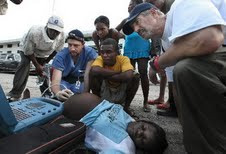
Paul Auerbach, MD (far right)
In this extraordinary first-hand account, Dr. Paul Auerbach (he is now the head administrator for NGOs at Port Au Prince’s largest hospital) describes what he has seen on the ground since his arrival one week ago.
[Audio:https://getbetterhealth.com/wp-content/uploads/2010/01/paulauerbach12410.mp3]
“The floor was covered with bodies. Some were dead, some were alive, some were screaming… There were rows of children with missing limbs… The smell of dead bodies was coming out of the old nursing quarters where the peers of the women helping us lay dead… The Haitian people are the strongest people I’ve ever seen.”
Read more »