July 30th, 2011 by Michael Kirsch, M.D. in Health Policy, Opinion
No Comments »

 As a gastroenterologist, I treat hundreds of patients with heartburn. You already know the names of the medicines I prescribe, since they are advertised day and night on television and appear regularly in print newspapers. Pharmaceutical representatives for each one of these drugs come to our office each claiming some unique clinical advantage of their products over the competitors. They have a tough job since the medicines are all excellent, are priced similarly and are safe. On some days we will have 2 or 3 reps visiting us, each one proffering a medical study or two that supports their product. They show us graphs where their drug is superior to the others regarding an event of questionable clinical import. Their goal is to show that the graph line of their drug is going up, while those of their competitors are going down.
Physicians, like me, who do give these folks some time, have mastered the art of the slow head nod as the drug’s virtues are being related. In the past, the relationships they cultivated with us translated directly into prescriptions being written. Not so today, when our prescribing pens are controlled by insurance company formulary requirements. Those drugs that are not on the coveted list not just swimming upstream, they’re trying to scale a waterfall.
Drug companies know a lot more about us than we know about them. They have Read more »
*This blog post was originally published at MD Whistleblower*
April 3rd, 2011 by Bryan Vartabedian, M.D. in Opinion
1 Comment »

Patient care is increasingly under third party control. And as a consequence I make fewer decisions regarding the brand of medication used in my patients.
So the role of a pharmaceutical rep comes into question. If I don’t choose which medication my patients will use, why would a representative call on me? And as American medicine becomes more centralized and standardized, I wonder how and why industry will connect with treating physicians. Pharma it seems is asking the same question: Of the core medications I prescribe, I see far fewer reps these days and our relationships are markedly different from a decade ago.
I don’t miss the pitch. But I find the element of human support to be important. For example, recently the FDA issued a black box warning for the concomitant use of Remicade and 6-MP. My representative visited to be sure that I was aware of the changes in the product insert. Sure the information was in my mailbox – along with 6 inches of pulp spam. It’s basic attenionomics: I’m more likely to hear a person than a letter. Read more »
*This blog post was originally published at 33 Charts*
July 6th, 2010 by GarySchwitzer in Better Health Network, Health Policy, News, Opinion, Quackery Exposed
No Comments »

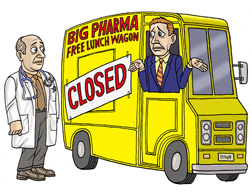 “Appetite for Instruction: Why Big Pharma should buy your doctor lunch sometimes” is the headline of an article on Slate.com that has upset many readers. I’m not terribly upset about it because it just seems too naive and misinformed to get upset about. The final line of the piece tells you all you need to know about the tone of the column:
“Ousting commercial support is creating a huge chasm in medical education, leaving doctors not only hungry but also starved for knowledge.”
A number of online comments were posted in reaction to the piece. Read more »
*This blog post was originally published at Gary Schwitzer's HealthNewsReview Blog*
December 14th, 2009 by Toni Brayer, M.D. in Better Health Network, Opinion
No Comments »


Most doctors have a closet in their office filled with various pharmaceutical samples. The pharmaceutical industry has had “drug reps” or account reps or pharmaceutical sales staff making the rounds on doctors offices in every city and town across the United States for decades. The industry spent $33.5 billion promoting drugs and sending reps to doctors offices with samples in 2004. That is a lot of samples!
Most of us thought we were doing the right thing for our patients when we accepted drug samples. I was able to give patients a month (or more) free to make sure it worked and that they tolerated it. Other patients had no insurance and I supplied them with all of their medication for free from my sample closet. I had a good relationship with the rep and they kept my office stocked with the medication my patients needed. It seemed like a win-win for everyone. Read more »
*This blog post was originally published at EverythingHealth*


 As a gastroenterologist, I treat hundreds of patients with heartburn. You already know the names of the medicines I prescribe, since they are advertised day and night on television and appear regularly in print newspapers. Pharmaceutical representatives for each one of these drugs come to our office each claiming some unique clinical advantage of their products over the competitors. They have a tough job since the medicines are all excellent, are priced similarly and are safe. On some days we will have 2 or 3 reps visiting us, each one proffering a medical study or two that supports their product. They show us graphs where their drug is superior to the others regarding an event of questionable clinical import. Their goal is to show that the graph line of their drug is going up, while those of their competitors are going down.