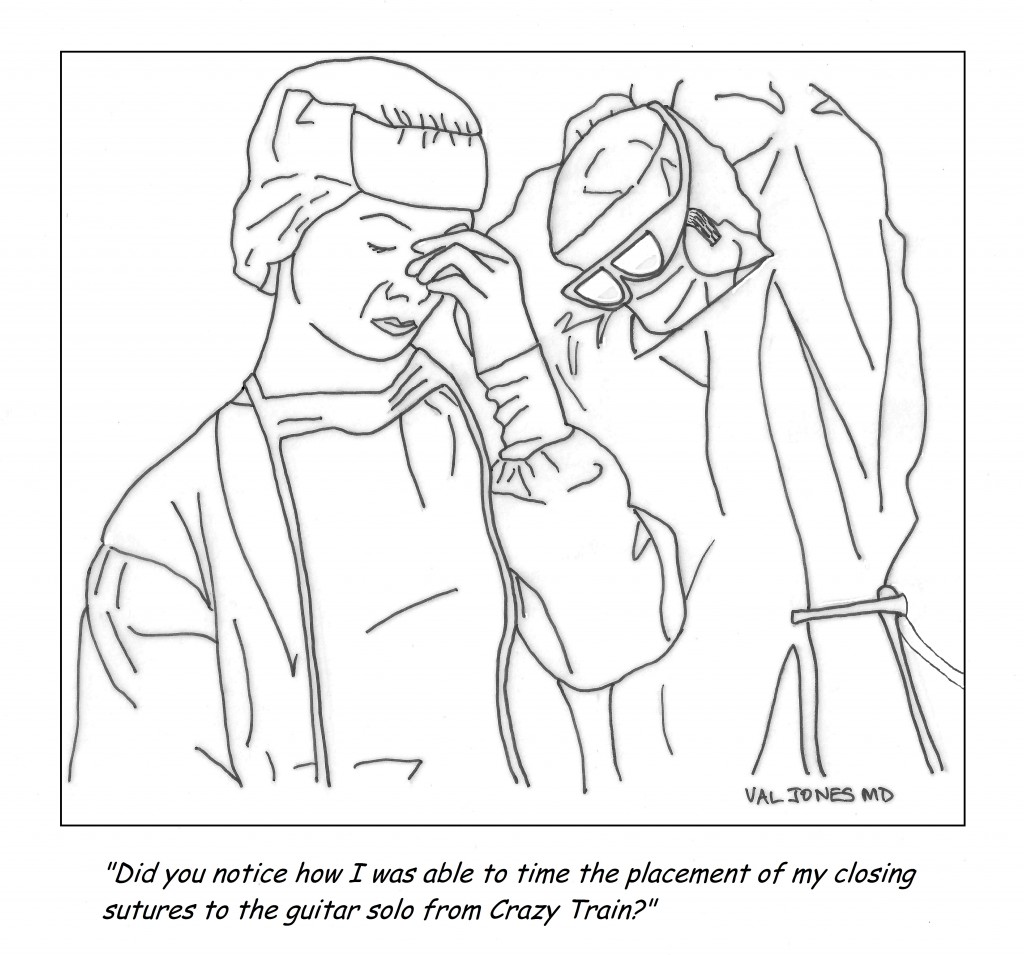
Cartoon: How Some Surgeons Behave In The O.R.


 I met Dr. Marty Makary over lunch at Founding Farmers restaurant in DC about three years ago. We had an animated conversation about hospital safety, the potential contribution of checklists to reducing medical errors, and his upcoming book about the need for more transparency in the healthcare system. Marty was well dressed and soft spoken – sincere, and human. We exchanged business cards and wished each other luck in changing the healthcare system for the better. We were two doctors tilting at windmills.
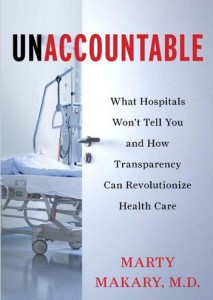
Just two months ago my fiancé sent me a “must read” article from the Wall Street Journal. It was Marty’s provocative piece, “How To Stop Hospitals From Killing Us.” The article was an excellent primer for his book, “Unaccountable: What Hospitals Won’t Tell You And How Transparency Can Revolutionize Health Care” which I highly recommend (holiday gifts, anyone?)
Unaccountable is both horrifying and oddly optimistic. Marty describes case after case of medical errors, lapses in judgment, and near misses in the surgical suite. He exposes the cultural foibles of the medical and hospital hierarchy, leaving no dirty stone unturned. Surgical delinquents such as Dr. Hodad (“hands-of-death-and-destruction”) are presented with detached accuracy, along with a clear list of reasons why the system fails to prevent the Hodads of the world from operating.
From the micro (individual physician mistakes) to the macro (trends in hospital safety breakdowns), Marty turns to survey data to make sense of the shortcomings. Interestingly, hospital “culture” (rated by its own employees) is the most predictive of overall hospital safety performance. Detailed record keeping of surgical complication rates correlates strongly with how employees rate their hospital on three simple questions:
1. Would you have your operation at the hospital in which you work?
2. Do you feel comfortable speaking up when you have a safety concern?
3. Does the teamwork here promote doing what’s right for the patient?
Marty’s conclusion that culture is the defining factor in patient safety and satisfaction ratings is both accurate and squishy. It’s difficult to create a reproducible template for a healthy work culture, and yet good culture is the basis for the success of hospitals such as the Mayo Clinic. Individual hospitals, like individual surgeons, have different personalities and temperaments. Raising them to be upstanding citizens involves a combination of good parenting and good luck.
Because I think Marty is absolutely right about culture as the foundation for safe and effective care, I think he’s also overly optimistic about the potential success of strategies to reproduce caring hospital cultures. By his own admission, not even the Mayo Clinic “mother ship” in Rochester, MN, has been able to create the exact level of quality care in its sister hospitals in Scottsdale, AZ, and Jacksonville, FL. So how can we dramatically improve patient care on a national level? Marty suggests that we need to find ways to force hospitals to become more transparent in order to revolutionize healthcare. His ideas include:
1. Mandatory hospital public reporting of patient re-admissions, complication rates, and never events.
2. Adoption of check lists by surgical teams to reduce errors.
3. Installation of video cameras throughout hospital floors and surgical suites so that staff behaviors can be monitored more effectively (e.g. to enforce hand washing or identify surgeons who have high error rates).
4. Accessible and transferable medical records that put patients at the center of their documentation.
While these ideas have merit, I believe they will fall short of achieving our ultimate goals. In my view, a culture of accountability is not the same as a culture of caring. Adopting certain “Big Brother” (cf. #3 above) strategies to pressure staff to behave/perform appropriately is only going to force the Hodads underground. We need staff to genuinely care enough about their patients to gang up on the Hodads and kick them out of the hospital for good. Caring doesn’t happen at a national level, it is personal and local. That’s why individual hospitals must develop their unique cultures for themselves, with progress measured by responses to those staff questions about whether or not they’d want to be cared for at their own institution.
I agree with Marty that hospital data transparency might be the best antiseptic we have to scrub the underbelly of medicine, though the ultimate success of our procedures will always be culture and surgeon-dependent. And that’s something you can’t regulate from Washington.
***
Marty’s book is available for purchase at Amazon.com.
Check out your local hospital safety scores from LeapFrogGroup.


Yes, I have an alter ego. Yes, I dress in funny clothes with a cap covering my head and a mask covering my face. And yes, dressed as such I try to fight the powers of evil (mainly sepsis and bleeding and cancer and the like). I am … a superhero. But there is often little understanding for what goes on under the paper thin masks and baggy gowns we wear. certain …um…occurrences, well, occur with us just as much as with other people.
A common cold behind a theatre mask is no small thing. Remember you can’t blow your nose. Sniffing loudly only works for a while and attracts all sorts of strange stares. Just leaving it is really the only option. The positive side of this is you suffer less from the mild dehydration that accompanies massive loss of …mucus. There is, after all, fluid replacement (it is a very short trip from your nostrils to your mouth over your upper lip). ‘Nuf sed. Somehow this never appealed to me though. So, for all you budding surgeons out there, when you have a cold, plug your nostrils with tissue before scrubbing up. once you’re scrubbed, it is too late. The side effects are only a slight change in voice which is a small price to pay to avoid the constant lip licking and salty taste throughout the operation. Read more »
*This blog post was originally published at other things amanzi*

A team of French anesthesiologists has developed an automatic delivery system of propofol and remifentanil, which they recently tested in a multi-center trial involving 196 surgical patients. The researchers reported in Anesthesia & Analgesia that the system, which uses a Bispectral Index (BIS) monitor as a guide, performed better than manual administration:
We have developed a proportional-integral-derivative controller allowing the closed-loop coadministration of propofol and remifentanil, guided by a Bispectral Index (BIS) monitor, during induction and maintenance of general anesthesia. The controller was compared with manual target-controlled infusion.
The controller allows the automated delivery of propofol and remifentanil and maintains BIS values in predetermined boundaries during general anesthesia better than manual administration.
Abstract in Anesthesia & Analgesia: Closed-Loop Coadministration of Propofol and Remifentanil Guided by Bispectral Index: A Randomized Multicenter Study

*This blog post was originally published at Medgadget*
 This post is a bit of a diversion from my usual posts, but I think it may still be worthwhile. You see, I want to promote a book.
I’ve just read the book, “Steeped in Blood: The Life and Times of a Forensic Scientist” by David Klatzow. What a stunning book. It really gives insight into the South Africa of old and possibly what South Africa of future may end up being like. I suggest that everyone get ahold of it and read it.
However, David, I do feel I must challenge you on one point. Towards the end of your book, you say one of your surgeon friends told you a story of one of our Cuban import surgeons who tried to do a tonsillectomy through the neck rather than through the mouth, the normal way of doing it. I know this story and have heard it often myself in the corridors in Pretoria. Unfortunately it’s urban legend and nothing more.
I have worked with the Cubans, and they aren’t too shabby. Don’t get me wrong — they aren’t a scratch on a South African specialist (although the standards are dropping as you rightly point out, and quite soon they may be far better than homegrown specialists), but the point is that they wouldn’t do something so bizarrely stupid. I even suspect I know who your surgeon friend might be, especially if he presently finds himself in Pretoria rather than Johannesburg, where you no doubt got to know him.
Anyway, still an absolutely brilliant read for anyone who wants to get a peek into the workings of the apartheid government of old. Go and buy it now.
*This blog post was originally published at other things amanzi*
It’s no secret that doctors are disappointed with the way that the U.S. healthcare system is evolving. Most feel helpless about improving their work conditions or solving technical problems in patient care. Fortunately one young medical student was undeterred by the mountain of disappointment carried by his senior clinician mentors…
I am proud to be a part of the American Resident Project an initiative that promotes the writing of medical students residents and new physicians as they explore ideas for transforming American health care delivery. I recently had the opportunity to interview three of the writing fellows about how to…

Book Review: Is Empathy Learned By Faking It Till It’s Real?

I m often asked to do book reviews on my blog and I rarely agree to them. This is because it takes me a long time to read a book and then if I don t enjoy it I figure the author would rather me remain silent than publish my…
The Spirit Of The Place: Samuel Shem’s New Book May Depress You

When I was in medical school I read Samuel Shem s House Of God as a right of passage. At the time I found it to be a cynical yet eerily accurate portrayal of the underbelly of academic medicine. I gained comfort from its gallows humor and it made me…
Eat To Save Your Life: Another Half-True Diet Book

I am hesitant to review diet books because they are so often a tangled mess of fact and fiction. Teasing out their truth from falsehood is about as exhausting as delousing a long-haired elementary school student. However after being approached by the authors’ PR agency with the promise of a…