October 21st, 2013 by Dr. Val Jones in Opinion
9 Comments »
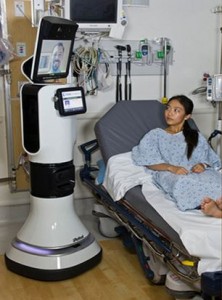
A "Medical Service Provider"
As I sat in my orthopedist’s exam room, the discussion quickly turned from my chief complaint to his: “I don’t know why I’m doing this anymore,” he said. “Medicine is just not what it used to be, and I don’t enjoy my work anymore. The bureaucracy and regulations are bad enough, but what really gets me is the hostility. My patients are chronically angry and mean. The only comfort I get is from talking to other doctors. Because they all feel the same way.”
Perhaps this sentiment strikes you as the spoiled musings of a physician who is lamenting his demotion from “god” to “man” – reflecting the fundamental change in the public perception of doctors that has occurred over the past ~50 years. Or maybe you wonder if this surgeon’s patients are mean because he is a bad doctor, or isn’t respectful of their time? Maybe he deserves the hostility?
I’ve found this particular surgeon to be humble, thoughtful, and thorough. He is genuinely caring and a proponent of conservative measures, truly eager to avoid surgical procedures when possible. He is exactly what one would hope for in a physician, and yet he is utterly demoralized. Not because of the hours of daily documentation drudgery required by health insurance and government regulators, but because the very souls he has been fighting to serve have now turned on him. Their attitudes are captured in social media feeds on every major health outlet:
Doctors? I no longer afford that kind of respect: I call them “medical services providers.” They and their families and the medical cabal created this mess when they got control of med schools so that the wealth of a nation would remain in the hands of a few medical elites and their families. The very notion that doctors are smarter, more productive, more anything than others is ludicrous. They are among the worst sluff-offs of our society, yet the richest at the same time. It is an unreal world they have created themselves and they are now watching the natural outcome of such a false system.
The very best physicians have always been motivated primarily by the satisfaction of making a difference in their patients’ lives. That drive to “help others” is what makes us believe that all the sacrifices are worth it – the years of training, the educational debt, the lack of sleep, the separation from family, the delay (and sometimes denial) of becoming a parent, the daily grind of administrative burden, the unspeakable emotional toll that death and disease take on your heart… All of that is offset by the joy of changing and saving lives. But when that joy is taken from you, what remains is despondency and burn out.
What patients need to realize is that they have been (and still are) the primary motivator of physician job satisfaction. Patients have the power to demoralize us like no one else – and they need to take that power very seriously. Because if negative attitudes prevail, and hostility spreads like a cancer in our broken system, the most caring among us will be the first to withdraw.
And in the end all that will be left is “medical service providers.”
August 15th, 2013 by Dr. Val Jones in Health Policy, Opinion
No Comments »
 As I travel around the country, working in the trenches of various hospitals, I’ve been struck by the number of errors made by physicians and nurses whose administrative burden distracts them from patient care. The clinicians who make the errors are intelligent and competent – and they feel badly when an error is made. However, the volume of tasks required of them in a day (many of which are designed to fulfill an administrative “patient safety” or “quality enhancement” process) makes it impossible for them to complete any task in a comprehensive and thoughtful manner. In the end, administrators’ responses to increased error frequency is to increase error tracking and demand further documentation that leads to less time with patients and more errors overall. It’s a vicious cycle that people aren’t talking about enough.
As I receive patient admissions from various referral hospitals, I rarely find a comprehensive discharge summary or full history and physical exam document that provides an accurate and complete account of the patient’s health status. Most of the documentation is poorly synthesized, scattered throughout reams of EMR-generated duplicative and irrelevant minutiae. Interpreting and sifting through this electronic data adds hours to my work day. Most physicians don’t bother to sift – which is why important information is missed in the mad dash to treat more patients per day than can be done safely and thoroughly.
I have personally witnessed many critical misdiagnoses caused by sloppy and rushed medical evaluations. I have had to transfer patients back to their originating surgical hospitals (at some of America’s top academic centers) for further work up and treatment, and have uncovered everything from cancer to brain disorders to medication errors for patients who had been evaluated and treated by many other specialists before me. No one seems to have the time to take a long hard look at these patients, and so they end up undergoing knee-jerk treatments for partially thought through diagnoses. The quality of medical care in which I’ve been engaged (over the past 20 years) has taken a dramatic turn for the worse because of volume overload (fueled by diminishing reimbursement) in the setting of excessive administrative and documentation requirements.
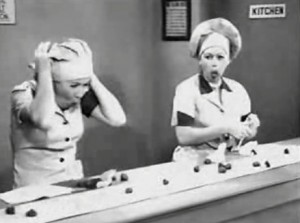
To use an analogy – The solution to the healthcare cost crisis is not to increase the speed of the assembly line belt when our physicians and nurses are already dropping items on the floor. First, stop asking them to step away from the belt to do other things. Second, put a cap on belt speed. Third, insure that you have sufficient staff to handle the volume of “product” on the belt, and support them with post-belt packaging and procedures that will prevent back up.
What we require most in healthcare is time to process our thoughts and engage in information synthesis. We must give physicians the time they need to complete a full, comprehensive, evaluation of each patient at regular intervals. We need nurses to be freed from desk clerk and safety documentation activities to actually inspect and manage their patients and alert physicians to new information.
Until hospitals and administrators recognize that more data does not result in better care, and that intelligent information synthesis (which requires clinician time, not computer algorithms) is the foundation of error prevention, I do not foresee a bright future for patients in this manic assembly line of a healthcare system.
June 27th, 2012 by Dr. Val Jones in Health Tips, Opinion, Research
1 Comment »
 One would think that happiness and healing are inextricably linked in healthcare, but the Happy Hospitalist (HH) raises an interesting question: is modern medicine’s emphasis on patient satisfaction (and shared decision-making) sacrificing our quality of care? A recent study found that patients who preferred their physicians to take the lead in their medical decision-making had shorter, less costly hospital stays.
HH argues that if physicians are expected to perform like airline pilots, reliably choosing/performing the best course of action for those depending on them, then patients should behave like passengers. In other words, passengers don’t tell the pilot how to fly the plane, nor should patients override a physician’s clinical judgment with personal preferences.
I think this analogy misses the mark because patients are rarely interested in making decisions about how a physician accomplishes her task, but rather which tasks she undertakes. Flight passengers aren’t interested in quibbling about the timing of landing gear, they are interested in the selection of their destination city. And so they should be.
While there may be a correlation between physician-led decision-making and shorter hospital stays, I’m not convinced that this translates to improved care quality. For the study subjects, discharge could have been delayed because the “empowered” patients insisted on ensuring that a home care plan was in place before they left the hospital. Or perhaps they wanted to get their prescriptions filled before going home (knowing that they couldn’t get to their home pharmacy over the weekend)? The study did not assess whether or not the discharge delays reduced readmission rates, nor did it seek to determine the cause of prolonged stays. This study alone is insufficient to draw any conclusions about the relative value of the patient empowerment movement on health outcomes.
While I certainly empathize with HH about the excessive focus on patient satisfaction surveys over true quality care, I strongly believe that an educated, participatory patient is our best ally in the practice of good medicine. There are simply too many cogs and wheels turning at once in the healthcare system to be able to ensure that the right care is provided at the right time, every time. We need all the help we can get to monitor our care plans in order to avoid medical errors, compliance problems and missed opportunities.
If you see something, say something. That principle applies to healthcare as much as it does to flight safety.
December 27th, 2011 by Stanley Feld, M.D. in Health Policy, Opinion
No Comments »

The difference between the healthcare system and the medical care system is very clear to me. The stakeholders in the healthcare system are patients, physicians, government, hospital systems, pharmaceutical companies, pharmacies, pharmacy middlemen, and healthcare insurance companies.
Government, hospital systems, pharmaceutical companies, pharmacies, pharmacy middlemen, and healthcare insurance companies are secondary stakeholders in the healthcare system.
The primary stakeholders are patients and physicians. They also comprise the medical care system. Without the primary stakeholders there would be no need for a healthcare system.
The secondary stakeholders have long ago taken over the healthcare system. All businesses and the government deal with the hand they are dealt using their best judgment. The people running the business or government pursue their vested interest. The difference between businesses and government is businesses work to make as big a profit as possible. Government, depending on the political party in power, pursues fulfillment of its ideology.
Since 1942 and the Economic Stabilization Act of President Roosevelt Read more »
*This blog post was originally published at Repairing the Healthcare System*
October 8th, 2011 by Stanley Feld, M.D. in Health Policy, Opinion
No Comments »
Mechanism Design has demonstrated that the most efficient systems are created when everyone’s vested interests are aligned.
“An example is defense contracting. If you agree to pay on a cost plus basis you have created incentive for the contractor to be inefficient.
The defense contractor will build enough extra into a fixed price system to account for cost overruns. The cost overrun would be permitted in the rules if the price was transparent. If there were no cost overruns the contractor’s profit would be increased. It would provide incentive to be efficient.
“If you agree to pay a fixed price, you can come close to an efficient price if you have all the truthful information.”
A reader wrote,
Stanley:
History has proven over and over again that only the market mechanism of willing sellers and willing buyers is the optimal way to allocate economic resources. This presumes an informed buyer, and a willingness of sellers to compete for buyers. Adam Smith was clear on this in the Wealth of Nations.
If incentives are aligned and truthful price information is available an efficient system is created. Most stakeholders think they can do better by not sharing truthful information. If the rules of the game require truthful information the system can become an efficient market driven solution.
The healthcare system must become market driven. At present Read more »
*This blog post was originally published at Repairing the Healthcare System*