June 3rd, 2014 by Dr. Val Jones in Health Policy, Opinion
6 Comments »
 In an effort to promote transparency in healthcare, the Association of Health Care Journalists (AHCJ) has published a database of recent hospital deficiencies discovered by Medicare and Medicaid inspectors. They then highlighted 168 reports containing the phrase “immediate jeopardy.” This, of course, piqued my interest as I presumed that hospitals who were putting putting patients in “immediate jeopardy” must be some pretty bad actors.
After sifting through the hospital names, I saw no record of ones who should probably be on the list based on my personal experiences. I did find some surprises, including well respected academic centers (including Stanford, UCSD, and Intermountain Health). I did a “deep dive” on a hospital for which I have a good deal of respect and some familiarity. What I discovered was both funny and sad.
In the case of the hospital that I knew, the very grave concerns expressed by the inspectors turned out to revolve around patient signatures on HIPAA documentation, and physicians refreshing their electronic restraint orders on patients with traumatic brain injuries. These documentation mishaps had landed the hospital on the ominous list of institutions who are “putting patients lives in immediate jeopardy.”
What a waste of inspector time and hospital resources! Apparently, a hospital who passes CMS muster simply means that they are providing documentation correctness to patients. Forget the real sources of life-threatening dangers – medication errors, poor physician handoffs, unnecessary testing and treatment, and unsanitary conditions. What the safety police are focused upon is whether or not the sick and delirious signed their health information privacy paperwork.
Now don’t get me wrong, I think it’s important to let patients know their rights, etc. But I’ve yet to see more than 10% of patients even read the HIPAA-related documentation that they sign. Surely an absent signature or two shouldn’t land a hospital on a humiliating federal watch list.
True patient safety cannot be regulated. It is far too complex and nuanced, requiring collaboration between all members of a hospital’s staff. From frequent nursing surveillance, to careful medication review, to laboratory critical value alerts, to conscientious sanitation practices – hospital culture dictates whether or not a patient receives excellent care. Watch lists would be far more accurate if they were simply based on hospital employee questionnaires. As Dr. Marty Makary has discovered, complicated care quality algorithms are no more accurate at predicting hospital excellence than simply asking staff if they’d recommend the place to family members.
So next time you see your hospital flagged by the feds, don’t assume that there is a serious problem going on – better to ask someone who works there if it’s a safe place for care.
November 30th, 2012 by Dr. Val Jones in Book Reviews
No Comments »
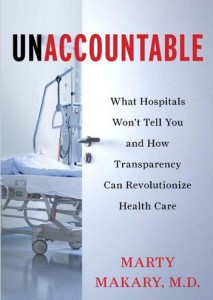 I met Dr. Marty Makary over lunch at Founding Farmers restaurant in DC about three years ago. We had an animated conversation about hospital safety, the potential contribution of checklists to reducing medical errors, and his upcoming book about the need for more transparency in the healthcare system. Marty was well dressed and soft spoken – sincere, and human. We exchanged business cards and wished each other luck in changing the healthcare system for the better. We were two doctors tilting at windmills.
Just two months ago my fiancé sent me a “must read” article from the Wall Street Journal. It was Marty’s provocative piece, “How To Stop Hospitals From Killing Us.” The article was an excellent primer for his book, “Unaccountable: What Hospitals Won’t Tell You And How Transparency Can Revolutionize Health Care” which I highly recommend (holiday gifts, anyone?)
Unaccountable is both horrifying and oddly optimistic. Marty describes case after case of medical errors, lapses in judgment, and near misses in the surgical suite. He exposes the cultural foibles of the medical and hospital hierarchy, leaving no dirty stone unturned. Surgical delinquents such as Dr. Hodad (“hands-of-death-and-destruction”) are presented with detached accuracy, along with a clear list of reasons why the system fails to prevent the Hodads of the world from operating.
From the micro (individual physician mistakes) to the macro (trends in hospital safety breakdowns), Marty turns to survey data to make sense of the shortcomings. Interestingly, hospital “culture” (rated by its own employees) is the most predictive of overall hospital safety performance. Detailed record keeping of surgical complication rates correlates strongly with how employees rate their hospital on three simple questions:
1. Would you have your operation at the hospital in which you work?
2. Do you feel comfortable speaking up when you have a safety concern?
3. Does the teamwork here promote doing what’s right for the patient?
Marty’s conclusion that culture is the defining factor in patient safety and satisfaction ratings is both accurate and squishy. It’s difficult to create a reproducible template for a healthy work culture, and yet good culture is the basis for the success of hospitals such as the Mayo Clinic. Individual hospitals, like individual surgeons, have different personalities and temperaments. Raising them to be upstanding citizens involves a combination of good parenting and good luck.
Because I think Marty is absolutely right about culture as the foundation for safe and effective care, I think he’s also overly optimistic about the potential success of strategies to reproduce caring hospital cultures. By his own admission, not even the Mayo Clinic “mother ship” in Rochester, MN, has been able to create the exact level of quality care in its sister hospitals in Scottsdale, AZ, and Jacksonville, FL. So how can we dramatically improve patient care on a national level? Marty suggests that we need to find ways to force hospitals to become more transparent in order to revolutionize healthcare. His ideas include:
1. Mandatory hospital public reporting of patient re-admissions, complication rates, and never events.
2. Adoption of check lists by surgical teams to reduce errors.
3. Installation of video cameras throughout hospital floors and surgical suites so that staff behaviors can be monitored more effectively (e.g. to enforce hand washing or identify surgeons who have high error rates).
4. Accessible and transferable medical records that put patients at the center of their documentation.
While these ideas have merit, I believe they will fall short of achieving our ultimate goals. In my view, a culture of accountability is not the same as a culture of caring. Adopting certain “Big Brother” (cf. #3 above) strategies to pressure staff to behave/perform appropriately is only going to force the Hodads underground. We need staff to genuinely care enough about their patients to gang up on the Hodads and kick them out of the hospital for good. Caring doesn’t happen at a national level, it is personal and local. That’s why individual hospitals must develop their unique cultures for themselves, with progress measured by responses to those staff questions about whether or not they’d want to be cared for at their own institution.
I agree with Marty that hospital data transparency might be the best antiseptic we have to scrub the underbelly of medicine, though the ultimate success of our procedures will always be culture and surgeon-dependent. And that’s something you can’t regulate from Washington.
***
Marty’s book is available for purchase at Amazon.com.
Check out your local hospital safety scores from LeapFrogGroup.
February 20th, 2011 by LouiseHBatzPatientSafetyFoundation in Opinion, True Stories
No Comments »
This is a guest post by J. Paul Curry, M.D.
I was inspired when I lost my best friend 15 years ago to a common medical-error phenomenon: The lack of monitoring patients in the hospital.
Losing Mark altered my entire career in medicine and started me on a long journey of trying to understand how this particular problem happens. The journey has been eye-opening for me for many reasons, and probably most importantly by striving to learn and understand how the human brain can deceive itself into believing that thoughtful, rational, goal-directed tactics are always the solution to finding the answers to highly-complex enigmas.
 Actually, the blockbusting solutions that change the course of our culture — how we do things — are most often totally unpredictable and discovered by accident by disruptive innovators, such as Dr. Larry Lynn of the Sleep and Breathing Research Institute, willing to tinker on their own and against the grain of thousands of smart people who dismiss this kind of outlier work as fantasy. To get just how often this happens and why, I’d invite those unfamiliar with Nassim Nicholas Taleb’s work to read “The Black Swan : The Impact of the Highly Improbable” and other books of his. This is what we’re up against today.
I was recently operated on, having a significant multi-level back surgery at one of the outstanding university spine programs in the country, supported by one of the elite anesthesia programs. I was told by the resident that I’d be going to the general care floor following my surgery, where I’d be checked on regularly. This was a given because I’m a fitness fanatic, but the resident wasn’t prepared for my followup questions. As I probed for more detail, it became apparent that no one in the organization had any inkling that nursing checks only occurring every four or eight hours on a patient fresh from surgery with patient-controlled narcotics was less than standard of care.
I told them I have mild sleep apnea and wanted pulse oximetry at minimum. I had to be upgraded to telemetry to get it. What’s more interesting is that there was so little understanding of this problem that they put me on pulse oximetry in a room where the only one who could watch it was me — the patient. Read more »
October 30th, 2010 by scanman in Better Health Network, Health Policy, News
No Comments »

I got an email from Mari (M4ID_Mari on Twitter) on behalf of the World Health Organization’s (WHO) Emergencies and Humanitarian Action team in South East Asia, based in New Delhi about WHO’s first social media-driven effort, aiming to engage 1 million people in the issue of making hospitals safe in disasters. From WHO:
“Floods, tsunamis, earthquakes, cyclones – the WHO South-East Asia Region is particularly vulnerable to natural disasters. In 1996-2005, such events led to the deaths of more than half a million people in this region. This makes up 58% of the total number of people killed worldwide due to natural disasters.
Hospitals are lifelines in the aftermath of a disaster, when large numbers of people are critically injured or vulnerable. It is particularly vital that they remain intact and functional to save lives. In addition to treating disaster victims, hospitals must also quickly resume treatment of everyday emergencies and routine care. When hospitals are damaged or destroyed during disasters, it has a social, economic as well as health impact. Hospitals and health facilities are at the core of the structure of every community. They also protect health workers and the most vulnerable people – the sick – all the time. When these are damaged, it can have a psychological impact on the entire community. Read more »
*This blog post was originally published at scan man's notes*
July 26th, 2010 by GruntDoc in Better Health Network, Health Policy, News, Opinion
No Comments »

From Campus Safety Magazine:
DANBURY, Conn. — The Occupational Safety and Health Administration (OSHA) has cited Danbury Hospital for failing to provide its employees with sufficient protection against workplace violence. The hospital has been fined $6,300.
The announcement comes on the heels of the March 2010 attack, when nurse Andy Hull was shot three times by 86-year-old Stanley Lupienski, a patient at the hospital.
Yes, $6,300 isn’t much money, I agree. But I’d imagine it’s not good for admin careers…
*This blog post was originally published at GruntDoc*