October 11th, 2012 by Dr. Val Jones in Book Reviews
1 Comment »
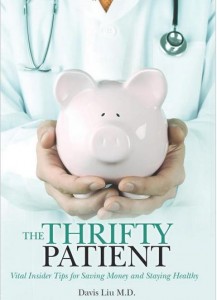 No matter the outcome of the presidential election this year, it’s likely that Americans will be spending more of their money on healthcare going forward. Dr. Davis Liu, a family physician at the Permanente Medical Group in California (and a contributor to this blog), has written a primer on how to get the most bang for your healthcare buck. The Thrifty Patient: Vital Insider Tips For Saving Money And Staying Healthy is a helpful little book for those smart enough to read it.
The first step to becoming a “thrifty patient” is to reduce your need for professional healthcare services. This lesson is perhaps the most important of all: lifestyle choices are the largest controllable determinant of how much healthcare you will consume. Daily exercise, healthy eating, and preventive care services (such as vaccines and screening tests) are the most effective ways to avoid expensive healthcare.
Dr. Liu offers tips for selecting a doctor, questioning the necessity of tests and procedures, choosing less expensive treatments, getting a second opinion, and learning to get the most out of a short doctor visit. He explains why annual check ups may not be necessary, and lists all the preventive health screening tests you’ll need (according to age) to maximize your chance of avoiding many major diseases or their expensive outcomes.
According to Liu, an excellent primary care physician (PCP) can be the best ally in avoiding unnecessary medical costs. Without a PCP’s guidance, 60% of patients select the wrong specialist for their symptoms or concerns. This can trigger a costly cascade of extra testing and referrals. Liu recommends trustworthy websites that can aid in disease management and patient education – suggesting that “Dr. Google” may not be so bad after all, armed with a correct diagnosis from a healthcare professional and links to credible sources of information.
Being thrifty isn’t necessarily “sexy” – but practical tips for avoiding unnecessary and expensive interactions with the healthcare system could add up to some pretty amazing savings (both financially and emotionally). Anyone who takes Dr. Liu’s advice to heart is likely to live longer and better – I just hope that the people who could benefit most from these tips find their way to this book. Perhaps you know someone who needs an early Christmas gift? 😆
The Thrifty Patient can be purchased here on Amazon.com
September 5th, 2012 by Dr. Val Jones in Book Reviews
2 Comments »
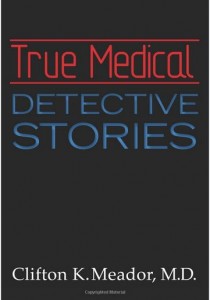 I just finished reading True Medical Detective Stories, Dr. Clifton Meador’s personal collection of medical mysteries. Dr. Meador is a prolific writer and the former dean of the University of Alabama School of Medicine and professor at Vanderbilt School of Medicine. His 50+ years in the academic arena have exposed him to some delightfully rare and bizarre medical cases, and he shares his top 18 in this pithy little book.
Dr. Meador was inspired by Berton Roueché, a staff writer at The New Yorker, who helped to popularize the medical detective story genre in the 1940’s and beyond. Each vignette is between 3-5 pages in length, making for a very quick and entertaining read. In choosing to review this book I was very tempted to give away details of some of the cases in order to entice you to read it, but I have resisted the urge so as not to spoil the fun.
Broadly speaking, the stories include a rare case of intractable hiccups, a bizarre infection caused by sexually deviant behavior, and several examples of the power of the mind to inflict bodily harm on oneself and others. In each situation, the underlying cause of the symptoms or disease is uncovered through careful listening and analysis. Often, human shame and fear must be managed before the truth can bubble to the surface.
I highly recommend this book to healthcare professionals, skeptics, and anyone interested in a fascinating look at some of the most unusual medical cases described in one book. Perhaps we can all learn to become better listeners, or true “medical detectives,” from Dr. Meador’s stories. You can find his book here at Amazon.com. Enjoy!
December 5th, 2011 by ChristopherChangMD in Opinion
2 Comments »


Would YOU as the patient see a doctor who is a well-known jerk, abuses drugs, gives the wrong diagnosis more often than not, and is known to like ordering very invasive tests??? Be honest…
The other week, a patient with a chronic cough exclaimed to me that she wished the fictional character Dr. House of TV fame actually existed in real life, because he was somebody who can diagnose anything.
I looked her straight in the eye and told her that somebody like Dr. House in the real world would be a physician nobody would want to see for many reasons:
- In the real world, patients expect doctors to have the correct diagnosis from the beginning (might forgive one wrong diagnosis). Dr. House seems to always get things wrong multiple times before he gets it right. I seriously doubt most patients would have stuck around as long as they do on the TV shows before going elsewhere. Read more »
*This blog post was originally published at Fauquier ENT Blog*
October 7th, 2011 by gbadmin in Opinion, Research
2 Comments »


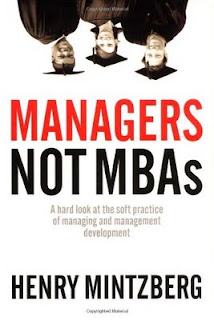 It’s been more than five years since Henry Mintzberg released the enlightening book ‘Managers, not MBAs’, a well-reasoned criticism of prevailing management education that basically revolves around Master in Business Administration (MBA) programs. Financial crisis was not even in sight but Mintzberg, a professor at McGill University in Montreal and one of the most important guiding lights in the questionable field of management, already pointed out that it was a serious danger for modern organizations to rely on professionals that had just finished their MBAs as the prime source for senior managerial positions.
Mintzberg focused his criticism on two essential aspects. First, most programs are aimed at people with no previous experience or knowledge about organizations and how they look like from the inside… and these same people then storm into companies believing that the real world works exactly as business school taught them it does. The second point is that many of these business schools spread a perverted set of values, such as the hunt for short-term profit, the belief that a good aim justifies any means and the urge to translate all human behaviors into accountable figures (the ‘countophrenia’ depicted by Vincent de Gaulejac in his must-read ‘La Société Malade de la Gestion’).
Then the crisis rose, and many CEOs of the biggest organizations had their share of responsibility for it, as they were enjoying multi-million dollar bonuses while taking their companies to the edge of bankrupcy. Most of them came from the most famous business schools in the world. I have outlined in the past the outrageous conflict of interests of many of these institutions, starting with Harvard, as Charles Ferguson perfectly displayed in his brilliant documentary ‘Inside Job’.
‘Social Science and Medicine’ published in its August issue a very interesting work by Amanda Godall, professor at the IZA Institute for the Study of Labor in Bonn, Germany. Godall’s is the first empirical research on the correlation between hospital results and having MDs in their top managerial positions. Read more »
*This blog post was originally published at Diario Medico*
September 13th, 2011 by RamonaBatesMD in Opinion, Research
No Comments »

Many women with large breast and weight issues seek breast reduction. I was taught to encourage them to lose weight first. Now there is a very small study that backs this up (full reference below).
The American Society of Plastic Surgeons issued a press release entitled “Breast Reduction and Bariatric Surgery—Which Should Be Done First?” and provided the answer “Final Results May Be Better When Weight Loss Comes First.” I agree, but find it odd that such a small study was published. There should have been more patients included.
Jeffrey A. Gusenoff, MD, and colleagues reviewed two groups of patients who sought consultation for body contouring surgery August of 2008 and February of 2010 after massive weight loss (defined as a weight loss of greater than 50 pounds).
Group I (n=15) included Read more »
*This blog post was originally published at Suture for a Living*