July 4th, 2015 by Dr. Val Jones in Research, True Stories
2 Comments »

Photo By Danny Kim
The short answer, in my opinion, is yes.
The long answer is slightly more nuanced. As it turns out, studies suggest that one’s relative risk of death is increased in teaching hospitals by about 4-12% in July. That likely represents a small, but significant uptick in avoidable errors. It has been very difficult to quantify and document error rates related to inexperience. Intuitively we all know that professionals get better at what they do with time and practice… but how bad are doctors when they start out? Probably not equally so… and just as time is the best teacher, it is also the best weeder. Young doctors with book smarts but no clinical acumen may drop out of clinical medicine after a short course of doctoring. But before they do, they may take care of you or your loved ones.
It has been argued that young trainees “don’t practice in a vacuum” but are monitored by senior physicians, pharmacists, and nurses and therefore errors are unlikely. While I agree that this oversight is necessary and worthwhile, it is ultimately insufficient. Let me provide an illustrative example.
When I was a new intern I was assigned to a patient with curious eyelids. He was a mildly obese, middle aged man with a beard who spoke in hushed tones. What struck me the most was that he had voluminous upper eyelids. They were so strange that I couldn’t stop staring at them. He didn’t have any hives or red blotches on his skin, and his eyeballs were clear and white. There was no pus or discharge of any kind. I was so perplexed that I began to search through his medical record for answers before I embarrassed myself by asking for a consult. After many hours of digging, I discovered the smoking gun.
Apparently, he had been given repeat boluses of 1 Liter of IV normal saline by dutiful interns and residents who had not communicated with one another about who would write the order. So they all did. This man was so fluid overloaded that his eyes were literally bugging out of his head. No one had noticed the edema because of his size, and because (thank God) his heart and kidneys were young and healthy enough to handle the load without going into outright failure. Also, normal saline is such an innocuous medication that it didn’t flag any concerns by the nurses (who were also rotating through the service and busy swatting the more obvious mistakes being made by the fresh crop of interns).
If this poor patient had congestive heart failure or kidney disease, he could have been killed by well-meaning, diligent interns with salt water. Fortunately for him, he made a full recovery – and because there was technically “no harm done” I don’t even think this case was discussed in M&M (morbidity and mortality) conference, and I also doubt that anyone was reprimanded. Sounds crazy, but there are bigger fish to fry in July.
So my point is this: rookie mistakes are not always tracked, documented, addressed, or perhaps even noted. But they are real. They are scary. And they are lurking at every teaching hospital in this country. We must all remain on high alert – and question everything. Because even eyelids offer important clues, and water can kill.
***
If you or a loved one insist on falling ill in July, I recommend finding a hospital with a culture of carefulness or bring a patient advocate with you.
February 2nd, 2015 by Dr. Val Jones in Health Policy, Opinion
1 Comment »
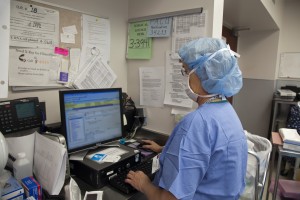 Electronic medical record systems (EMRs) have become a part of the work flow for more than half of all physicians in the U.S. and incentives are in place to bring that number up to 100% as soon as possible. Some hail this as a giant leap forward for healthcare, and in theory that is true. Unfortunately, EMRs have not yet achieved their potential in practice – as I have discussed in my recent blog posts about “how an EMR gave my patient syphillis,” in the provocative “EMRs are ground zero for the deterioration of patient care,” and in my explanation of how hospital pharmacists are often the last layer of protection against medical errors of EPIC proportions.
Considering that an EMR costs the average physician up to $70,000 to implement, and hospital systems in the hundreds of millions – it’s not surprising that the main “benefit” driving their adoption is improved coding and billing for reimbursement capture. The efficiencies associated with access to digital patient medical records for all Americans is tantalizing to government agencies and for-profit insurance companies managing the bill for most healthcare. But will this collective data improve patient care and save lives, or is it mostly a financial gambit for medical middle men? At this point, it seems to be the latter.
There are, however, some true benefits of EMRs that I have experienced – and to be fair, I wanted to provide a personal list of pros and cons for us to consider. Overall however, it seems to me that EMRs are contributing to a depersonalization of medicine – and I grieve for the lost hours genuine human interaction with my patients and peers. Though the costs of EMR implementation may be recouped with aggressive billing tactics, what we’re losing is harder to define. As the old saying goes, “What good is it for someone to gain the whole world, yet forfeit their soul?”
| Pros Of EMR |
Cons Of EMR |
| Solves illegible handwriting issue |
Obscures key information with redundancy |
| Speeds process of order entry and fulfillment |
Difficult to recall errors in time to stop/change |
| May reduce redundant testing as old results available |
Facilitates excessive testing due to ease of order entry |
| Allows cut and paste for rapid note writing |
Encourages plagiarism in lieu of critical thinking |
| Improves ease of coding and billing to increase reimbursement |
Allows easy upcoding and overcharging |
| Reminds physicians of evidence-based guidelines at point of care |
Takes focus from patient to computer |
| Improves data mining capabilities for research and quality improvement |
Facilitates data breaches and health information hacking |
| Has potential to improve information portability and inter-operability |
Has potential to leak personal healthcare information to employers and insurers |
| May reduce errors associated with human element |
May increase carry forward errors and computer-generated mistakes |
| Automated reminders keep documentation complete |
May increase “alert fatigue,” causing providers to ignore errors/drug interactions |
| Can be accessed from home |
Steep learning curve for optimal use |
| Can view radiologic studies and receive test results in one place |
Very expensive investment: staff training, tech support, ongoing software updates, etc. |
| More tests available at the click of a button |
Encourages reliance on tests rather than physical exam/history |
| Makes medicine data-centric |
Takes time away from face-to-face encounters |
| Improved coordination of care |
Decrease in verbal hand-offs, causing key information to be lost |
| Accessibility of health data to patients |
Potential for increased legal liability for physicians |
December 1st, 2014 by Dr. Val Jones in Health Tips, Opinion
1 Comment »
 Whenever possible I make a point of rounding on patients with their nurses present. I rely on nurses to be my eyes and ears when I’m not at the bedside. I need their input to confirm patient self-reports of everything from bowel and bladder habits to pain control, not to mention catching early warning signs of infection, mental status changes, or lapses in safety awareness. Oftentimes patients struggle to recall bathroom details, and they can inadvertently downplay pain control needs if they don’t happen to be in pain when I visit them. A quick check with their nurse can clarify (for example) that they are asking for pain medicine every 2 hours, that they have missed therapy due to somnolence, that their wound incision looks more red, and/or that they haven’t had a bowel movement in a dangerously long time. All critical details that I wouldn’t necessarily know from talking to the patient alone. Some of this information is not accurately captured in the electronic medical record either.
On a recent trip to a new facility, I asked the head nurse when change of shift occurred. She was visibly perplexed and asked why I wanted to know. I explained that I planned to attend nursing sign out so that I’d be up to date on how my patients were doing. She raised her eyebrows to their vertical limit and responded, “I haven’t seen a doctor do nursing rounds in 30 years.”
That was one of the saddest things I’d heard in a long time. How is it that one of the fundamental features of medical care (doctors and nurses visiting patients together) has gone the way of the dinosaur? Most of my colleagues say they don’t round with nurses because they “don’t have time for that stuff” or that they can “flag down a nurse when there’s an issue” without needing scheduled communication. While I can sympathize with the fear of yet another “time suck” during a busy hospital day, I believe that rounding with nurses can actually save time, reduce medical errors, and head off developing problems at earlier stages (e.g. wound infections, intestinal obstructions, delirium, over/under medication and unwanted medication side effects).
You may think that coordinating nursing rounds with medical rounds is an insurmountable logistical nightmare, and if you have patients scattered throughout various floors of a hospital, that will certainly make things more difficult. But I have found ways to overcome these barriers, and highly recommend them to my peers:
1. Attend nursing sign out at change of shift if possible. Do not disrupt their hand-off process, but ask for clarification (or offer clarification) at key points during patient presentation.
2. Listen to the change of shift recording. Some nurses have their night shift team record their observations and findings in lieu of a 1:1 hand-off process during busy morning hours. This has its advantages and disadvantages. The good thing is that relaying information becomes asynchronous (i.e., like email vs a phone call – you don’t have to be present to get the info), the bad thing is that you can’t ask for clarification from the person delivering the information. If the nurses know in advance that the patient’s doctor is also listening in, they will leave targeted medical questions and concerns for you on the recording.
3. Do your rounds at times when medications are most commonly delivered. You will be more likely to run into a nurse in the patient’s room and can coordinate conversations as well as perform skin checks together.
4. Communicate with nurses (between rounds) when you are about to order a series of tests or dramatically change medication regimens. Explain why you’re doing it so they will be able to plan to execute your orders more efficiently (i.e. before the patient leaves for a radiologic study, etc.) This open communication will be appreciated and will be reciprocated (and may help to spark interest in joining you for regular rounds).
5. Invite nurses to round with YOU. If you can’t join their change of shift, consider having them join your medical rounds. You’ll need to negotiate this carefully as the goal is to streamline rounding processes, not double them.
A recent study published in the New England Journal of Medicine described a sign out process that reduced medical errors by 30%. This communication strategy involved 1:1 transfer of information about patients in a structured team environment (including nurses in some physician meetings). I anticipate that further investigation will reveal that interdisciplinary rounding (with nurses and doctors together) is a critical piece of the error reduction process. For all our advances in technology and digital information tracking, “old school” doctor-nurse rounds may prove to be more important in reducing errors and keeping our patients safe than other far more costly (and exasperating) interventions.
November 6th, 2014 by Dr. Val Jones in Opinion, Research
No Comments »
 I have spent many blog hours bemoaning the inadequate communication going on in hospitals today. Thanks to authors of a new study published in the New England Journal of Medicine, I have more objective data for my ranting. A prospective intervention study conducted at 9 academic children’s hospitals (and involving 10,740 patients over 18 months) revealed that requiring resident physicians to adopt a formal “hand off” process at shift change resulted in a 30% reduction of medical errors.
What was the intervention exactly? Details are available via mail order from the folks at Boston Children’s Hospital. It may take me a few weeks to get my hands on the curriculum (which was supported by a grant from the Department of Health and Human Services). I’m not sure how complex the new handoff initiative is in practice (or if it’s something that could be replicated without government-approved formality) but one thing is certain: disciplined physician communication saves lives.
I myself (without a grant from HHS or a NEJM study to back my assertions – ahem) proposed a set of comprehensive communication practices that can help to reduce medical errors in the hospital. My list involves more than peer hand-offs, but also nursing communication, EMR documentation strategies, and reliance on pharmacists for medication reconciliation and review. It is more than just an information exchange protocol for shift-changes, it is a lifestyle choice.
I applaud the I-PASS Handoff Study for its rigorous, evidence-based approach to implementing communication interventions among pediatric residents in children’s hospitals. I am stunned by how effective this one intervention has been – but a part of me is saddened that we practically had to mandate the obvious before it got done. What will it take for physicians to adopt safer communications strategies for inpatient care? I’m guessing that for many of us, it will involve enrollment in a workshop with hospital administration-driven requirements for participation.
For others of us – regular communication with staff, patients, and peers already defines our medical practice. But because (apparently?) we are not in the majority, we’ll just carry on our instinctual carefulness and wait for the rest to catch up. At least now we know that there is a path forward regarding improving communication skills and transfer of patient information. If we have to force doctors to look up from their iPhones and sit around a table and speak to one another – then so be it. The process may improve our lives while it saves those of our patients.
November 3rd, 2014 by Dr. Val Jones in Health Tips, Opinion
214 Comments »
 Most hospitalized patients and families don’t realize that life-threatening medication errors are regularly thwarted by pharmacists. They are truly the unsung heroes of patient care. I just finished a locum tenens assignment at a hospital that uses EPIC as their electronic medical records system, and I was stunned by the impossibly complex medication reconciliation process. Each time a patient is admitted to the hospital, or transferred to another part of the hospital, a physician must review, approve, and re-order their medications. While this may seem like a good way to insure that medication errors are avoided, it actually has the exact opposite effect.
Because EPIC keeps lists of home meds, discontinued meds, and current meds available for review and reactivation, it takes little more than one misplaced check box to order the wrong dose or type of medication. Physicians who transfer a patient to another service can indicate their intended medication list and keep it “on hold” for the receiving physician to review and approve. Unfortunately, the software’s tab system is so complex that it’s extremely difficult to find that list and activate it. Lost in a sea of admissions tasks and order boxes in different fonts, colors, and drop down menus, one often accidentally reviews and approves discontinued types and doses of medicines. The only protection against such errors is the hospital pharmacist.
With each new admission to the inpatient rehabilitation unit, I had to resort to calling a pharmacist for help. I was terrified that I would accidentally insert medication errors into the patient’s order set by carrying forward discontinued meds. The long-suffering pharmacists explained to me that “most physicians make medication order errors in EPIC with each admission.” They said that they regularly had to talk physicians out of throwing their computer out the window in a state of extreme frustration. They also said that their EPIC user environment looked very different (and less confusing) than what the physicians used, so that they couldn’t even provide real-time phone guidance regarding order entry process.
The scary thing is that EPIC has the largest market share of any EMR in the United States. It is also (in my experience) the most prone to medical errors due to its overly complex medication reconciliation process. I have used other EMRs that have far simpler and more intelligent medication order entry processes. Soarian (Sieman’s EMR, just sold to Cerner) has, for example, an outstanding order entry system. So my complaint is not that “all EMRs are bad” – it’s that some have particularly flawed designs that are causing real harm to untold millions of patients. We just haven’t documented the harm yet. I tremble at the thought of what we’d find.
Until electronic medication reconciliation is made safer, pharmacists will be working overtime to correct records and protect patients from carry over errors. I thank my lucky stars that I have had vigilant, determined pharmacists by my side as I cared for very complex, sick patients who were exceptionally vulnerable to dosing errors. There has never been a more important time to exercise caution when entering hospital medication orders, or to express your appreciation for pharmacists. Without their help we might all be experiencing medication errors of EPIC proportions.