Most hospitals have slim margins, and budgets are set based on anticipated average patient reimbursement at Medicare rates. Some private insurers pay higher rates than Medicare, and the differential is often used to offset the cost of treating Medicaid patients. Medicaid reimburses at about half what Medicare pays, which is usually not enough to break even. Out of financial necessity, Medicaid patients are often given limited access to care and services. This is done in some subtle and some not-so-subtle ways. In a recent conversation with an orthopedist friend of mine, he confided in me candidly:
“Some of my colleagues in private practice can’t pay their office overhead if they treat Medicaid patients. So we see poor people with severely arthritic joints left in pain at home. In addition, with bundled payments, the surgeon gets a fixed amount for the patient’s operation and recovery. What incentive is there to send the patient to a rehab facility? It just takes money away from the surgeon. So the poor have to suffer with very long wait times to see someone who will operate on them, and then afterwards they’re on their own for recovery. Patients who go straight home are at higher risk of falling and may have much poorer outcomes. Surgeons get financial incentives for good outcomes, so it becomes a double disincentive to treat Medicaid patients. You don’t get enough for the operation, and you’re likely to get penalized for their poorer outcomes. Some surgeons I know wont touch a patient with Medicaid for any elective procedure. I have ethical problems with that – so I work at a non-profit hospital where we treat everyone. But I have to do higher volume to break even. I work 90 hours a week and barely see my family. I don’t know how much longer I can do it.”
It is common practice among nursing homes to have a limited number of “Medicaid beds.” The facility simply declines to admit more than 20% of patients with Medicaid. I hear case managers on the phone all day long, looking for a post-acute care facility who will accept a Medicaid patient. For the few non-profit facilities who don’t turn them away, deep financial costs are incurred as they struggle for survival.
The reality is that Medicaid rates are so low that having this insurance is not much better than none at all. As I’ve explained previously in the outpatient world (see an example of an insanely low Medicaid reimbursement for eye care), Medicaid is tantamount to charity care. The news that 21.3 million Americans might receive Medicaid coverage in the next decade should not be hailed as a leap forward. As I see it, that’s just a larger group of people with debilitating arthritis who can’t get hip and knee replacements and are left to suffer in pain at home.
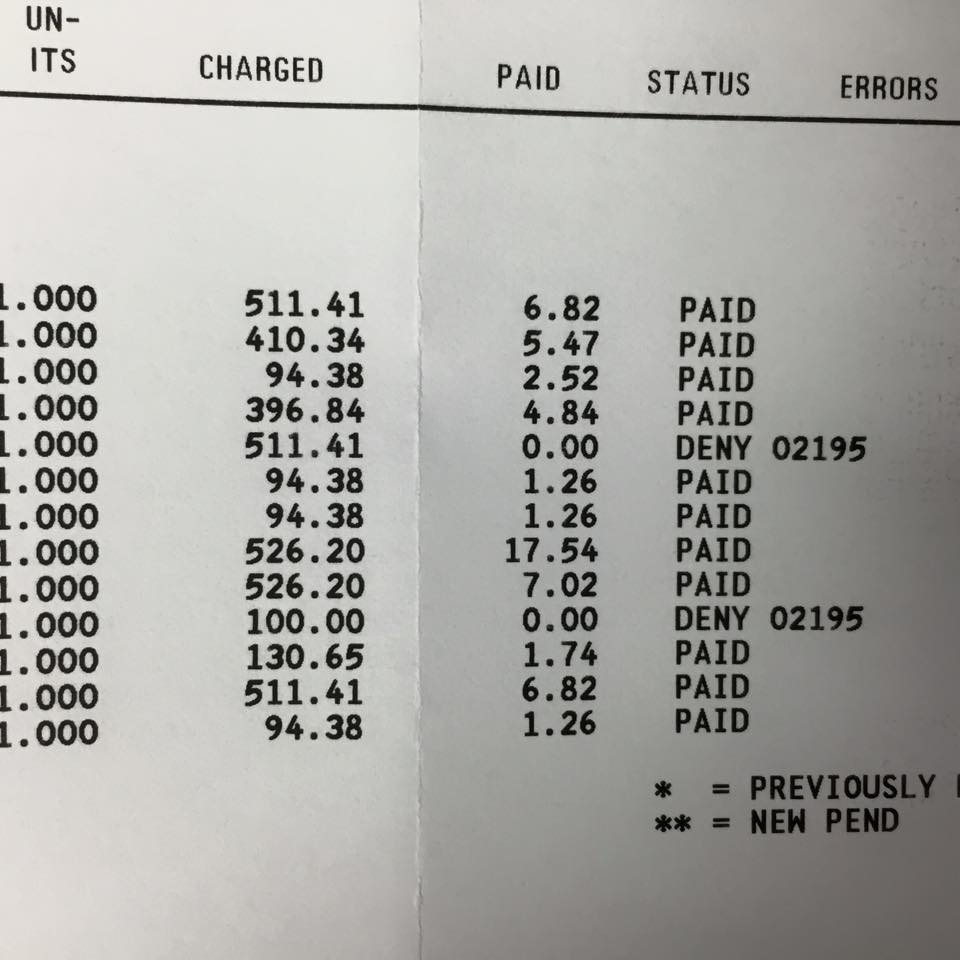
A physician friend of mine posted a copy of her Medicaid reimbursement on Facebook. Take a look at the charges compared to the actual reimbursement. She is paid between $6.82 and $17.54 for an hour of her time (i.e. on average, she makes less than minimum wage when treating a patient on Medicaid).
The enthusiasm about expanding Medicaid coverage to the previously uninsured seems misplaced. Improved “access” to the healthcare system via Medicaid programs surely cannot result in lasting coverage. In-network physicians will continue to dwindle as their office overhead exceeds meager reimbursement levels.
In reality, treating Medicaid patients is charity work. The fact that any physicians accept Medicaid is a testament to their generosity of spirit and missionary mindset. Expanding their pro bono workloads is nothing to cheer about. The Affordable Care Act’s “signature accomplishment” is tragically flawed – because offering health insurance to people that physicians cannot afford to accept is not better than being uninsured.
After all, improved access to nothing… offers nothing. Inviting physicians to work for less than minimum wage so that politicians can crow about millions of uninsured Americans now having access to healthcare, is ridiculous. Medicaid expansion is widening the gap between the haves and the have-nots. The saddest part is that the have-nots just don’t realize it yet.
In another example of government over-reach, the NYT describes how the Obama administration is enlisting the help of patients to report physicians (whom they believe may have made a medical error), directly to the federal government. While there are systems already in place for such reports at the local hospital level, apparently the “under reporting of medical errors” has triggered AHRQ to pilot a program in which questionnaires are sent to patients to ferret out potential examples of errors caused by the following:
* “A doctor, nurse or other health care provider did not communicate well with the patient or the patient’s family.”
* “A health care provider didn’t respect the patient’s race, language or culture.”
* “A health care provider didn’t seem to care about the patient.”
* “A health care provider was too busy.”
* “A health care provider didn’t spend enough time with the patient.”
* “Health care providers failed to work together.”
* “Health care providers were not aware of care received someplace else.”
So if a patient determines, for example, that a physician did not spend enough time with them, and they believe that resulted in a medical error (whatever that might be), they can/should report the physician to the federal government. Wow. One physician explains the potential hazards of such a process:
Dr. Kevin J. Bozic, the chairman of the Council on Research and Quality at the American Academy of Orthopaedic Surgeons, said it was important to match the patients’ reports with information in medical records.
“Patients’ perceptions and experience of care are very important in assessing the overall success of medical treatments,” Dr. Bozic said. “However, patients may mischaracterize an outcome as an adverse event or complication because they lack specific medical knowledge.
“For instance, a patient may say, ‘I had an infection after surgery’ because the wound was red. But most red wounds are not infected. Or a patient says, ‘My hip dislocated’ because it made a popping sound. But that’s a normal sensation after hip replacement surgery.”
I believe that reporting medical errors is critical in the process of quality improvement, but that is most efficiently handled at the hospital level. There is no need to involve the federal government at the earliest stages of investigation, and the amount of bureaucracy required to support such an effort boggles the mind.
In the past when I encountered medical errors in the hospital setting, I found successful ways to report the incidents to the local administration. The result was a rapid correction of the problems and new processes put in place to ensure that it didn’t happen again. This is how medical errors should be reported and resolved. Soliciting patients for accounts of subtle lapses in social graces by their healthcare providers, and then reporting them to the government for it, is nothing short of Big-Brother creepy.
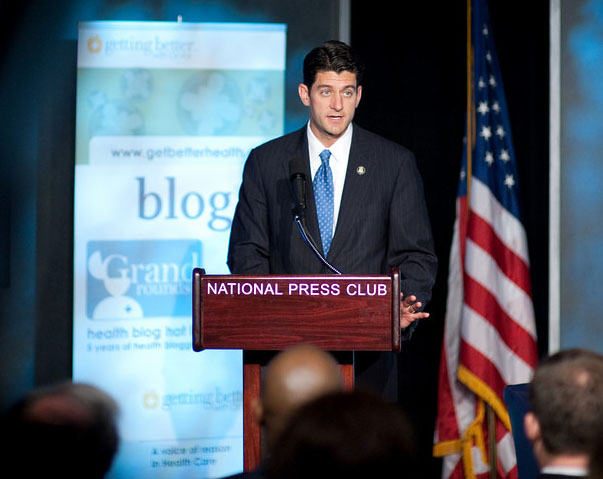
Now that Mitt Romney has announced that Paul Ryan is his VP pick, I thought it would be helpful to repost some video and transcripts from a healthcare reform conference that I organized in 2009. Paul Ryan was our keynote speaker at the National Press Club, and I found him to be a bright, articulate, and humble person. I remember that he was eager to please, and that he came to the conference early so that he would have time to listen to the physicians and nurses who had traveled from across the country to speak out about healthcare reform.
I hope the video and transcript give you some insight into his take on (what is now) Obamacare. Enjoy!
*** Congressman Paul Ryan addressed the crowd at Better Health’s “Healthcare Reform: Putting Patients First” event. This is a transcript of his speech: ***
This event is a landmark in how we get discussion and debate going in the 21st century. We are communicating with the grass roots, with medical bloggers here in this room and across the country.
Let me tell you this: I don’t want government interfering in the relationship between doctors and patients…and I don’t want insurance companies interfering either! I want a vibrant health care market that lets patients choose the health care options that are right for them and their loved ones. I want a free market democracy that puts patients first. We can have this, and I’ll say something more about that in a minute.
Right now Congress is rushing through a health care overhaul that goes in the opposite direction. It’s important to analyze the relative financial costs and benefits of these proposals, but our greater challenge is not the dollars and cents. It goes to the issue of continuing the tradition of excellent health care that medical practitioners now provide. It’s about the equal dignity of each human person…and the future of America as a free society. The American character, and the principles of freedom & democracy which protect & preserve it, may be lost beyond recovery if Congress chooses the wrong path on health care reform—the path down which I believe the Obama Administration seems determined to lead our country.
Public health has always been a government priority. Our Constitution’s Framers saw every individual as having a “right of personal security” which includes being protected against acts that may harm personal health. This right is part of the natural right to life, and it is government’s very purpose to secure our natural rights to live, to be free, and to pursue happiness.
Now here is where believers in big government make their big mistake. The right of each person to protection of health does not imply that government must provide health care. The right to have food in order to live doesn’t require government to own the farms and raise the crops. Government’s obligation is normally met by establishing the conditions for free markets to thrive. Societies with economic freedom almost always have a growing abundance of goods and services at affordable costs for the largest number. When free markets seem to be failing to meet this test – and I’d argue today’s health care delivery is an example – government should not supply the need itself. It should correct its own interventions and liberate choice and competition.
We know from survey after survey that a vast majority of Americans are personally satisfied with the quality of their own health care. The problem is really with health care delivery, which is growing too costly and leaving many people without coverage. The proponents of government-run health care claim there are only two alternatives: either enact their plan or do nothing. This is false. Government bureaucracy is not the answer to insurance company bureaucracy.
An authentic solution to the problem of affordability should be guided by the principles of moral and political freedom… respect doctor and patient privacy…restrain spending…and channel the energy of our free market system, not dry it up. There is no lack of sensible alternative solutions proposed by Republicans to put patients first. Senators Coburn and Burr, and Congressman Nunes and I have offered one, called “The Patients’ Choice Act.” It’s an example of how to eliminate government-driven market distortions that exclude many from affordable health care delivery. More uninsured Americans can be covered by spending current dollars more wisely and efficiently than by throwing trillions more at the problem. Our health care delivery alternatives are based on timeless American moral and political truths.
In essence, we believe that the dollars and decisions should flow through the individual patient, not from the government. I want to see a market where providers truly compete against each other for our business as consumers and patients – not a bureaucratized system where health care providers vie for government favor as patients wait in line.
When federal bureaucracy replaces consumer choice and competition, services are distorted and costs escalate. Consider Medicare and Medicaid. Real cost control has become a national nightmare. Fraud has proliferated despite every effort to stop it. Program costs are always underestimated. In 1966, the cost of Medicare to the taxpayers was about $3 billion. Congress estimated that by 1990, Medicare would cost taxpayers only about 12 billion in real dollars. The actual cost? Nearly nine times as high — $107 billion. By 2006, Medicare reached $401 billion, while Medicaid added another $309 billion for a total of $710 billion. The failure to control Medicare’s costs shows us why we should look to free markets and decentralization for the answers.
The health care programs being pushed by the Democrats are outrageously expensive and fiscally irresponsible. Like Medicare and Medicaid, they will fail to control health care costs. They will exacerbate our growing debt. They will require crushing taxes. Their approach would spend trillions more dollars, mandate that all but the smallest of businesses provide health insurance, require every American to pay for health insurance or punish them for not buying it, impose a massive new tax burden on employers & heath care practitioners, and make our entitlement crisis worse by adding yet another open-ended entitlement.
The so-called “public option” is presented as a way of “keeping private insurance honest”. Well, if this is their idea of “honesty,” we’re in really big trouble. The “public option” isn’t honest. It is designed to make private insurers go away.
Government has four huge powers that force free market competitors out of business. First, the government does not pay taxes and the private competitors do. Second, it forces competitors to establish high capital reserves while the government has none. Third, the government does not have to account for employee wage and benefit costs – private competitors do. Fourth, the government gets to dictate the prices it pays, which are much lower than its competitors.
It isn’t “honest competition” when government serves as both referee and player in the same game. Before the game begins, you know who will win. Unfortunately, it’s the people who lose. According to one independent study from a reputable actuarial firm, two out of three Americans will lose the health coverage they now have in three years if the House bill becomes law.
Government-monopolized health service contradicts everything America stands for. It conflicts with our people’s character…it conflicts with moral principles…it conflicts with market freedom…it conflicts with democracy…and it conflicts with American health care excellence that still draws patients from socialist utopias for medical treatments in this country.
Bureaucratized health care is not compassionate health care. Let me say that again: bureaucratized health care is uncompassionate, impersonal, and inflexible. When government agents make decisions about how to treat the sick, they don’t decide according to need…they decide according to a budget-driven calculus. Bureaucratic indifference replaces compassionate caregiving by loved ones under free markets offering a range of health services. We need to restore personal, patient-centered health care, the very opposite of the plan now moving through Congress.
The question really before us is about power. Where does the power go? In other words, where do the money and decisions come from? Right now, the nucleus of power in health care lies with third parties – insurers, employers, administrators. Patients and doctors are at the fringe. Should this power be shifted to the government OR to patients and doctors?
It’s a truly critical question. The answer will determine how competition in health care works. Will doctors, hospitals, and patients contend for government favors? A better reimbursement? Coverage of a new cancer treatment? Approval of a new process? The currency in this power structure is political connections, interest group politics, and bureaucratic dictates. OR will providers compete with each other based on price, quality, and outcome for the patient’s business? The currency in this power structure is value, results, and achievement. These principles work in every other market when used – why not health care?
In this debate, direction is destiny. And the destination of the bill now before Congress is government-run health care.
The logic of this bill will require government rationing of health care resources. Last February, the Economic Stimulus package set up a new agency to do this, the Council for Comparative Effectiveness Research, or CCER, modeled on Britain’s National Institute for Health and Clinical Excellence—they call it “NICE”. CCER’s stated purpose is to identify medical practices that produce outcomes that work as opposed to those that don’t work. As long as there is a competitive private health care market, better information on price and quality could help bring much needed transparency to healthcare in America. But under the government-run plan, providers will not be paid for health care which CCER disapproves of. Once competing plans have been driven out, CCER’s approval or disapproval will dictate the care providers may offer, automatically denying treatments for certain categories of patients.
England’s NICE is now a rationing bureaucracy. Under NICE rationing, the government has capped the amount that may be spent on treatments to extend someone’s life by six months. The amount is $22,000, an arbitrary number arrived at not by medical professionals but by government accountants.
The idea that the government should make decisions about how long people should live is deeply offensive to everything America stands for. It is wrong to conclude that because health care resources are limited, therefore the federal government must ration care. This is what free markets are for: finite goods and services, including health care, are rationed by each person judging their unique needs as they allocate their own resources among competing producers. But should government do this with its “one-size-fits-all” template? I believe government rationing is morally and politically abhorrent. It denies basic personal rights. The sick, special needs patients, and seniors – those most at risk when the government involves itself in these tough decisions – deserve better. Like it or not, once government-run health care is a fait accompli, government rationing becomes the logical endpoint.
Now I want to speak from the heart to every provider of health-related services, including doctors and nurses, assistants, educators, hospitals and clinics. Many of you have traveled great lengths to join us today. You will be profoundly affected by the outcome of this debate. EITHER US health care will travel down a path directed by Washington, where you take your orders and instructions from the federal government – a path like that of our friends to the North and many in Europe – OR health care will be reformed to empower practitioners to pursue health care excellence. Countries that have chosen nationalized health services have wiped out individual competition and stunted innovation, by eliminating the incentives to outperform. By law or in effect, medical professionals become government wage earners without adequate reward for exceeding average standards.
Government-driven health care threatens providers in at least three ways:
First: Every aspect of government-monopolized medicine inevitably will be reduced to “cookie cutter” standards. As providers, you know patients’ conditions are not exactly the same. Treatments must be tailored to unique needs. Health care excellence like this is only possible under a vibrant free market.
Second: The cost and price structure of nationalized medical services are distorted by price controls dictated by political demands for low rates of reimbursement. The principal result is to shrink supplies of price controlled human and material resources – fewer doctors, medicines, & hospitals. Then government must manage the decline. The shortages must be spread around by deciding who shall receive and who shall be denied life-saving support. Patients with greater needs and groups deemed less worthy of treatment are the first victims.
Third: Government-run health services build barriers to talented young men and women considering a career in medicine. Today there is a growing need for more talented medical practitioners to care for aging boomers. America needs young people with ability and skill to take on the long years of education and incur substantial student loans to serve our growing need for health care. The best and brightest won’t do this just to become de facto government employees whose practice and reimbursement are dictated by Congress.
If government-run health care becomes law, it will prove lethal to America’s health care providers. We will be on the path to socialized medicine. The Congressional majority ridicules the claim that this is their objective, but the government-run plan which they propose as “an important tool to discipline insurance companies,” in the President’s own words, must lead step-by-step down that road. Mocking a fact does not make it untrue.
Some of the biggest health care organizations are trying to cut a “deal” with the Administration and Congressional leaders. With all due respect, they should know better. This is a fool’s errand. All they can salvage is a temporary stay of execution…because a government takeover of health care in the United States will either squeeze out or take over all private sector providers, large and small.
What is at stake in this battle goes far beyond health care. This debate encapsulates the defining issue of our generation: do we reform and strengthen American free market democracy, or abandon it for European-style social welfare?
If the majority party wanted more competition, why propose government insurance instead of enabling more non-profit insurance?
If they had no intention of transforming the system into Medicare for all, why do they tie all payments to Medicare?
If they were so worried about our skyrocketing national debt and the burden on the next generation, why do they want to create an entirely new entitlement that would deal a staggering blow to our economy – an entitlement that rivals the size and liabilities of Medicare and Medicaid? Just yesterday the Director of the nonpartisan Congressional Budget Office told the Senate that their health care plan would worsen the overall fiscal outlook, and his review so far of the House proposal draws the same conclusion. It makes the fiscal situation even worse.
The fact is, this is ultimately not about health care but about promoting an ideological objective. This nation, founded on the self-evident truth that unalienable rights were granted to all not by government but by “nature and nature’s God,” is to be remade into a “benevolent” social welfare state. Federal health care is but the first step. Until now, people in other countries that have chosen that path might at least come to the United States. But where will Americans go when the US also has government-run health care? There will be no place of freedom left to us.
Every day America’s health care professionals meet the critical medical needs of our people with selfless dedication and passion. They would jump in front of a bus to save their patients. They deserve not just thanks but our recognition that their excellent care cannot continue under a government monopoly.
This is not the time to stand to one side. Providers themselves must engage in the struggle for the future of their high profession and commitment to the wellness of our people.
August is the time for action. This is the time when Americans either engage this debate and tell Congress they reject government-run health care…or sit silently by while Congress forces it on them. The President and Congressional leaders are saying this has to be done immediately – it has to be done right now – and leave the details to them – they know best. Well, whether your pet peeve is Iraq or bailouts or the so-called stimulus, we’ve all heard that line before. You know what they say: fool me once, shame on you. Fool me twice – or in the current political environment – 3 or 4 times – shame on me. Will we heed this lesson?
I am initiating this call to every person and group involved in health care: you must act now! Doctors, your patients trust you, they will listen to your “prescription.” Ask them. They’ll jam the Congressional switchboards. They have done it before and need to do this from now through August. They will defeat this threat to everything America has stood for.
Let’s get government health care off the table. Then we can address real reforms to bring patient-based health care back to America.
Government, hospital systems, pharmaceutical companies, pharmacies, pharmacy middlemen, and healthcare insurance companies are secondary stakeholders in the healthcare system.
The primary stakeholders are patients and physicians. They also comprise the medical care system. Without the primary stakeholders there would be no need for a healthcare system.
The secondary stakeholders have long ago taken over the healthcare system. All businesses and the government deal with the hand they are dealt using their best judgment. The people running the business or government pursue their vested interest. The difference between businesses and government is businesses work to make as big a profit as possible. Government, depending on the political party in power, pursues fulfillment of its ideology.
It’s no secret that doctors are disappointed with the way that the U.S. healthcare system is evolving. Most feel helpless about improving their work conditions or solving technical problems in patient care. Fortunately one young medical student was undeterred by the mountain of disappointment carried by his senior clinician mentors…
I am proud to be a part of the American Resident Project an initiative that promotes the writing of medical students residents and new physicians as they explore ideas for transforming American health care delivery. I recently had the opportunity to interview three of the writing fellows about how to…
I m often asked to do book reviews on my blog and I rarely agree to them. This is because it takes me a long time to read a book and then if I don t enjoy it I figure the author would rather me remain silent than publish my…
When I was in medical school I read Samuel Shem s House Of God as a right of passage. At the time I found it to be a cynical yet eerily accurate portrayal of the underbelly of academic medicine. I gained comfort from its gallows humor and it made me…
I am hesitant to review diet books because they are so often a tangled mess of fact and fiction. Teasing out their truth from falsehood is about as exhausting as delousing a long-haired elementary school student. However after being approached by the authors’ PR agency with the promise of a…


 Most hospitals have slim margins, and budgets are set based on anticipated average patient reimbursement at Medicare rates. Some private insurers pay higher rates than Medicare, and the differential is often used to offset the cost of treating Medicaid patients. Medicaid reimburses at about half what Medicare pays, which is usually not enough to break even. Out of financial necessity, Medicaid patients are often given limited access to care and services. This is done in some subtle and some not-so-subtle ways. In a recent conversation with an orthopedist friend of mine, he confided in me candidly:
 A physician
  In another example of government over-reach, the