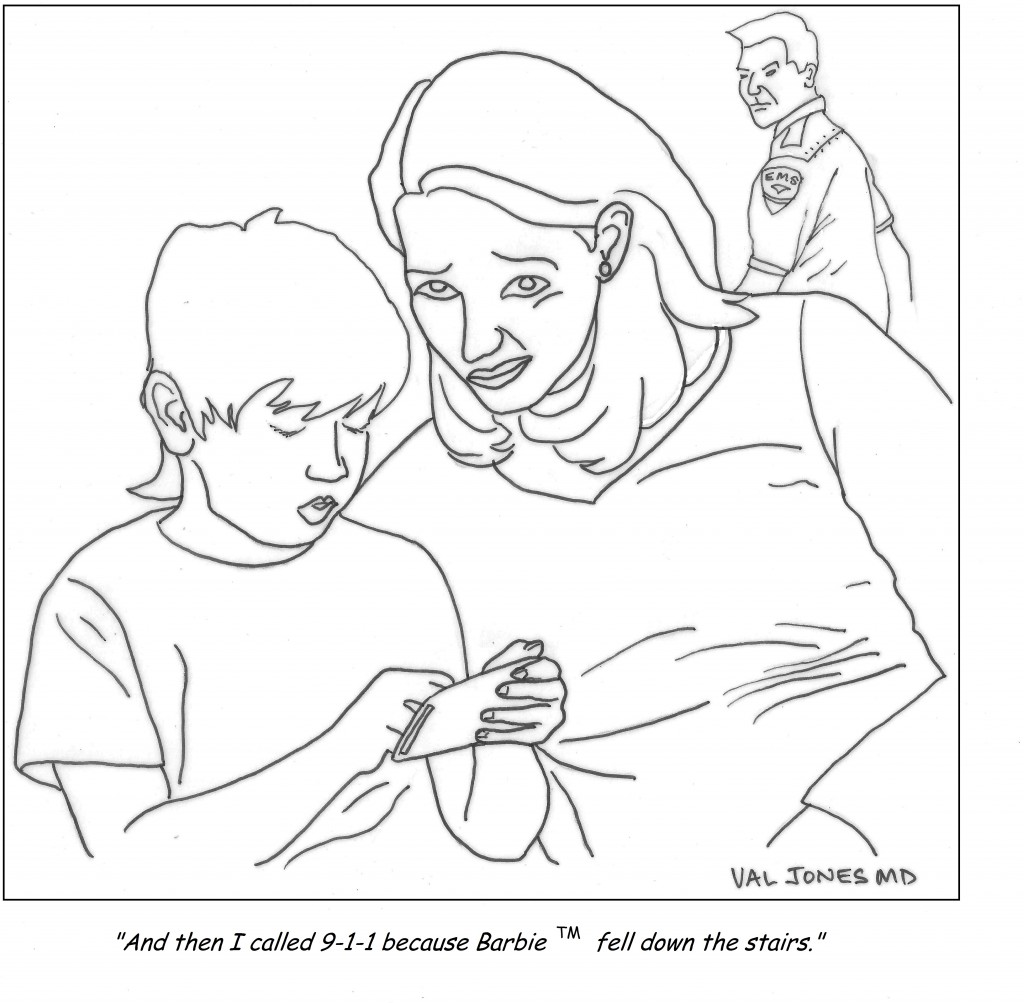
Cartoon: That Moment When You Realize Your Child Took Your Emergency Training Very Literally


 I have spent many blog hours bemoaning the inadequate communication going on in hospitals today. Thanks to authors of a new study published in the New England Journal of Medicine, I have more objective data for my ranting. A prospective intervention study conducted at 9 academic children’s hospitals (and involving 10,740 patients over 18 months) revealed that requiring resident physicians to adopt a formal “hand off” process at shift change resulted in a 30% reduction of medical errors.
What was the intervention exactly? Details are available via mail order from the folks at Boston Children’s Hospital. It may take me a few weeks to get my hands on the curriculum (which was supported by a grant from the Department of Health and Human Services). I’m not sure how complex the new handoff initiative is in practice (or if it’s something that could be replicated without government-approved formality) but one thing is certain: disciplined physician communication saves lives.
I myself (without a grant from HHS or a NEJM study to back my assertions – ahem) proposed a set of comprehensive communication practices that can help to reduce medical errors in the hospital. My list involves more than peer hand-offs, but also nursing communication, EMR documentation strategies, and reliance on pharmacists for medication reconciliation and review. It is more than just an information exchange protocol for shift-changes, it is a lifestyle choice.
I applaud the I-PASS Handoff Study for its rigorous, evidence-based approach to implementing communication interventions among pediatric residents in children’s hospitals. I am stunned by how effective this one intervention has been – but a part of me is saddened that we practically had to mandate the obvious before it got done. What will it take for physicians to adopt safer communications strategies for inpatient care? I’m guessing that for many of us, it will involve enrollment in a workshop with hospital administration-driven requirements for participation.
For others of us – regular communication with staff, patients, and peers already defines our medical practice. But because (apparently?) we are not in the majority, we’ll just carry on our instinctual carefulness and wait for the rest to catch up. At least now we know that there is a path forward regarding improving communication skills and transfer of patient information. If we have to force doctors to look up from their iPhones and sit around a table and speak to one another – then so be it. The process may improve our lives while it saves those of our patients.
 Thanks to support from OTCSafety.org, I’ve created a series of health tips for common medical concerns. This week’s article is about how to diagnose and treat sleep difficulties in children and adolescents. There are many possible causes of insomnia, which include everything from emotional distress to bad dreams, breathing problems, stomach pains, medical conditions or behavioral problems.
In my article I discuss how you can work with a healthcare professional to determine the cause of your child’s sleep difficulties (this includes details on how to keep a sleep diary). I offer instructive do’s and don’ts to promote healthy sleep, and offer examples of symptoms that may require medical intervention.
For the full article, please click here. I promise it won’t put you to sleep! 😉
 I’ve continued to have terrific email questions and answers with the Boys & Girls Clubs’ Fit Family Challenge participants. I thought I’d publish some of our conversations so that you can participate as well. The Lang family shared this image of their son eating dinner next to the latest USDA dietary recommendations “MyPlate” materials. A picture’s worth 1000 words, isn’t it?
This cute fella is a healthy weight, he is very athletic, and he’s also wondering where chicken nuggets, french fries, and pizza fit in to the MyPlate dinner plans… His mom asked me how to make more “kid friendly” healthy meals. Perhaps some folks reading this have some success stories that they’d like to share? Here’s what I had to say to the Langs and others…
1. My son doesn’t think the MyPlate suggested meals are kid friendly. What can we do?
I wonder if your son would be open to trying healthier variations of the foods he likes? You could make a pretty tasty pizza with whole wheat crust, grilled veggies, a little pesto or tomato sauce and some ham cubes (ham is much lower in fat than sausage or pepperoni) and low fat shredded mozzarella. You can get a pizza stone to help crisp the crust in a regular oven. The pizza would probably reheat well so you could make it in advance too.You can bread chicken strips and bake them (instead of frying them) to simulate healthy chicken “nuggets.” Same for fish sticks. You can try sweet potato fries for a healthier fry option – bake them in the oven with a little olive oil, salt and pepper. More nutritious, kid-friendly recipes may be found at KidsHealth.org
2. Do my kids need 8 cups of water a day?
As far as water is concerned, the amount you need really depends on how much liquid you’re getting from other sources (food, beverages) as well as how much you’re sweating (exercise), how hot/dry the environment is and how much you weigh. Eight cups/day is a very rough rule of thumb. Some people need more or less depending on the day. Unless you are doing extreme exercise (in the heat) that requires fluid replacement before you notice that you’re thirsty, thirst is a good indicator of whether or not you need to drink. Also, I’ll tell you a doctor secret – all you need to know about hydration is in your urine color. Urine becomes very concentrated (dark yellow) when you are dehydrated. If you drink enough water to keep your urine a nice light yellow, then that’s all you need.
3. What are the best vegan protein substitutes for meat?
Concentrated vegetable protein is primarily derived from soy (tofu and tempeh) and wheat (seitan). Nuts and seeds also contain some degree of protein, as well as beans, lentils, and rice. Tofu, tempeh, and seitan can be molded into burger and hotdog shapes and may be prepared to mimic meat flavors. Keep in mind that concentrated soy or wheat proteins may not agree with your intestinal tract (some complain of excessive gas and bloating). So if you have those reactions, at least you’ll know that it’s quite common.
4. Is it healthy to be a vegetarian? Is there such a thing as too much fruit and veggies?
Vegetarianism can be healthy, though it takes some effort to ensure that adequate amounts of nutrients are received – especially if you’re vegan (no dairy, no eggs). The most common deficiencies for vegans are iron, B12, calcium, Omega-3 fatty acids, protein, and Vitamin D. (You can read more about how vegetarians can overcome these deficiencies here.) I guess my main concern with veganism is the low omega-3s. It is basically impossible to get enough omega-3 fatty acids from plant sources (certain seeds, you may have heard, have a good amount of omega-3 fatty acids but what they won’t tell you is that plant omega-3’s aren’t processed by the body so they remain inactive and don’t provide much benefit.) Omega 3 fatty acids form a protective layer on the outside of cell membranes by reducing inflammation. This is particularly helpful in the reduction of plaque build up in heart arteries, and reducing the risk of various dementias (such as Alzheimer’s) that have an inflammatory cause.
Excellent sources of omega 3 fatty acids are oily fish (sardines, salmon, mackerel, sea bass). This is why the American Heart Association (and MyPlate.gov) recommend 2 servings of oily fish/week for optimal health. Vegetarians are missing out on this important benefit.
As far as eating too many fruits/veggies is concerned – I can’t think of too many potential harms from eating large amounts of fruits/veggies (other than weight gain if you really eat a lot of fruit – they have quite a bit of natural sugar). The real harm comes from excluding vital nutrients by eating plants exclusively (without a careful strategy to get the right plant sources of vitamins and minerals, along with omega-3 supplements).
 As fathers, one of our most important responsibilities is to be there for our children. Work and travel schedules may make it difficult to be home every night for dinner or to catch every baseball game or music performance, but taking action on a few simple things can help us invest in our health today to ensure we are around to support and guide our children as they grow.
As the survivor of a health scare a few years ago, I have made a personal commitment to a simple, five-point plan for health – and I encourage others to do the same. Here’s the plan I follow that can also help you invest in your future:
1. Know your numbers – Cholesterol, blood pressure, blood sugar. The key to good health is understanding first where you stand, and what you need to improve. For me, I love to cook so it’s about reducing the amount of salt and sugar I use to keep my numbers in check.
2. Know your history – Just as important as the lifestyle you lead is what you’ve inherited from your family. Knowing what you face genetically can go a long way in ensuring your current and future health. Share your family history with your physician who can help develop a customized health care plan that allows you to monitor and track against illnesses for which you might be disproportionately at risk due to what you’ve inherited.
3. Make balanced choices in your diet – Healthy eating isn’t about denying yourself every food you enjoy. As my doctor likes to say, you don’t have to give up everything. You never will be successful. But you do have to discipline yourself, and that’s something I have been working on as I try to manage my own weight. It’s not about going on a diet, which is based on denial, but about making responsible decisions that let you enjoy the foods and drinks you love, but in moderation. It’s tempting to eat steak and burgers – but research continues to caution against eating too much red meat. Instead of reaching for the chips, eat celery or carrot sticks instead. And instead of grabbing that cookie, reach for a peach or an apple to satisfy your sweet tooth.
4. Get moving! Get active – Most of us sit behind desks – or in traffic – for a good part of the day, so I can’t emphasize this point often enough. Physicians usually recommend at least 30 minutes of exercise, five days a week. You don’t have to be an athlete to get active – just walk, walk, walk! As president of a large, national health care organization, I log many miles traveling to our various sites. During my time on the road, I often take a personal walking tour of the many cities I visit. Walking doesn’t take fancy equipment and you don’t need to dress up or drive somewhere to do it. All you need is a sturdy pair of walking shoes, and many hotels provide maps for walking. You can even log miles and track your progress with walking partners at www.everybodywalk.com.
5. Have a good relationship with your physician. I respect – and also really like my doctor. She is more than a physician; she is a great coach. You should have the type of relationship with your physician where you feel he or she is on your team. If you don’t feel comfortable with your physician or don’t think of her or him as a partner in your life plan for health, then it’s time to find a doctor who can support your path to total health.
According to the U.S. Surgeon General, 80 percent of premature deaths in the U.S. are caused by four preventable behaviors: lack of physical activity, poor diet, alcohol use and smoking. The five steps I’m sharing with you are simple behavioral changes that won’t take up a lot of time, and will pay off in dividends in 10, 20, even 30 years down the road. Making time to invest in your health is a commitment well worth making and every effort you contribute starting today, will pay significant dividends for years to come.
Bernard J. Tyson is president and chief operating officer of Kaiser Foundation Hospitals and Health Plan, Inc.
It’s no secret that doctors are disappointed with the way that the U.S. healthcare system is evolving. Most feel helpless about improving their work conditions or solving technical problems in patient care. Fortunately one young medical student was undeterred by the mountain of disappointment carried by his senior clinician mentors…
I am proud to be a part of the American Resident Project an initiative that promotes the writing of medical students residents and new physicians as they explore ideas for transforming American health care delivery. I recently had the opportunity to interview three of the writing fellows about how to…

Book Review: Is Empathy Learned By Faking It Till It’s Real?

I m often asked to do book reviews on my blog and I rarely agree to them. This is because it takes me a long time to read a book and then if I don t enjoy it I figure the author would rather me remain silent than publish my…
The Spirit Of The Place: Samuel Shem’s New Book May Depress You

When I was in medical school I read Samuel Shem s House Of God as a right of passage. At the time I found it to be a cynical yet eerily accurate portrayal of the underbelly of academic medicine. I gained comfort from its gallows humor and it made me…
Eat To Save Your Life: Another Half-True Diet Book

I am hesitant to review diet books because they are so often a tangled mess of fact and fiction. Teasing out their truth from falsehood is about as exhausting as delousing a long-haired elementary school student. However after being approached by the authors’ PR agency with the promise of a…