October 7th, 2011 by KennyLinMD in Health Policy
1 Comment »

A New York Times Magazine story published on the newspaper’s website on Wednesday details the complicated history of screening for prostate cancer in the U.S. and revisits the related story of the U.S. Preventive Services Task Force meeting that was abruptly cancelled for political reasons on November 1, 2010, the day before the midterm Congressional elections. I was interviewed several times for this story, starting shortly after my resignation from my position at the Agency for Healthcare Research and Quality, where for 4 years I had supported the USPSTF’s scientific activities on a wide range of topics.
I commend science journalists Shannon Brownlee and Jeanne Lenzer for their tireless reporting efforts and dogged persistence in pursuing the real reason for the meeting’s cancellation, despite repeated and vigorous denials of senior government officials. Former USPSTF Chairman Ned Calonge confirms in the Times story that politics played a role: “In November 2010, just before midterm elections, the task force was again set to review its [prostate screening] recommendation when Calonge canceled the meeting. He says that word leaked out that if the November meeting was held, it could jeopardize the task force’s financing.” It’s true that several members of Congress had threatened to cut off funding for the Task Force after it recommended against routine mammography for women in their 40s. To the best of my knowledge, however, the order to cancel the meeting came directly from the White House, not Congress. And according to my superiors at the time, Dr. Calonge had no choice in the matter. Read more »
*This blog post was originally published at Common Sense Family Doctor*
September 27th, 2011 by Edwin Leap, M.D. in Health Policy, Opinion
No Comments »

I recently saw a teenage boy with headaches. His father, wringing his hands, said that the headaches had been present for two years; but that the child had never been evaluated for them. No imaging, no neurologist. No insurance, of course.
A family friend, another child, had been diagnosed with a brain tumor. The family of my patient was terrified. Where to turn? They were, reasonably, concerned about cost.
Contrast that with the woman I saw on state assistance. Read more »
*This blog post was originally published at edwinleap.com*
September 10th, 2011 by GruntDoc in Health Policy, Research
3 Comments »

Why don’t docs get more of what they want in DC? There’s a quite instructive graph in a blog post from NRO last week (talking about Union campaign donations), but I found this one to be very instructive, and have added labels so the point cannot be missed:
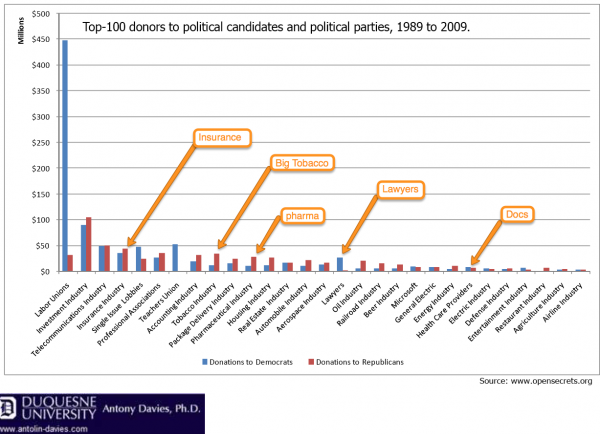
In politics, generally what you give is what you get. I’ve taken to giving more to the PACs that represent me.
As an aside, it’s political malpractice to give only to one party (Teachers). Eventually that one party will be on the outs, and then where are you?
*This blog post was originally published at GruntDoc*
September 8th, 2011 by Edwin Leap, M.D. in Opinion
No Comments »
I think a lot about the slow, certain dissolution of medicine as we know it. Mental health issues crowd emergency departments, as few mental health clinics are available. Psychiatrists are in short supply. Drug abuse overwhelms the medical system, with either patients seeking pills or patients families hoping to get them off of pills.
Persons with little interest in their own health continue to smoke and drink, use Meth and eat poorly. Disability claims are skyrocketing as younger and younger individuals confabulate their misery in hopes of attaining a check, paid for by someone else.
The poor, with genuine medical problems, have increasing difficulty finding care as jobs, and insurance, fade away. Politicians, eager to be re-elected, eager to be loved, promise Read more »
*This blog post was originally published at edwinleap.com*
July 13th, 2011 by gbadmin in Opinion
No Comments »

Both Germany and France have now suspended the marketing of Actos (pioglitazone) due to concerns of a link between Actos and bladder cancer. Though we have known about bladder cancer concerns for some time, these recent concerns about the bladder cancer link stem from a recent report analyzing the FDA’s Adverse Event Reporting System (AERS), which found that 93 cases of cancer were recorded between 2004 and 2009 in patients treated with antidiabetic drugs, of which 31 patients were treated with pioglitazone, representing a statistically significant increased risk of bladder cancer (ROR 4.30, 95% confidence interval, 2.82-6.52; P less than 0.0001).
Interestingly, the FDA announced that it was going to look into the link between Actos and bladder cancer only a few days before it made its final decision on what to do with Avandia (as if they didn’t know about the Actos cancer risk before the July 2010 advisory board).
Despite the many things you have heard about Avandia, back in July 2010, the FDA decided to severely restrict the use of Avandia for three reasons: Read more »
*This blog post was originally published at ACP Internist*