December 12th, 2014 by Dr. Val Jones in Expert Interviews, Health Tips
1 Comment »
 I am proud to be a part of the American Resident Project, an initiative that promotes the writing of medical students, residents, and new physicians as they explore ideas for transforming American health care delivery. I recently had the opportunity to interview three of the writing fellows about how to help patients take control of their health. Dr. Marissa Camilon (MC) is an emergency medicine resident at LA County USC Medical Center, Dr. Craig Chen (CC) is an anesthesiology resident at Stanford Hospitals and Clinics, and Dr. Elaine Khoong (EK) is a resident in internal medicine at San Francisco General Hospital. Here’s what they had to say:
1. How would you characterize the patients who are most successful at “taking charge of their health?”
MC: They are usually the the patients who aren’t afraid to ask questions about everything- possible treatments, pathology, risk factors.
EK: I think there are several traits that make patients successful at modifying their health: 1) Understanding of their disease: patients need to understand how their actions impact their health and be able to clearly identify the steps they need to take to achieve their desired health. 2) Possessing an internal locus of control: patients need to feel that their health is actually in their control. Oftentimes, patients who come from families that have a history of chronic diseases simply assume certain diseases may be their fate. But in reality, there are things that can be done to manage their disease. 3) Living in a supportive, nurturing environment: behavior changes are difficult. It is often not easy to the right thing for your health. Patients that take control of their health have a support system that helps ensure they take the steps they need. 4) Having realistic expectations: improving your health takes time and thus it requires patience. Individuals must be able to identify the baby steps that they’ve taken towards improving their health.
CC: Patients must collaborate with their physician – the best patients come in motivated, knowledgeable, and educated so they can have a meaningful dialogue with their doctor. Medical decision making is a conversation; patients who are invested in their health but also open to their doctor’s suggestions often have the best experiences.
2. What do you see as the main causes of non-adherence to medical advice/plans?
MC: Not fully understanding his or her own disease process, denial/shock, inability to pay for appointments/rides/medications.
EK: I think there are several reasons that patients may be non-adherent. These reasons can largely be grouped into three main categories — knowledge, attitude, and environmental factors. Some patients simply don’t understand the instructions provided to them. Providers haven’t made it clear the steps that need to be taken for patients to adhere. In other cases, patients may simply not believe that the advice provided will make an impact on their health. Probably most frequently, there are environmental factors that prevent patients from adhering to plans. Following medical advice often requires daily vigilance and strong will power. The challenges of daily life can make adherence difficulty.
CC: In my mind, non-adherence is not a problem with a patient, but instead a problem with the system. Modern medicine is a complex endeavor, and patients can be on a dozen different medications for as many medical problems. It’s unreasonable to expect someone to keep up with that kind of regimen. Socioeconomic factors also play a big role with adherence. Patients who are poor struggle to maintain housing, feed their children, hold a job; how can we expect them to be perfectly medically compliant? Tackling the issue of non-adherence requires engagement into the medical and social factors that pose challenges for patients.
3. Could mobile health apps help your patients? Do you think “there’s an app for that” could revolutionize patient engagement or your interaction with your patients now or in the future?
MC: Apps, not necessarily. Most of patient population has limited knowledge of their mobile phones (if they even have mobile phones). If they do have a phone, its usually an older model that doesn’t allow apps.
EK: I absolutely think that mobile health apps could help my patients. I work at a clinic for an urban underserved population. For patients that work multiple part-time jobs to make ends meet, it is difficult to ask them to come into see a healthcare provider (particularly if the commute to see us requires 2+ bus rides). Unfortunately the patients who are working multiple jobs are often patients in their 40’s and 50’s when they start manifesting the early signs and symptoms of our most common chronic diseases (hypertension, diabetes, and cardiovascular disease). Mobile applications have great potential to simplify the way through which patients can receive medical guidance especially helping the patients who don’t have the luxury to seek medical advice during normal work hours.
CC: I think there is a role for technology in the delivery of modern medical care. However, we have to keep in mind that not everyone has access to smartphones, and often the most medically disadvantaged populations are those who need support the most. Although initially, technology seemed to put a barrier between the clinician and the patient, I think as devices become more prevalent and we become better at using them, we’ll be able to use these collaboratively. The main advantage of an “app” or device is giving the patient more control over their health; they can track their sleep, diet, exercise, medication adherence, and other aspects of their health and work with their doctor to optimize it.
4. Do you know of any programs to improve health literacy that have been particularly successful or innovative? If so, describe. If not, what kind of initiative do you think could make a difference for your patients?
MC: I know that some of the primary care clinics in the county have started using texting for appointments reminders. Texting seems to be more accessible to our county population.
EK: Unfortunately, off the top of my head, I cannot think of any great programs that have increased health literacy. Part of the reason for this is that we really don’t have a great sense of what levers increase literacy. Any initiative that will work best honestly depends on the individual patient — each patient has different barriers that limit their health literacy. For some patients, their limited English proficiency is the greatest barrier. For other patients, there are cultural beliefs that must be considered in delivering health content. And for some patients, numeracy or general literacy is an issue. Unfortunately, I think there is no one size fits all solution for addressing health literacy.
CC: I don’t think there’s any magic bullet for health literacy. Different communities, patient populations, and clinical settings merit different interventions. For example, tackling child obesity in a neighborhood with lots of fast food requires a different program than ensuring prenatal health in an immigrant community.
5. Are there generational differences in how your patients interact with the healthcare system? Describe.
MC: I tend to see older patients since they usually have more medical problems. They are more likely to have a primary care doctor; whereas younger patients don’t come in as often, but don’t usually have access to primary care.
EK: I think more than a generational difference there is actually a cultural and socioeconomic difference. Traditionally, we are taught or somehow led to believe that older patients are more likely to simply adhere to medical advice whereas younger patients question. But in my limited experience, I have seen affluent patients more engaged with providers (bringing in their own resources, asking about health advice they’ve heard or read about). Some of my less wealthy patients seem more passive about their health and during visits. Furthermore, patients from certain cultural backgrounds are more or less likely to view healthcare providers as an authoritative figure rather than a partner in shared decision making.
6. Do you use digital systems (EMR/Social Media/Mobile) to interact with your patients in any way? Do you think you should do more of that, or that there is a desire for more on the part of your patients?
MC: We do have an EMR but don’t really use it to interact with patients. As I mentioned before, mobile texting may encourage patient interaction.
EK: The main way that I currently use digital systems to interact with patients is via email. Our clinic has a somewhat difficult-to-navigate telephone prompt system, so some patients email me directly re: changing their appointments, medical advice, or medication refills. Unfortunately our EMR doesn’t currently have a patient portal (although it will be rolling this out soon). I think a patient portal is a great tool for helping patients stay more engaged in their healthcare.
I think there is a role for SMS messaging to remind patients about appointments, important medications, or other healthcare related notices. For the right patient population, I think this could make a big difference.
In general, I am a big proponent of technology. I don’t think it’s going to be a panacea for our many problems in the healthcare system, but I think there are very specific shortcomings that technology can help us address.
7. What would your patients say they needed in order to be better educated about their health and have more successful healthcare experiences?
MC: More time with their physicians, mainly.
EK: Almost certainly simply more time with healthcare providers to better explain their health issues as well as more time to explore shared decision making.
CC: There is a lot of information out there about common illnesses and diseases, but not all of it is accurate or up-to-date. One challenge for patients is identifying appropriate resources written in a manner that can be easily read and understood with content that has been reviewed by a physician or other health care expert.
8. If you could pick only 1 intervention that could improve the compliance of your patients with their care/meds, what would it be?
MC: Increase the amount of time physicians have to answer questions with patients and discuss medical treatment options with them.
EK: Wow, that’s a hard one. I struggle to answer questions like this because I strongly believe that each patient is so different. Any non-adherent patient has his or her own barrier to adherence. But I suppose if I had to pick something, it might be some form of weekly check-in with a health coach / community health worker / health group class that intimately knew what the most important steps would be to helping that one patient ensure better health.
CC: I think that social interventions make the most difference in the health of underserved populations. For example, stable housing, healthy meals, job security, and reduction in violent crime will improve health including medical compliance far more than any medicine- or technology-based intervention.
October 14th, 2014 by Dr. Val Jones in Health Policy, True Stories
3 Comments »
Physicians looking for part-time jobs to supplement their income may have run across advertisements for “lucrative” Medicare Advantage evaluation opportunities at CenseoHealth. Here’s a typical ad:
|

CenseoHealth is the leading Risk Adjustment provider for Medicare Advantage plans – with a network of more than 1,800 credentialed providers conducting over 20,000 member health evaluations a month. Due to our continued growth, we are currently looking to hire in-home physician evaluators to work in these states.
As a CenseoHealth physician, you will meet with Medicare Advantage members in their homes to conduct their annual medical history and physical evaluation.
Additional Information:
-
Conduct evaluations when it’s convenient for you
-
Ongoing physicians can make $3,500 to $4,000 per week
-
Physicians who work 1-3 days per week can make $800 – $2,000
-
Travel and lodging expenses are covered, plus we provide a per diem reimbursement
-
Malpractice insurance is included
-
This position does not require you to prescribe medicine, order lab tests, do blood work, or alter the member’s current treatment regimen
Please contact us, for more information.
Bryan Cooke
Director of Physician Recruiting
P: 972.715.3772
E: physicians@censeohealth.com
|
|
Sounds pretty good, right? Well here’s what they won’t tell you:
1. Low Hourly Pay. Compensation is $100 per completed evaluation – but you have to drive to each member’s house (sometimes an hour each way) to complete a 31 page history and physical exam. Members are often medically complex, cognitively impaired, and/or non-English speaking. In the end (after counting travel time, cancellations, scheduling snafus, and long hours completing paperwork and FedEx shipping) the hourly wage works out to be about $30.
2. Poor Logistics. Members are scheduled back-to-back without regard to distance between their locations. That means you are chronically late, and some members cancel their meeting with you. No-show and cancellation rates (in my experience) are about 20%. You are not compensated for any of the time associated with driving to their location, talking to them on the phone, or otherwise trying to locate them when they are not home upon your arrival. Once a member cancels, you cannot fill their slot with someone else on the same day.
3. Threat of harm. Members mostly come from low to middle class income levels. Some of them live in truly horrific living situations (no electricity, a home overrun with cockroaches, no food or running water), and others are psychologically unstable. As a female physician driving alone into a very rural area to conduct a physical exam on a male patient who is actively psychotic… this can be dangerous. You never know what or who you will face. I have had to call social services on numerous occasions and have narrowly escaped inappropriate sexual advances.
4. Limited Support. There is no guarantee that anyone from the parent company will be available via phone when you call during an emergency. I have called on several occasions during critical situations where I had to leave a voice message and was assured that “my call was very important” and someone from provider services “would get back to me within 1/2 a business day.”
5. Questionable ethics. Schedulers do not explain to the members why you are coming to their home to evaluate them. Because the schedulers seem to work on commission, they often use questionable tactics to get the members to agree to the evaluation – such as telling them that the meeting is “mandatory” and will “take 20 minutes” or is “just a wellness visit.” For this reason, many members receive you with suspicion, wondering if you’re there to try to “throw them off the Medicare plan” or are angry that they were mandated to meet with you. Lengthy conversations and apologies to set the stage for your evaluation are commonplace.
6. Payment denials and exaggerated pay potential. Evaluations must be completed meticulously or the quality assurrance reviewers will reject your forms and you will not be compensated for your work (if you, for example, forget to check a box or use a non-approved abbreviation). Although the advertisements state that some physicians complete 35-45 evaluations per week, that is nearly impossible in areas where clients are not clustered together tightly. It is an extremely misleading statement, in my experience. Apparently online reviewers agree.
7. Glitchy and costly technology. In order to save on costs, electronic evaluations can be completed via an iPad rather than paper forms. Unfortunately, the software often crashes, resulting in a return to paper in the middle of an evaluation. This ends up increasing the amount of time required to complete evaluations as your evenings are spent copying paper records into the iPad program. In addition, you are required to purchase your own stylus for data entry, as well as all the equipment required during your physical exam (e.g. blood pressure cuff, bathroom scale, ophthalmoscope, stethoscope, and more).
8. Low-budget travel and accommodations. While the agency boasts that they will pay for your accommodations and rental car, that typically translates into a room at a low-budget hotel and a Toyota Yaris with roll-down windows and no GPS.
9. The truth is hidden. The real reason for the evaluations is to help health insurers obtain larger reimbursements from the government. A physician (or NP) is required to verify all of the patient’s current medical conditions to justify their “risk score.” Medicare Advantage plans get paid more to manage patients with higher risk scores, so they are very motivated to document the complete list of diseases and conditions per at-risk senior. Patients may benefit from having an objective third party review their health record, but this is not the main goal. Also, it is unclear if the higher risk scores ultimately translate to more benefits and services for the patients.
10. Treated like a number. Sadly, my experience with my recruiter (the person who matches your availability with evaluation needs in various states where you hold a medical license) has been underwhelming. I took the time to make suggestions about how to improve the process for evaluators, but my recommendations fell on deaf ears. Not only were my phone calls and emails not returned, but when I suggested that it didn’t make sense for me to continue seeing members when I had a 66% no-show rate he simply replied, “I took you off the schedule – we have an abundance of FL doctors so it is not an issue.”
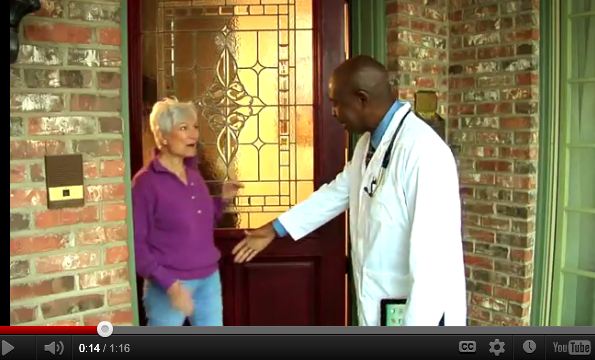
Take a look at the lovely marketing promotional images for the job:
And this video of what it’s like to do a home evaluation:
Now take a look at some photos that I took while on assignment (note: these are not actual patient homes, but are very similar to ones I encountered):



Taking a job as a Medicare Advantage evaluator was a real eye-opener. Poverty and chronic illness in America takes on a whole new light when you experience patients’ actual home environments. It’s like being a medical missionary in your own country. I’ve met patients who hadn’t seen a physician in decades, diagnosed life-threatening illnesses, and made sure that care (or case management) was initiated for countless people living on the fringes of society.
I’m glad for the experience – but think that my peers considering similar work should be told the truth about what they will be doing. Being a Medicare Advantage evaluator is not like the shiny “care anywhere” ad suggests – and “lucrative” is not exactly the right adjective for $30/hour for an MD’s time. But if you don’t mind being treated poorly by your employer, investing a lot of your own money in equipment costs, and putting your life at risk in dangerous home environments – you may actually do some good for the forgotten, frail elderly of this nation, (while helping middle men like Censeo Health to profit from health insurance behemoths, alas). Now you know the truth behind the advertising and can make an informed decision about whether or not you’d like to sign up for this work.
Any takers?
December 23rd, 2011 by Richard Cooper, M.D. in Health Policy, Opinion
No Comments »

There is a romantic view of America as a homogeneous nation – a nation that is flat. But the real America has high peaks of affluence and deep valleys of poverty and a varied landscape of health care spending. It is a hilly terrain of income inequality.
The Affordable Care Act was based on homogeneity. Not only would its provisions be disseminated equally, but smoothing the peaks and valleys of health care utilization would liberate the funds necessary to finance it. Under reform, Newark would come to resemble Grand Junction CO, and Mayo would be the model for Manhattan. No longer would Los Angeles, home to the nation’s largest concentration of poverty, consume more resources than Green Bay, WI, where poverty is infrequent. Regional variation in income and poverty could be ignored all together. The problem is “practice variation,” and health care reform will fix that.
Of course, the US is not homogeneous, and poverty cannot be ignored. In fact, Read more »
*This blog post was originally published at PHYSICIANS and HEALTH CARE REFORM Commentaries and Controversies*
October 27th, 2011 by Richard Cooper, M.D. in Opinion
No Comments »
 (Note: After a five month absence from posting comments, I offer this observation, with more to come. There’s much to do.)
The message resonating from the Wall Street protesters is that income inequality doesn’t work. And among the developed nations, theUS is the most unequal. This distinction does not come without cost. The greatest, of course, is the social cost borne by those who are poor. But what the protesters may not fully realize is that another is the high costs of health care. This is because the costs of caring for the poor are much greater. And together with the rising numbers of poor patients, they are crushing the health care system.
This notion may seem shocking, since it is generally believed that low-income patients receive less health care. After all, many have little or no health insurance, and most have poor access to primary care. Isn’t it the wealthy whose access is best and who use the most? The answer is Read more »
*This blog post was originally published at PHYSICIANS and HEALTH CARE REFORM Commentaries and Controversies*
October 13th, 2011 by RyanDuBosar in Research
No Comments »

Hospitals that provide the lowest quality care at the highest cost care for more than twice the proportion of elderly minority and poor patients as the nation’s best performers, researchers found. And patients at the “worst” institutions are more likely than patients elsewhere to die of certain conditions, such as heart attacks and pneumonia.
These hospitals and their patients may be the ones most at risk under new Medicare payment arrangements that could cut payments to hospitals that fail to meet quality metrics, reported researchers from the Harvard School of Public Health.
The researchers examined how quality, costs and patients served correlated among 3,200 hospitals nationwide. They then identified 122 “best” hospitals, those that were in the highest quartile of quality and lowest quartile of risk-adjusted costs, and 178 “worst” hospitals, those in the lowest quartile of quality and the highest quartile of costs.
Hospital quality and performance data were Read more »
*This blog post was originally published at ACP Hospitalist*