September 24th, 2011 by ChristopherChangMD in News
No Comments »

 On Sept 16, 2011, the Stone Temple Pilots had to cancel their tour because their lead singer Scott Weiland was placed on voice rest due to damaged vocal cords at risk for permanent damage. Specifically, the doctors at University of Cincinnati Voice Health Center determined that he had scarring on his left vocal cord and a tremendously inflamed right vocal cord.
The left vocal cord scarring is likely from past vocal trauma that did not heal properly and is now permanently damaged whereas the right vocal cord is at risk of also becoming permanently damaged if not aggressively managed. The picture shown here is an example with inflammation involving both vocal cords. Compare this with Read more »
*This blog post was originally published at Fauquier ENT Blog*
August 14th, 2011 by ChristopherChangMD in Health Tips, Opinion
No Comments »
 I was informed about this interesting concept on ABC news…
With many aging baby boomers tapping into cosmetic surgery in order to look younger, some are taking it a step further to “sound” younger as well with a “voice lift”.
For some, it’s not right to look 10-20 years younger after a facelift but still sound like 70 years old.
A hoarse voice with aging is not unusual, but a surgical “voice-lift” is not necessarily the first step that should be taken.
First things first… Read more »
*This blog post was originally published at Fauquier ENT Blog*
July 18th, 2011 by ChristopherChangMD in Health Tips, Video
No Comments »
 Our office has created a new video describing what a patient goes through when they undergo esophageal manometry as well as 24 hour multi-channel pH and impedance testing.
This test is often ordered when a patient is suspected to be suffering from reflux, whether acid or non-acid, or is possibly suffering from abnormal muscle activity of the esophagus.
Symptoms that a patient may experience that may lead to such testing include: Read more »
*This blog post was originally published at Fauquier ENT Blog*
April 4th, 2011 by M. Brian Fennerty, M.D. in Health Tips, Opinion
No Comments »

H. pylori dominated the GI news in the 1990s, and despite it disappearing from the front pages, it remains a common and important clinical problem. The dominant recommended initial treatment strategy has been a clarithromycin-based PPI triple therapy, with either amoxicillin or metronidazole as the third drug. This approach was based on clinical studies, ease of use, and tolerability factors. Bismuth-based quadruple therapy (a bismuth agent, metronidazole, tetracycline, and a PPI), despite demonstrating excellent activity, was usually relegated to second-line therapy because of the complexity of the dosing as well as compliance and tolerability issues.
However, duringthe last decade, the widespread use of macrolides in the general population has led to rising resistance to clarithromycin (by 30% or more of H. pylori strains in some areas), and when clarithromycin resistance is present, the efficacy of clarithromycin-containing triple therapy falls from about 80% to 50% or even lower. However, clarithromycin resistance does not affect the efficacy of bismuth-based quadruple therapy, and that efficacy of those regimens remains at about 90% when patients are compliant with the treatment.
So the questions for you to consider are:
1) Do you know what the clarithromycin resistance rate in H. pylori is in your community?
2) What first-line H. pylori treatment regimen do you use?
3) Are you planning to change your H. pylori treatment strategy now that clarithromycin resistance rates are rising?
Let us know what you think.

*This blog post was originally published at Gut Check on Gastroenterology*
June 21st, 2009 by Dr. Val Jones in Book Reviews
No Comments »
 Have you ever been seated next to a screaming infant in an airplane? If so, you know that even short flights can feel like an eternity. But the question is: why is the baby so miserable? Is there something that can be done to ease their discomfort?
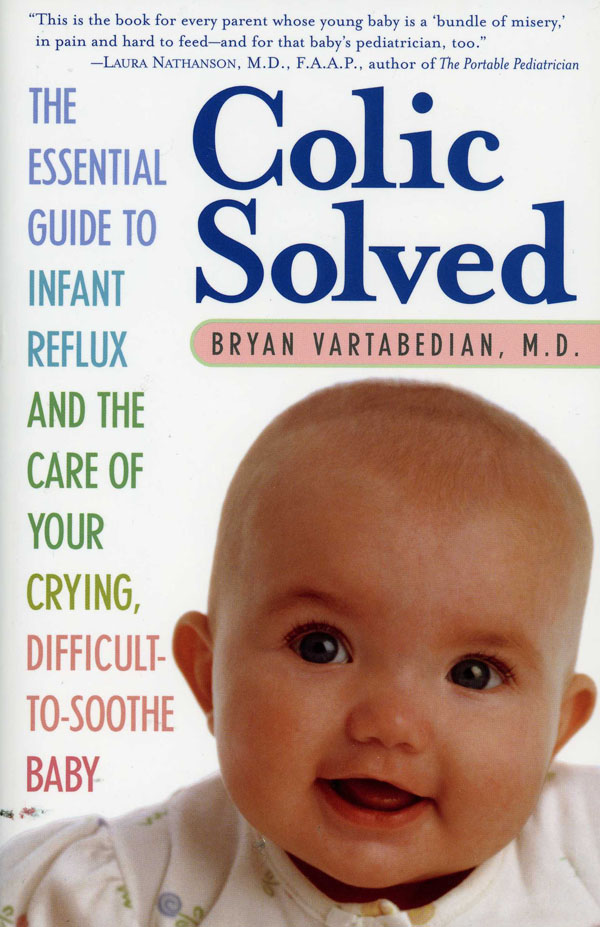
According to pediatric gastroenterologist Dr. Bryan Vartabedian, the answer is a resounding “Yes!” In his new book, Colic Solved Dr. Vartabedian (or “Doctor_V” as he is known on Twitter) describes why unexplained fussiness may often be caused by gastroesophageal reflux disease. Doctor V explains that “colic” is an old-fashioned term to describe the behavior of uncomfortable babies. Colic is not a medical diagnosis anymore than “crying” is… and fortunately the underlying cause of “colic” has been discovered so that it can also be treated.
I met Doctor V at a conference in Albuquerque, New Mexico a couple of months ago. Before our introduction I had no idea that he spent all of his clinical time examining and treating screaming babies – but once that fact was revealed, I understood immediately that he was the right guy for the job. Doctor V is a tolerant, affable man with a tremendous sense of humor and a voice made for radio. He is not easily flustered and has a genuine curiosity about others and their life stories. In fact, there’s something soothing about Doctor V – something that makes you feel that everything’s going to be ok.
And so it’s no surprise that Colic Solved is a written expression of Doctor V’s winsome personality. Every chapter is filled with empathy and reassurance, yet with a clear path forward for teasing out the real cause of a baby’s misery. In most cases, “colic” is actually caused by milk protein allergy or infant reflux (a painful burning sensation caused by regurgitating stomach acid). Doctor V carefully explains how to tell the difference, and what to do about it. Interspersed are amusing vignettes called “Tales From The Crib” in which parents with difficult-to-soothe babies navigate their way towards a resolution.
But best of all, Doctor V does not hesitate to do some good old fashioned myth-busting when it comes to exaggerated claims not based on scientific evidence. Infant formula makers, baby bottle makers, and baby product manufacturers are notorious enablers of magical thinking – moms and dads purchase all kinds of products in a desperate attempt to soothe their babies. Unfortunately, most of these solutions do not treat the root cause of the problem – though businesses thrive on colic cures for desperate parents.
Here’s an excerpt of Doctor V’s exposé of a common soy formula myth (p. 117):
Soy Formula – Do You Feel Lucky?
One of the first impulses for parents with a screaming baby is to reach for soy formula. It sounds all natural and easy to digest. But the role of soy formula in the milk-allergic baby is very misunderstood…
The real problem with soy formula comes with the belief that it’s a reasonable cure for the allergic baby. But up to 50% of babies who are allergic to cow’s milk will react to soy protein in a similar way, so if you or your pediatrician chooses to treat your allergic baby with soy formula, you should consider it a gamble…
Colic Solved is a gem of a book. It’s witty, wise, and well written – a must-read for any parent of a chronically fussy baby. I also think that pediatricians and family physicians should strongly consider prescribing this book to parents of unhappy infants. There’s probably no better way to solve colic once and for all.