September 10th, 2011 by GruntDoc in Health Policy, Research
3 Comments »

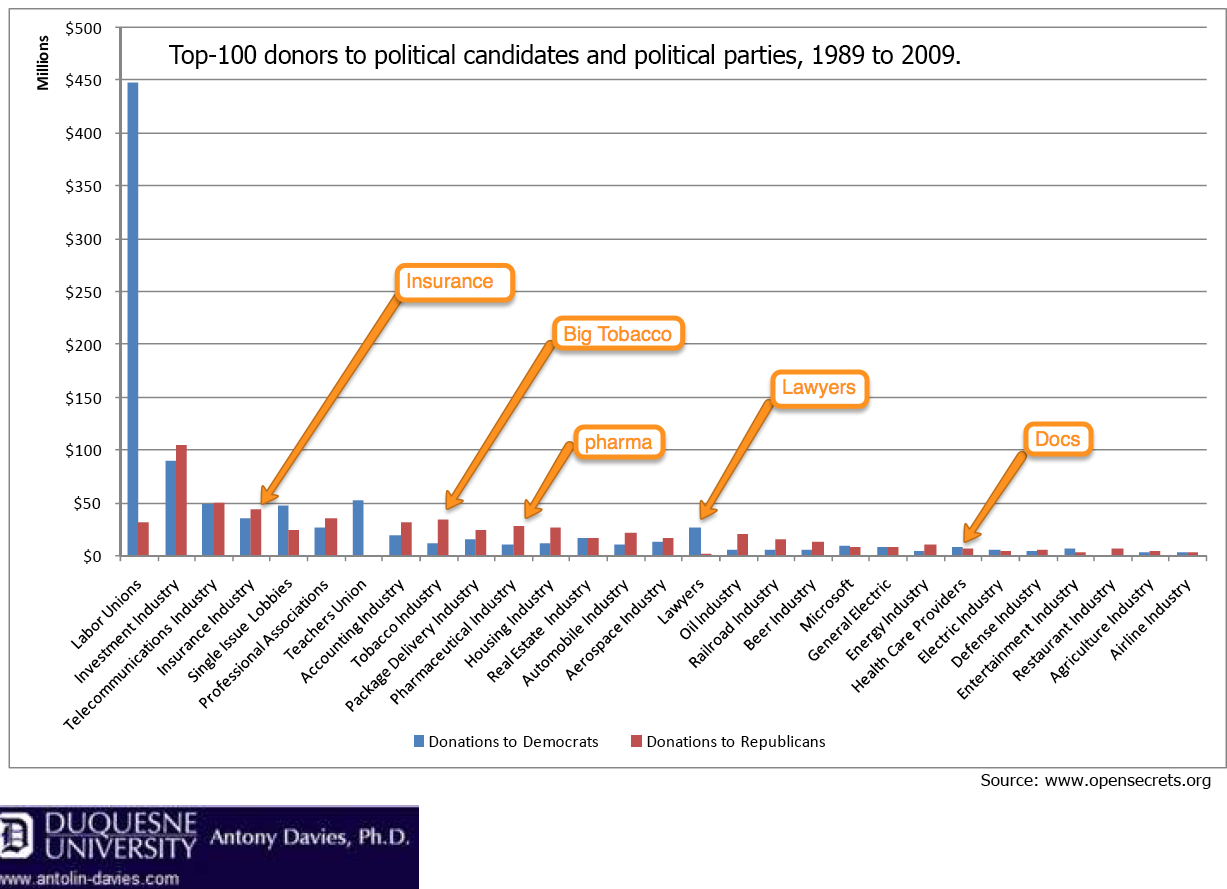
Why don’t docs get more of what they want in DC? There’s a quite instructive graph in a blog post from NRO last week (talking about Union campaign donations), but I found this one to be very instructive, and have added labels so the point cannot be missed:

In politics, generally what you give is what you get. I’ve taken to giving more to the PACs that represent me.
As an aside, it’s political malpractice to give only to one party (Teachers). Eventually that one party will be on the outs, and then where are you?
*This blog post was originally published at GruntDoc*
May 25th, 2011 by BobDoherty in Health Policy, Opinion
No Comments »

You’d think that ensuring that there will be enough primary care doctors would not become a partisan issue. If you are a Republican congressman from Texas, or a Democratic Senator from California, you’d want your constituents to have access to a primary care doctor, right?

Apparently not: in the hyper-polarized and ideological world in which we now live, even modest steps to support primary care have been caught up in the worst kind of partisanship. The Washington Post reported recently that funding for a new expert commission authorized by the Affordable Care Act (ACA), which was to examine barriers to careers in primary care, has been blocked by Republicans:
“When the government set out to help 32 million more Americans gain health insurance, Congress and the Obama administration acknowledged that steering more people into coverage had a dark underside: If it works, it will aggravate a shortage of family doctors, internists and other kinds of primary care. So Page 519 of the sprawling 2010 law to overhaul the health-care system creates an influential commission to guide the country in matching the supply of health-care workers with the need. But in the eight months since its members were named, the commission has been unable to start any work. Read more »
*This blog post was originally published at The ACP Advocate Blog by Bob Doherty*
April 30th, 2011 by DrRich in Health Policy, Opinion
1 Comment »

The last two weeks have made clear that the debate over our national debt will play a major role in the next election cycle.
On one side, many Republicans, lead by Representative Ryan, insist that the rate of growth of our national debt – especially the massive projected growth of Medicare and Medicaid – promises to destroy our society within a generation or two; and that the only way to avert that catastrophe is to make substantial structural changes to our entitlement programs. The subtext of their message is: Federal debt is bad, and debt of this magnitude will be fatal.
On the other side, most Democrats, led by President Obama, stress that our entitlement programs are promises that simply can’t be changed in any substantial way, insist that such entitlements are “investments in our future,” and suggest that whatever shortfalls our current system might encounter can be remedied by taxing millionaires and billionaires. The subtext of their message is: Federal debt can be a force for good, and in this case will trigger a much-needed redistribution of wealth (which is a primary goal of Progressives).
The debate over the national debt is as old as the Republic. In the original version of this debate, the part of the modern Republicans (i.e., debt is bad) was played by Jefferson, and the part of modern Democrats (i.e., debt is an investment in the future) by Hamilton. Read more »
*This blog post was originally published at The Covert Rationing Blog*
March 23rd, 2011 by John Mandrola, M.D. in Health Policy, Humor
No Comments »

In Washington, even exercise gets political.
This morning, the WSJ reported that a small group of Congressmen, primarily Republicans, have embraced the adrenaline-infused exercise regimen that is P90X. They jump, stretch and flex to the tune of Tony Horton, a man who clearly checked the right box on career day. The 90-day results-intensive program celebrates its “I couldn’t move the next day” sensations.
On the other side of the ideological spectrum resides the pragmatic approach of the White House. Last month, the NY Times described the regimented, non-boot-campish routine espoused by Mr and Mrs Obama. Our current executive branch favors a personal trainer who likes working people hard, but…”as politely as possible.” The president adheres to a common sense program of regular morning exercises that balances cardio and strength training. Calm, measured and balanced.
Both approaches to exercise appeal to me. Read more »
*This blog post was originally published at Dr John M*
November 5th, 2010 by RyanDuBosar in Better Health Network, Health Policy, News
No Comments »

Republicans who had opposed healthcare reform before the election are now elected officials with a say in how the programs are funded. At federal and state levels, the program’s opponents either have a larger voice or are now in charge of implementing elements of reform. Sen. Majority Leader Harry Reid said he’d consider adjustments to healthcare reform.
Frightened seniors flipped toward opposition to healthcare reform, while flipping on the issue may have saved a few Democrats. Exit polling showed 48 percent would repeal healthcare reform, 16 percent would leave it as is, and 31 percent would expand it.
Now that Republicans have a larger say in the matter, take a look at their plan for healthcare in A Pledge to America, starting on page 25, and decide for yourself. (New York Times, Kaiser Health News, Reuters, Wall Street Journal, Politico, CBS News, GOP.gov)
*This blog post was originally published at ACP Internist*