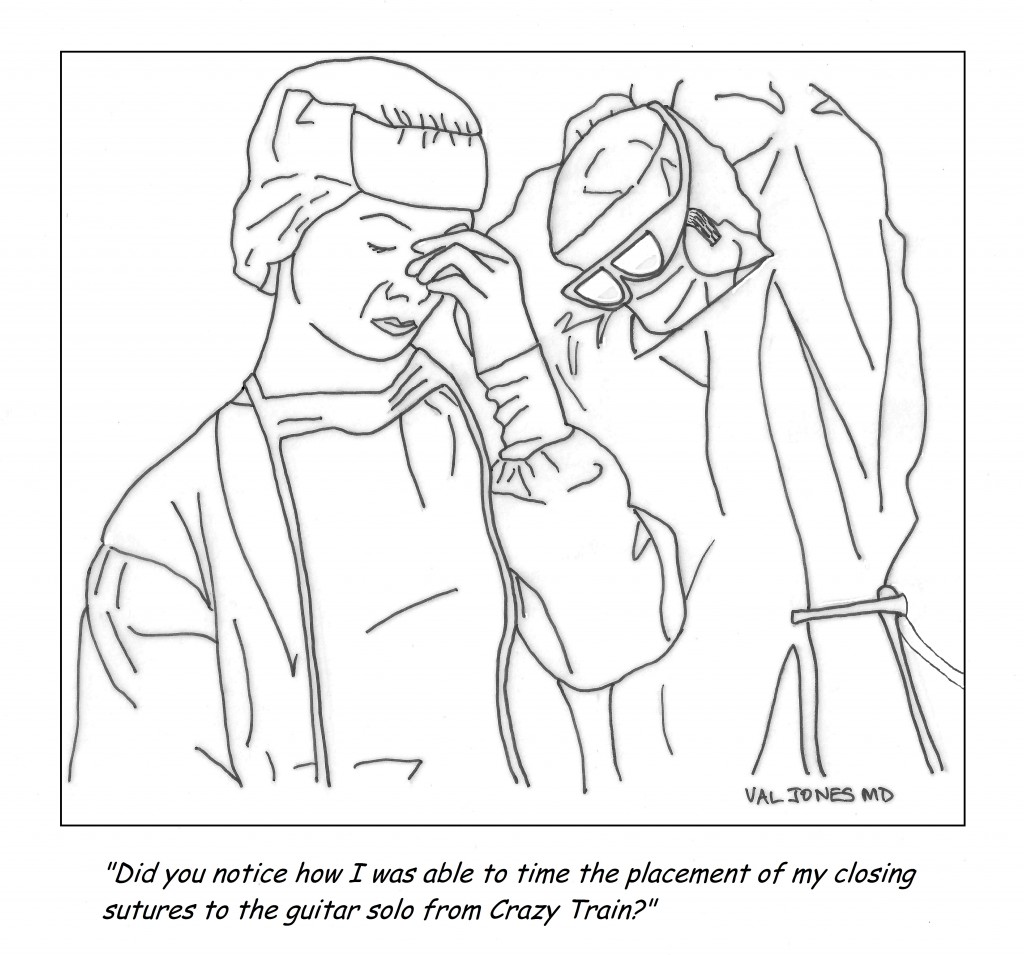
Cartoon: How Some Surgeons Behave In The O.R.


Editor’s Note: This post is meant to be tongue-in-cheek. We sincerely hope that our colleagues are not offended by the use of the term “jerk” to describe physician behavior. If you are a jerk, please feel free to leave a nasty complaint in the comment section of this post. Thank you!
Physicians have a reputation for being, to put it bluntly, jerks. It took me a long time to accept the fact that we are (on average) a disagreeable bunch, and my years of denying that there is a problem has finally given way to acceptance and even some degree of tolerance of “assholitry.” Few of us doctors think that we’re the one with the attitude problem, but I’m afraid that even the sweetest pediatrician can show some mighty claws when backed into a corner.
I didn’t think that I was a jerk until a few days ago when a surgeon made a medical error in the care of my loved one. I won’t go into details here, but let’s just say that evisceration was on the menu. My family member overheard one of the conversations and commented timidly, “I think you’ve probably just successfully alienated yourself from the entire medical community at Hospital X.” Yes, I was a total fire-breathing monster.
But this got me thinking – maybe if I explained all the reasons why doctors have bad attitudes, there would be a little more grace shown to us? Maybe our patients would be less offended and more understanding of our dispositions? I suspect that most people feel that there is “no excuse for rudeness” but I’ll offer a few nonetheless and see if I can’t change your mind. Here are the primary reasons that doctors are jerks:
1. We are afraid.
Being responsible for sick peoples’ lives is a scary thing. There are so many variables outside our control, and yet we believe that we must control the outcomes at all costs. It’s as if doctors somehow absorb the false belief that we can cheat death, and so when our patients don’t experience the optimal outcome from our every action and decision, we engage in some serious self-flagellation or (for those who possess a higher jerk index) we kick the proverbial dog (i.e. you).
Fear of inadvertent medical errors is a real butt-clencher for many doctors, and as science provides us with more insight into disease management we must be ready to do things differently, and to relearn everything we were taught. Keeping abreast of all these changes is very hard work, as there are over 6000 new research studies published world-wide each day. Our fear of failing to know everything we “should” causes many of us to hide behind a veil of toughness. Arrogance is often just a cover for vulnerability, and with so much information that we’re expected to digest, we are at risk for making a bad decision if we aren’t up to date. And when a doctor makes an error, he or she can pay a high penalty, including public humiliation by her peers, loss of her medical license, livelihood, the pain and suffering of legal action, and even confiscation of personal assets and savings.
And then there’s the daily fear of “fire-breathing monsters” like me. At any turn, irate family members, colleagues, hospital administrators, and staff can swoop in and criticize your best efforts.
2. We are hen-pecked.

The constant juxtaposition of trivial and critical can make doctors seem dismissive and arrogant. This is a subtle point, but one that is really important to understand a physician’s mental state. Imagine that you’re tending to a dying man with a gunshot wound to the chest, and a hospital administrator taps you on the shoulder to ask if you could fill out a form about insurance coding. You would view that request as particularly annoying given the context in which it occurred, right?
This may be an extreme example, but similar scenarios play out in our work days constantly. We are frequently interrupted (in the midst of very grave conversations, for example) with requests for approval of Tylenol orders, coding clarifications for duplicate insurance documents, or updates of no apparent consequence (such as, “Dr. Jones, I just wanted you to know that Mrs. Smith did receive your Tylenol order.”)
The very act of doctoring can make us feel as if we’re undergoing harassment by the hopelessly inane, punctuated by terrifying bouts of near-death scenarios accompanied by the usual fire-breathing monsters. If that job doesn’t turn you into a jerk, then… you probably are a robot.
3. We are exhausted.
Sleep deprivation is a well-known form of torture used by interrogators to extract information from “evil-doers.” It is also used by residency programs to keep whining residents from having the energy to complain effectively or to organize their efforts against their torturers. Then once these doctors-in-training accept chronic sleep deprivation as the new-normal, they carry an expectation of it throughout the rest of their careers. Of course, sleep-deprived people are more likely to be irritable, short-tempered, impulsive, grandiose, and hostile – aka jerks.
4. We were probably jerks to begin with.
Getting into medical school is extremely competitive. Only the very top students make it, and they are generally ranked according to science test scores (not compassion scores or charming personality scores). Successful pre-meds are generally type A personalities with a fierce competitive nature. And what kind of person would sign up for a career where they are harassed, blamed, required to do endless paperwork of indeterminate usefulness, denied regular sleep, and endure hostility from staff, coworkers, family members, and error-prone colleagues? A person with a pretty thick skin and a high tolerance for sadism and/or masochism… also known as a jerk. So, for the few doctors who don’t enter medical school as fully formed jerks already (let’s say they didn’t realize what they were getting into), the work they do will thicken their skin eventually, creating jerk-like personality traits in the end.

Is there a jerk scale in medicine? Who are the biggest jerks? Yes, all doctors exist somewhere on the jerk continuum, and you can roughly guess where they’ll be depending upon how likely that an encounter with them will end in your demise. Trauma surgeons, cardio-thoracic surgeons, and neurosurgeons have the strongest jerk traits, while pediatricians, physiatrists, and family physicians are probably on the other end of that scale. There are some exceptions, of course, but actually not many.
What can you do to make the best of having to work with a jerk? At some point, you or a loved one will need medical care (no one gets out of this life alive) so you will probably have to deal with some serious jerks along the way. Knowing that this is in your future, you should probably start planning how you will handle this now. I offer you my do’s and don’ts of jerk management, or how best to ally with your physician:
Don’t:
1. Bring your doctor more trivia. Jerks have a low tolerance for irrelevant details, largely because they are tortured by it daily (such as pages of EMR-generated duplicates of physical exam findings from interns). Think about what you really want to talk about with your doctor and don’t get side tracked with your own personal “hot flash tracker” data or other tangential story that is unrelated to your current problem.
2. Threaten your doctor with legal action or allusions to your “friend the lawyer.” The jerk you’re talking to is already frightened enough about frivolous law suits. If you tap into that fear he or she will just go into self-protection mode and probably harm you with excessive and unnecessary tests, consults, and referrals. Or even worse, maybe they’ll hide information from you.
3. Attack your doctor’s judgment directly. This is a tricky one because your doctor won’t always make the best clinical decision in your case, and you have the right to point that out. The best strategy for getting your way (assuming that you’ve found a true error) is to be friendly about it. Use the Socratic method if you can so that they’ll think they discovered the mistake themselves.
4. Fight fire with fire. You would think that you could get some respect from a jerk by being just as nasty to them as they are to you – and that strategy may work with playground bullies – but unfortunately that rarely helps in medical culture. More likely the physician will become quiet and simply resolve to stonewall you and be extra unhelpful in processing your care needs. You don’t need that.
Do:
1. Be prepared for your visit. Bring a list of your medications, relevant medical history and test results. Write down your questions in advance. Anticipate the questions that your doctor will ask you (if you can) and be ready with focused answers. You will look like a super-star and your doctor will be indebted to you.
2. Be understanding of our lateness. I know it drives you crazy and you feel disrespected by your doctor. But know that lateness can be caused by many things, including ill-prepared patients, really sick people, emergency surgery and golf games. If your doctor is a major jerk and the cause of his/her lateness is golf-related, then at least YOU will feel better if you presume he/she was delayed by a real emergency.
3. Be a “compliant” patient. Once you and your doctor decide upon a care or treatment plan that is right for you, try to stick with it. It’s in your best interest to do so and your doctor will love you for it. Sure, if he’s a big jerk he’ll only love you because your good outcomes make his performance measures (and payment structure) increase, but if he has a conscience he’ll also be genuinely pleased that you’re well.
4. Find another doctor if you need to. Although this isn’t always an option for folks in rural areas, if your doctor is impossible to work with, then you should find someone else to take care of you. Be very polite, get copies of all your medical records, and then take them elsewhere. Don’t be stoic and stick with a total jerk if your care is being compromised by his or her attitude and behavior.
So there you have it. When you have your next unsatisfactory encounter with me or one of my colleagues, please consider that there are some good reasons for our irritability. But being a jerk isn’t always a bad thing, because if your loved one needs a medical champion, then a fire-breathing monster is probably an excellent advocate. You can harness a monster for your purposes if you follow the do’s and don’ts of physician relationship management. I wish you luck with your future encounters with us!

Aah, the French:
The idea of putting maggots into open flesh may sound repulsive, but such a therapy might be a quick way to clean wounds, a new study from France suggests.
via Maggots Clean Wounds Faster Than Surgeons | Wound Healing | LiveScience.
I kid. I think this is a good idea, and it’s natures’ way of saying ‘cleanup on aisle three’. Patients not infrequently will be brought to the ED with awful, non-healing wounds infested with maggots.
We typically kill them off, more because a) the staff is completely grossed out and b) if you’re living at home and have maggots in your wounds, let’s just say your personal hygiene is deeply suspect. Rank, in fact. Needs a decon level bad.
However, there is a legitimate role for biological wound cleaning; I have a WWII surgical book with a chapter in it on growing your own sterile maggots. It’s not an ER thing, but it’s yet another tool in the armamentarium of bad wounds.
*This blog post was originally published at GruntDoc*

Don’t simply look for a surgeon who is board certified. Make sure they are trained to do the procedure you are having. Yes, board certification is important, but the training is more so (in my humble opinion).
If you are having a breast augmentation, you don’t want a board certified maxillofacial surgeon or Ob-Gyn or neurosurgeon. You want someone trained in plastic surgery. It is a bonus if they are board certified. By the same token, if you need brain surgery you don’t want a board certified plastic surgeon you want someone trained in neurosurgery.
This rant was prompted by Read more »
*This blog post was originally published at Suture for a Living*

I think a lot about the slow, certain dissolution of medicine as we know it. Mental health issues crowd emergency departments, as few mental health clinics are available. Psychiatrists are in short supply. Drug abuse overwhelms the medical system, with either patients seeking pills or patients families hoping to get them off of pills.
Persons with little interest in their own health continue to smoke and drink, use Meth and eat poorly. Disability claims are skyrocketing as younger and younger individuals confabulate their misery in hopes of attaining a check, paid for by someone else.
The poor, with genuine medical problems, have increasing difficulty finding care as jobs, and insurance, fade away. Politicians, eager to be re-elected, eager to be loved, promise Read more »
*This blog post was originally published at edwinleap.com*
It’s no secret that doctors are disappointed with the way that the U.S. healthcare system is evolving. Most feel helpless about improving their work conditions or solving technical problems in patient care. Fortunately one young medical student was undeterred by the mountain of disappointment carried by his senior clinician mentors…
I am proud to be a part of the American Resident Project an initiative that promotes the writing of medical students residents and new physicians as they explore ideas for transforming American health care delivery. I recently had the opportunity to interview three of the writing fellows about how to…

Book Review: Is Empathy Learned By Faking It Till It’s Real?

I m often asked to do book reviews on my blog and I rarely agree to them. This is because it takes me a long time to read a book and then if I don t enjoy it I figure the author would rather me remain silent than publish my…
The Spirit Of The Place: Samuel Shem’s New Book May Depress You

When I was in medical school I read Samuel Shem s House Of God as a right of passage. At the time I found it to be a cynical yet eerily accurate portrayal of the underbelly of academic medicine. I gained comfort from its gallows humor and it made me…
Eat To Save Your Life: Another Half-True Diet Book

I am hesitant to review diet books because they are so often a tangled mess of fact and fiction. Teasing out their truth from falsehood is about as exhausting as delousing a long-haired elementary school student. However after being approached by the authors’ PR agency with the promise of a…