Comedian John Oliver did an excellent job explaining everything that’s wrong with the Dr. Oz show and the dietary supplement industry. Please watch this video for a good laugh:
I’m very excited to be the nutrition coach for the Boys & Girls Clubs’ Fit Family Challenge again this year. In surveying the finalist families, I discovered that the two most important nutrition issues on their minds were cooking speed and food affordability. Far down the list were things like food allergies, weight loss, and nutrition basics.
Contrary to popular belief, healthy eating doesn’t have to be expensive. A new study showed that a healthful diet only costs an average of $1.50/day more than an unhealthy diet, and the additional cost is mostly related to the expense of leaner protein sources. So with a little bit of shopping savvy, you can change your family’s nutrition without breaking the bank.
Since busy moms and dads are always looking for ways to provide fast, nutritious meals for their children, I thought I’d provide some tips for doing so on a budget. These are strategies that I also use when I’m traveling across the country, working long hours at hospitals with only a microwave and small refrigerator available, and very little time for meal prep. If your day is frantic, and you don’t have much time to cook, then these tips are for you! (I’m not saying we’re going to win any culinary awards for these meals, but they are very practical. Please use your own favorite herbs and spices for flavor. I have added links throughout this post to show you examples of products I’ve used and like – but there are many other good ones out there!) 😀
1. Tupperware. Make sure you have lots of plastic storage containers (Tupperware or other brand) and baggies in various sizes. You can reuse the containers and portion out food into single serving sizes in advance. Don’t worry about finding containers that are “BPA-free” – they may cost more and fifty+ years of scientific studies (reviewed by the U.S. Food and Drug Administration) have determined that they are safe for microwave use and food storage.
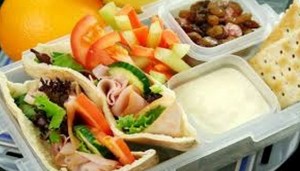
2. Prepare meals ahead of time. Set aside one day a week where you will fill containers and baggies with single serving sizes of 1) protein, 2) fruits/veggies, 3) nuts/fats, and 4) complex carbohydrates. Each meal should include one of each. Snacks can contain two or three of the four groups. Each family member can quickly grab portions for their meals, lunch boxes, or snacks, and you can make up plates for dinner by reheating them in the microwave.
3. Fast protein. Pre-cooked, grilled chicken or turkey strips can be found in the refrigerated or frozen section of your local discount store. Four ounces of grilled chicken is a good serving size, and make sure you choose the chicken without sauce or chemical flavorings as your healthiest option. One serving takes about a minute to reheat in the microwave. Other great sources of protein include plain Greek yogurt (a serving is 1 cup), protein powder (whey, egg, or vegan sources), pre-packed hard-boiled eggs, canned tuna or fish in water, smoked salmon, and low-fat cheese sticks.
If you have a stove and 4-8 minutes to spare, quick-fry pork chops, lean beef, fish fillets, or egg beaters (plain, liquid egg whites in a carton are even better) with low-fat shredded cheese with a few chopped veggies can make a great omelet that’s fast and affordable.
You can make egg whites in a microwave (spray a microwave container with a little bit of pure olive oil cooking spray) and cook for one and a half minutes per serving. Top with salt, pepper, cheese, and maybe a little ketchup if you like that. Super fast, super healthy.
In a pinch, beef, pork, and natural turkey jerkies are very portable protein sources. However, they can be expensive, and you must look for the all natural varieties (not the jerky full of salt and chemicals at various truck stops across the country).
4. Fast fruits & veggies. Fruits are pretty easy because you can chop them up or peel them quickly, but if you don’t want to chop them too far in advance, pre-made fruit cups are a little more expensive, but very convenient. Make sure you choose the fruit that is packed in its own juice, not syrup.
As far as veggies are concerned, some can be enjoyed raw (celery, carrot sticks, lettuce, tomatoes etc.) but others need cooking. The fastest way to cook most fresh veggies is to steam them in a microwave. Stores now pack veggies (such as green beans, broccoli, and snow peas for example) in “steam-in bags” where you can just puncture the bag with a fork and then microwave the veggies for a couple of minutes. If you’re buying veggies in bulk, you can purchase “Zip n’ Steam” bags and use those instead. I’ve used these bags for everything from butternut squash to corn on the cob. They lock in all the vitamins and minerals that you may loose in a boiling or canning process.
Otherwise, frozen veggies are very convenient and are pre-chopped. Canned vegetables are also rich in vitamins (though they tend to lose the water soluble A&B vitamins so you’ll need to get those from your fruits or a squeeze of lemon in your water) and very easy to heat and are affordable.
5. Fast fat. Mostly, what I mean by healthy fats is nuts, seeds, and vegetable oils (especially olive). Fats are rarely cost-prohibitive and it doesn’t take much to “prepare” them. Healthier nuts and nut butters are plain (no sugar or salt added). Avoid candy-coated nuts, sugary spreads, or trail mixes that have “yogurt-covered” anything or chocolate added. Go easy on the dried fruit as it is a simple sugar. Cook with olive oil or olive oil spray when you can. Limit your animal fat intake (butter, high-fat cheese, lard, bacon) as it is not as healthy for you as vegetable sources.
6. Fast complex carbohydrates. I’m a big fan of brown rice. It’s very inexpensive and reheats well with a little moisture in the microwave. You can purchase the rice dry (this is the most affordable way, but you’ll need to cook up a big batch once a week), or pre-cooked in microwavable bags or containers. Brown rice grits, corn grits, cream of wheat, and oats all make quick, microwavable portions of carbs. Whole grain tortillas take 15 seconds to heat in the microwave and can be used as a wrap or side-dish. Whole grain breads, sugar-free whole wheat cereal, canned beans, hummus, and sweet potatoes (not in syrup) are all fast and affordable.
7. Drink water. It’s free, it’s everywhere, it has no calories. Water is the healthiest fluid source available, so make use of it. To save money, you can re-use plastic water bottles by refilling them with tap water. If your tap water doesn’t taste great, a squirt of fresh lemon or lime juice (along with keeping it colder) should solve the problem. Sugary sodas, juices, and energy drinks should be limited. Club soda, sparkling water, or diet sodas are a better choice if you are craving carbonation. Skim milk, almond, rice, or soy milk are healthy options as well.
8. Buy in bulk. So now that we have broken down the healthy, affordable diet into its four components and fluids – it’s time to stock up! Buying large quantities of your favorite non-perishable items can save money. Consider cost-sharing with another family, coupon-clipping, and price-shopping. Some items that you normally don’t think of as frozen goods actually store very well in the freezer – bread, tortillas, nuts, and bananas for example can last for months in the freezer. For a review of the best grocery items to buy in bulk, see this slide show.
9. Skip the organic food. Organic products are very expensive and do not provide a significant nutritional advantage over regular foods. You may wish to buy organic food to support your local farmers or because the items are fresher-looking or their packaged goods may have fewer preservatives or added ingredients, but don’t spend your last penny on organic foods because you think it’s the only way to keep your kids well-nourished. As far as reducing your potential exposure to pesticides, organic foods may reduce pesticide exposure by 30%, not exactly the “pesticide-free” level that some would lead you to believe. Most experts (including the FDA) agree that the amount of potential pesticide residue found on fresh fruit and vegetables is too low to pose a significant risk human health. Washing fresh produce with soap and water, or removing the skin, can further reduce levels if you have concerns.
10. Don’t waste money on vitamins and supplements. Although it seems like a good idea to provide your children with extra vitamins in pill-form, the majority of U.S. children and adults (according to large CDC nutrition studies) are not deficient in any vitamin or mineral. Our fortified food sources, even with sub-optimal diets, are doing a surprisingly good job of getting us all the nutrition we need. If your doctor has determined that you or a family member has a nutritional deficiency, then please follow their advice regarding supplementation. As for herbal supplements, be very careful of those since recent studies have shown that they often don’t contain the active ingredients on their labels and may even contain harmful allergens instead.
There are probably many other terrific ideas that you’ve discovered on the path to feeding your family quickly and affordably. Please share them on the blog so we can expand our creative meal planning together! I’ll be thinking of the Fit Family finalists as I enjoy my brown rice and green pepper chicken fajitas in my hospital microwave this week!
Eye diseases and vision loss are becoming more common in the United States as diabetes rates rise and the population ages. Many eye conditions worsen very slowly and have no noticeable symptoms in their early stages. For this reason, getting an annual eye exam is extremely important. But is there anything we can do to prevent eye disease from a nutritional perspective? Experts believe that there is such a thing as an “eye-healthy diet.” I interviewed Dr. Jeffrey Anshel, President of the Ocular Nutrition Society, and Dr. Elizabeth Johnson, a leading nutrition researcher, to get their views on the subject. Please listen to the full HealthyVision podcast here.
Some of the my favorite learning points from the show:
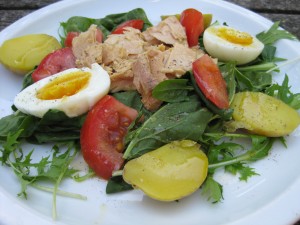
1. Which foods are healthy for the eyes? The human retina contains about 1000 times more concentrated carotenoids (found primarily in plant pigments) than any other part of the body. Our eyes use these pigments to protect themselves from the photo-damage of sunlight. Carotenoids (including beta-carotene, lycopene, lutein, and zeoxanthin) are found in highest concentrations in dark green, leafy and brightly colored vegetables. Egg yolks are also a good source of carotenoids. Interestingly, our retinas have a predilection for omega-3 fatty acids (found in fatty fish) to protect the eyes from UV radiation. My bottom line – the most eye-healthy meal on earth is probably a salmon salad Niçoise (see photo image above)!
2. Are carrots good for our eyes? While carrots can be part of healthy diet, choosing carrots as our primary source of vegetable intake may not be a good idea. Carrots contain beta-carotene, which competes with other carotenoids for transport molecules. Beta-carotene is a pretty good competitor and can “bump off” lutein and zeaxanthin from getting transported to the retina. Adults don’t process beta-carotene as well as kids do, so too many carrots may not be a great thing after all (especially as we get older)!
3. Should I take nutritional supplements for the eye? It’s always best to get your carotenoids from real food. However, some people (who take blood thinners for example) cannot eat dark green leafy vegetables because they also contain Vitamin K which can interfere with the medicines. For those who cannot get sufficient carotenoids from food, supplements may be beneficial.
4. What is the connection between obesity and chronic eye disease? While obesity is a risk factor for diabetes, and diabetes can cause chronic eye disease, there may be another problem at play. Carotenoids are fat soluble, and so they are preferentially stored in fat cells rather than remaining suspended in our blood stream. When we have larger fat stores, that fat may “mop up” the healthy vegetable carotenoids that we eat, without allowing them to be transported to the eyes to support retinal structures. Some researchers suggest that obese individuals may need to increase their carotenoid intake with supplements in order to prevent eye pigment deficiencies and potential macular degeneration. Losing body fat is also an important strategy of course.
Other questions answered in the podcast:
* How does cooking impact the nutritional value of fruits and veggies?
* Is there such a thing as over-supplementation (especially with Zinc)?
* How many veggies do I need to meet my daily carotenoid requirements?
* How do I know which vitamin supplements to trust?
I hope you enjoy the podcast – and redouble your efforts to eat a diet rich in fruits, veggies, fish and eggs and maintain a healthy weight. Remember that even though your mom may have told you that Bugs Bunny’s diet was best for your eye health, Popeye’s veggie of choice is even better for you!
Miracles are pretty rare events. Except on television’s “Dr. Oz Show,” where they appear with astonishing frequency. Oz of course doesn’t claim to raise the dead or part the Red Sea, but he does raise people’s hopes of parting with their flab. And he’s certainly not shy about flinging the word “miracle” about. But it seems miracles fade as quickly as they appear. Raspberry ketones, acai berries and African mango, once hyped as amazing “fat busters,” have already given way to newer wonders.
Granted, Dr. Oz, or more likely his producers, do not pull miracles out of an empty hat. They generally manage to toss in a smattering of stunted facts that they then nurture into some pretty tall tales. Like the ones about chlorogenic acid or Garcinia cambogia causing effortless weight loss. The former piqued the public’s interest when the great Oz introduced green coffee bean extract as the next diet sensation. Actually “chlorogenic acid” is not a single compound, but rather a family of closely related compounds found in green plants, which perhaps surprisingly, contain no chlorine atoms. The name derives from the Greek “chloro” for pale green and “genic” means “give rise to.” (The element chlorine is a pale green gas, hence its name.)
An “unprecedented” breakthrough, Dr, Oz curiously announced, apparently having forgotten all about his previous weight-control miracles. This time the “staggering” results originate from a study of green coffee bean extract by Dr. Joe Vinson, a respected chemist at the University of Scranton who has a long-standing interest in antioxidants, such as chlorogenic acid. Aware of the fact that chlorogenic acid had been shown to influence glucose and fat metabolism in mice, Vinson speculated that it might have some effect on humans as well. Since chlorogenic acid content is reduced by roasting, a green bean extracts was chosen for the study.
In cooperation with colleagues in India who had access to volunteers, Dr. Vinson designed a trial whereby overweight subjects were given, in random order, for periods of six weeks each, either a daily dose of 1,050 mg of green coffee bean extract, a lower dosage of 700 mg, or a placebo. Between each six-week phase there was a two-week “washout” period during which the participants took no supplements. There was no dietary intervention; the average daily calorie intake was about 2,400. Participants burned roughly 400 calories a day with exercise. On average there was a loss of about a third of a kilogram per week. Interesting, but hardly “staggering.” And there are caveats galore.
The study involved only eight men and eight women, which amounts to a statistically weak sample. Diet was self-reported, a notoriously unreliable method. The subjects were not really blinded since the high dose regimen involved three pills, the lower dose only two. A perusal of the results also shows some curious features. For example, in the group that took placebo for the first six weeks, there was an 8 kilogram weight loss during the placebo and washout phase, but almost no further loss during the high dose and low dose phases. By the time, though, that critics reacted to Oz’s glowing account, overweight people were already panting their way to the health food store to pick up some green coffee bean extract that might or might not contain the amount of chlorogenic acid declared on the label. As for Dr. Oz, he had already moved on to his next “revolutionary” product, Garcinia cambogia, unabashedly describing it as the “Holy Grail” of weight loss.
We were actually treated to the Grail in action. Sort of. Dr. Oz, with guest Dr. Julie Chen, performed a demonstration using a plastic contraption with a balloon inside that was supposed to represent the liver. A white liquid, supposedly a sugar solution, was poured in, causing the balloon, representing a fat cell, to swell. Then a valve was closed, and as more liquid was introduced, it went into a different chamber, marked “energy.” The message was that the valve represents Garcinia extract, which prevents the buildup of fat in fat cells. While playing with balloons and a plastic liver may make for entertaining television, it makes for pretty skimpy science.
Contrary to Dr. Oz’s introduction that “you are hearing it here first,” there is nothing new about Garcinia. There’s no breakthrough, no fresh research, no “revolutionary” discovery. In the weight control field, Garcinia cambogia is old hat. Extracts of the rind of this small pumpkin-shaped Asian fruit have long been used in “natural weight loss supplements” Why? Because in theory, they could have an effect.
The rind of the fruit, sometimes called a tamarind, is rich in hydroxycitric acid (HCA), a substance with biological activity that can be related to weight loss. Laboratory experiments indicate that HCA can interfere with an enzyme that plays a role in converting excess sugar into fat, as well as with enzymes that break down complex carbohydrates to simple sugars that are readily absorbed. Furthermore, there are suggestions that Garcinia extract stimulates serotonin release which can lead to appetite suppression.
Laboratory results that point toward possible weight loss don’t mean much until they are confirmed by proper human trials. And there have been some. Fifteen years ago a randomized trial involving 135 subjects who took either a placebo or a Garcinia extract equivalent to 1500 mg of HCA a day for three months, showed no difference in weight loss between the groups. A more recent trial involving 86 overweight people taking either two grams of extract or placebo for ten weeks echoed those results. In-between these two major studies there were several others, some of which did show a weight loss of about one kilogram over a couple of months, but these either had few subjects or lacked a control group. Basically, it is clear that if there is any weight loss attributed to Garcinia cambogia, it is virtually insignificant. But there may be something else attributed to the supplement, namely kidney problems. Although incidence is rare, even one is an excess when the chance of a benefit is so small. So Garcinia cambogia, like green coffee bean extract, can hardly be called a miracle. But it seems Dr. Oz puts his facts on a diet when it comes to fattening up his television ratings.
Joe Schwarcz is director of McGill University’s Office for Science & Society (mcgill.ca/oss). He hosts The Dr. Joe Show on CJAD Radio 800 AM every Sunday from 3 to 4 p.m.
This year’s Fit Family Challenge competitors are smart, savvy, and full of great nutrition-related questions! I just finished a one hour conference call with 10 family finalists from across the U.S. and Hawaii. As part of their challenge to adopt healthy diet and exercise practices, they were asked to send me their most burning nutrition questions. One mom told me that her goal was “to teach her girls how to think critically” about health information. I was so pleased to see those values being promoted that I thought I’d share some of our mythbusting FAQs here on the blog:
1. I live in a community that doesn’t add fluoride to the public water supply. Do my kids need to take fluoride supplements?
Fluoridation of our water supply is considered to be one of the top 10 most effective public health initiatives of the 20th century. Enhancing the natural fluoride content of water results in up to a 60% reduction in tooth decay for kids! The cost to a community of adding fluoride to the water supply is about 50 cents per person per year, so it’s really quite affordable. I’m not sure why your community water hasn’t been fluoridated, but it’s estimated that about 1/3 of Americans still live in communities that haven’t supplemented their water with fluoride (so you’re not alone).
Our teeth use fluoride to strengthen our enamel – and we can get fluoride to our teeth in two ways: 1) from our blood stream (e.g from the water we drink, digest, and absorb) and 2) topically (e.g. from toothpaste). Studies have shown that it’s best to get fluoride via both routes for optimal enamel strength. For children living in areas where the water is not fluoridated, the American Dental Association (ADA) recommends fluoride vitamins until at least age 16. There are two strengths of fluoride vitamins, and the dosage required depends on the fluoride levels in the local water supply (you can ask your local Water Department for that information if you haven’t already). Keep in mind that most children’s permanent teeth (with the exception of “wisdom teeth”) erupt by age 13 – and before that age there is no way to get fluoride to them except via the blood stream. So digesting fluoride (via water or vitamins) is critical to strengthen those teeth that haven’t broken through the gums yet.
2. Should parents be concerned about hormone levels in milk? Is there an advantage to buying organic milk?
All mammals release trace amounts of hormones into their milk. Cow’s milk naturally contains a small amount of bovine somatotropin (bST) which is a protein that is quickly broken down by our stomachs when we drink milk. Some farmers give their cows additional amounts of the hormone to stimulate milk production. This rbST (or BGH) is virtually identical to naturally occurring cow hormones and the decades of research we’ve collected has been reviewed by the FDA (Food and Drug Association), WHO (World Health Organization), NIH (National Institutes of Health), AMA (American Medical Association), and ADA (American Dietetic Organization) – and all agree that rbST is safe for human consumption in the levels it occurs in cow’s milk. Interestingly, studies have shown that milk hormone levels in organic milk is essentially identical to levels in regular milk. There is therefore no advantage in buying organic milk insofar as hormones are concerned.
I believe that cow’s milk is safe and nutritious for kids (so long as they have no milk allergies or lactose intolerances). The milk/hormone scare is kind of an urban legend, so I wouldn’t be too worried about it. Your girls haven’t suffered any harm from drinking regular milk – and it’s great that you all enjoy the skim variety, by the way. Lower calorie options can help you maintain your weight over your lifetime.
3. Are there lifestyle choices that I can make to reduce my risk of getting cancer? Can vitamins help?
You are right that there are lifestyle choices that can substantially reduce your risk (and your childrens’ risk) of getting cancer. However, there is no way to guarantee that you’ll never get cancer, no matter how carefully you control your diet and lifestyle. Nevertheless it’s an excellent idea to do what we can to reduce our risks. Cancer is actually a complicated collection of different diseases, and so specific behavior changes may reduce the risk of certain cancers but not others. For example, a high fiber diet may reduce the risk of colon cancer, but not skin cancer.
Also note that it’s very hard to prove that any one dietary change (such as consuming a larger amount of one particular vitamin or herb) has a direct impact on cancer risk. What works is sometimes more general (such as avoiding becoming obese). Here are some behavior changes that have been scientifically proven to reduce cancer risks or prevent certain cancers:
1. Smoking cessation
2. Regular use of sunscreen
3. A diet rich in fiber (i.e.lots of fruits and veggies and whole grains)
4. Maintaining a healthy weight
5. Regular exercise
6. HPV vaccines (especially for young girls – can prevent cervical cancer) and hepatitis vaccines (can prevent liver cancer)
7. Drinking very little alcohol (no more than 1 drink/day)
Screening for cancer is also important – because catching a cancer early is often the best way to cure it. The most effective screening tests are:
1. Colonoscopies (for adults over age 50)
2. PAP smears (for sexually active women and women who haven’t had hysterectomies)
3. Physical exams to check for skin cancer, oral cancer, and testicular cancers
Mammograms and prostate blood tests are less effective at catching cancers early, but they are recommended by most medical professional associations.
Multivitamins are not recommended for cancer prevention. Although it would seem that vitamins could help reduce the risk of cancer, large studies have shown that they do not reduce the risk of cancer, and may even increase one’s risk (especially vitamin E.) The best source of vitamins is healthy food – and their fiber benefits are excellent as well. For a nice summary of the unhelpfulness of vitamin supplements, please see this ABC News summary of recent research.
It’s no secret that doctors are disappointed with the way that the U.S. healthcare system is evolving. Most feel helpless about improving their work conditions or solving technical problems in patient care. Fortunately one young medical student was undeterred by the mountain of disappointment carried by his senior clinician mentors…
I am proud to be a part of the American Resident Project an initiative that promotes the writing of medical students residents and new physicians as they explore ideas for transforming American health care delivery. I recently had the opportunity to interview three of the writing fellows about how to…
I m often asked to do book reviews on my blog and I rarely agree to them. This is because it takes me a long time to read a book and then if I don t enjoy it I figure the author would rather me remain silent than publish my…
When I was in medical school I read Samuel Shem s House Of God as a right of passage. At the time I found it to be a cynical yet eerily accurate portrayal of the underbelly of academic medicine. I gained comfort from its gallows humor and it made me…
I am hesitant to review diet books because they are so often a tangled mess of fact and fiction. Teasing out their truth from falsehood is about as exhausting as delousing a long-haired elementary school student. However after being approached by the authors’ PR agency with the promise of a…


 I’m very excited to be the nutrition coach for the Boys & Girls Clubs’
  Eye diseases and vision loss are becoming
  I hope you enjoy the podcast – and redouble your efforts to eat a diet rich in fruits, veggies, fish and eggs and maintain a healthy weight. Remember that even though your mom may have told you that Bugs Bunny’s diet was best for your eye health, Popeye’s veggie of choice is even better for you!
 Miracles are pretty rare events. Except on television’s “Dr. Oz Show,” where they appear with astonishing frequency. Oz of course doesn’t claim to raise the dead or part the Red Sea, but he does raise people’s hopes of parting with their flab. And he’s certainly not shy about flinging the word “miracle” about. But it seems miracles fade as quickly as they appear. Raspberry ketones, acai berries and African mango, once hyped as amazing “fat busters,” have already given way to newer wonders.
 This year’s